
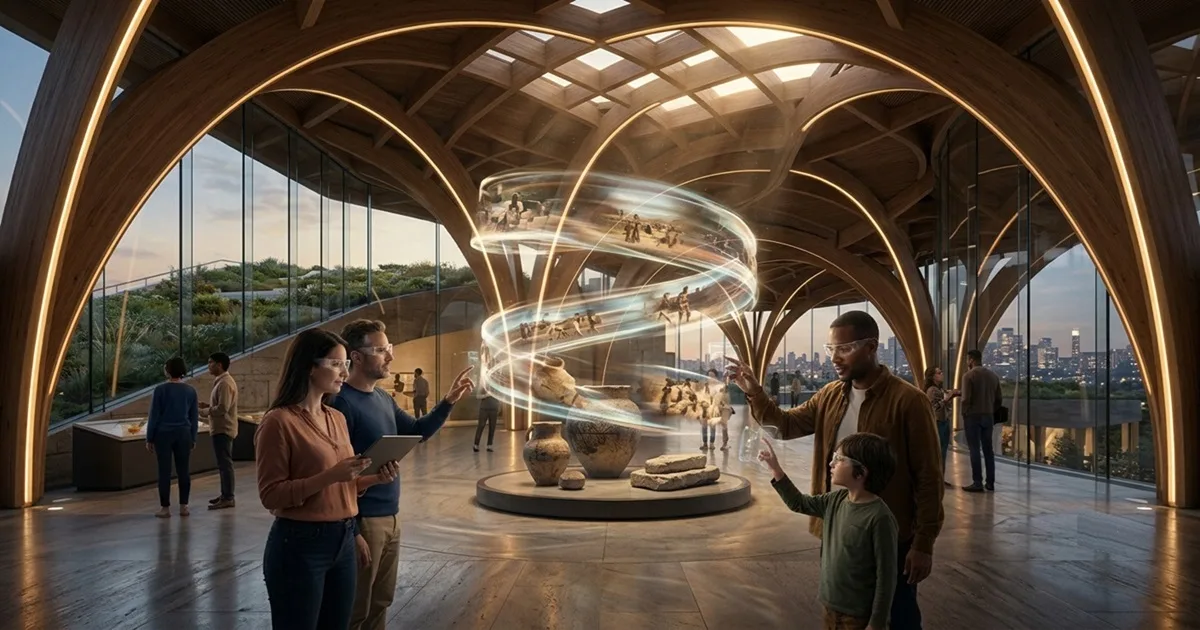
A global tour of museums where architecture, storytelling, and technology turn every visit into an experience.
A Feeling That Begins at the Front Door
Walk toward a great museum and something shifts before you ever see a single artifact. The roofline, the fall of light, the hush of a courtyard set the mood and hint at the journey ahead. The best buildings treat that first impression as part of the exhibition itself.
This is why museum design has become one of architecture's most ambitious fields. A well-planned museum guides emotion and attention long before any label is read. The museum design examples below show how architecture, spatial storytelling, and technology combine to create places people remember.
What Makes a Museum Design Truly Exceptional?
Exceptional museum design balances beauty with purpose. A striking facade earns attention, but the experience inside keeps it.
Strong museum architecture usually shares a few priorities:
Clarity of journey: Visitors move naturally from one idea to the next through good interpretive planning.
- Emotional pacing: Spaces brighten, darken, expand, and contract to match the story being told.
- Accessibility: Ramps, sightlines, seating, and multilingual content welcome every age and ability.
- Restraint: The architecture supports the collection rather than competing with it.
10 Breathtaking Museum Design Examples
1. Guggenheim Museum Bilbao (Bilbao, Spain)
Frank Gehry's titanium-clad landmark opened in 1997 and changed how cities view culture. Its curving, sculptural forms catch the light. The building revived a fading industrial city so dramatically that planners coined “the Bilbao effect” for architecture as urban renewal.
2. Louvre Abu Dhabi (Abu Dhabi, UAE)
Jean Nouvel placed this museum beneath a 180-metre dome built from nearly 7,850 overlapping stars. As the sun moves, light filters through eight layers to create a shifting “rain of light.” Nouvel designed it as a museum city beside the sea, pairing Arab heritage with passive cooling.
3. National Museum of African American History and Culture (Washington, D.C., USA)
David Adjaye and Philip Freelon wrapped this Smithsonian museum in a bronze “corona” inspired by Yoruban crowns and the ironwork of enslaved craftspeople. More than half the building sits underground, guiding visitors on an emotional climb from history toward hope. The Smithsonian calls the building a space for memory and reflection.
4. TeamLab Borderless (Tokyo, Japan)
Reopened in Tokyo's Azabudai Hills in 2024, this digital art museum has no fixed map. Projected artworks and immersive installations flow across walls and floors, drift between rooms, and react to visitors. It is one of the purest examples of immersive museum experiences built entirely from light and code.
5. Jewish Museum Berlin (Berlin, Germany)
Daniel Libeskind's zinc-clad building uses architecture as narrative. Sharp angles, slanting floors, and empty concrete “voids” express loss in ways words cannot. The Garden of Exile and the Holocaust Tower turn spatial storytelling into a physical experience.
6. National Museum of Qatar (Doha, Qatar)
Jean Nouvel again, inspired by the desert rose, a crystal that forms in the sand. Interlocking discs curve around a restored historic palace at the museum's core. A 1.5-kilometre loop of cinematic walls and oral histories immerses visitors in Qatari heritage.
7. Museum of the Future (Dubai, UAE)
Killa Design's torus-shaped building, opened in 2022, is wrapped in Arabic calligraphy that doubles as its windows. Inside, exhibitions use VR, AR, and AI to picture the year 2071. It is a model for future-ready, smart museums where technology is part of the story.
8. Te Papa Tongarewa (Wellington, New Zealand)
New Zealand's national museum, opened in 1998, rests on a bicultural foundation that gives equal weight to Māori and European perspectives. Hands-on, interactive exhibits and a welcoming layout make it a benchmark for visitor engagement and accessibility.
9. The Broad (Los Angeles, USA)
Diller Scofidio + Renfro built The Broad, opened in 2015, around a “veil-and-vault” idea. A porous honeycomb shell filters daylight into the galleries, while the collection store, the vault, stays partly visible. Free admission keeps the collection open to everyone.
10. V&A Dundee (Dundee, Scotland)
Kengo Kuma's first UK building, opened in 2018, echoes Scotland's sea cliffs and shipbuilding past. Layered concrete panels lean over the River Tay like a ship's prow, and an open atrium serves as a “living room for the city.” As Scotland's first design museum, it anchored a waterfront revival.
Why Are Modern Museums Becoming More Interactive?
Modern museums are becoming more interactive because audiences now expect to take part, not just look on. Touchscreens, projection mapping, AR and VR experiences, and responsive lighting design help people connect with difficult subjects, putting interactive museum exhibition design at the centre of planning.
Many institutions reach this balance by pairing strong curatorial research with experience design, often working with specialist studios to build interactive digital exhibits that sit beside physical collections. This kind of museum digital transformation deepens understanding without overshadowing the objects themselves, a balance rooted in human-centered design and careful museum planning.
Common Characteristics of Great Museum Design
Across different budgets and cultures, the strongest projects share recurring traits:
- A clear concept that links the building to its story or place.
- Light treated as a material, shaping mood and guiding movement.
- A considered visitor journey with room to pause and reflect.
- Inclusive, accessible spaces designed for diverse audiences.
- Technology with a purpose that supports real objects rather than replacing them.
This is why some museums feel effortless to move through while others leave visitors lost.
Final Thoughts
The best museum design examples prove a building can do far more than hold a collection. It can shape how people feel, learn, and remember. From Gehry's titanium curves to teamLab's digital worlds, each one treats architecture and storytelling as a single idea. For anyone planning a cultural space, the lesson is simple: design for the visitor first, and the experience will follow.