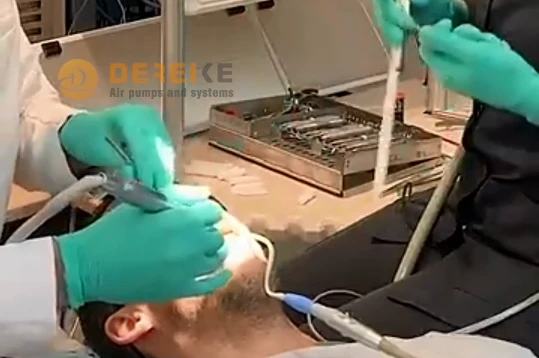
Many people fear going to the dentist. Beyond the treatment itself, they are more afraid of the "awkwardness" when opening their mouths—such as water mist splashing on the face during teeth cleaning, foreign objects getting stuck in the throat during fillings, and blood and debris piling up after extractions. Behind these embarrassments lies the "power source" of the dental suction system, and the core supporting this system is precisely the side channel blower. Today, let’s take a closer look at how high-pressure air blowers make dental procedures more comfortable, dentists more efficient, and serve as an "invisible helper" in dental clinics.
Why Dental Suction Cannot Do Without High-Pressure Air Blowers? It’s a Dual Guarantee of "Cleanliness and Visibility"
Dental procedures have three clear core requirements: a clean surgical area, unobstructed visibility, and patient comfort. Whether it’s teeth cleaning, fillings, or extractions, water mist, saliva, tartar debris, and even blood are generated. If these substances cannot be suctioned away promptly, they will not only interfere with the dentist's work (e.g., water mist from the drill blocking the view) but also cause patient discomfort like nausea and coughing, and even increase the risk of cross-infection.In the dental suction system, the high-pressure air blower acts as a "precision power source," solving these problems through three key functions:
- Instantly suck away foreign objects to keep the surgical area dry: The high-pressure air blower quickly generates stable negative pressure, and through saliva suction tubes or built-in tubes in teeth cleaners, it suctions away saliva, water mist, and debris from the surgical area in real time. For example, during fillings, resin materials can only adhere firmly if the tooth cavity remains dry, and the continuous suction of the high-pressure air blower ensures the surgical area meets the required dryness standard.
- Control suction intensity to balance comfort and efficiency: Different procedures require different suction strengths—stronger suction is needed to remove large amounts of water mist during teeth cleaning, while overly strong suction can discomfort children during their dental visits and thus needs to be gently adjusted. High-pressure air blowers support precision frequency conversion, allowing dentists to adjust suction in real time via a foot pedal, avoiding "insufficient suction for thorough cleaning" or "excessive suction causing discomfort."
- Aid in cross-infection prevention and reduce cleaning burdens: High-quality high-pressure air blowers, when paired with filtration systems, filter bacteria and droplets from the air after suction, then discharge clean air—reducing air pollutants in the clinic. Meanwhile, the blower’s sealed design prevents sewage backflow, lowering the difficulty of pipeline cleaning.
Three Core Advantages Meeting the "Special Requirements" of Dental Scenarios
Dental scenarios are completely different from industrial ones: small spaces, sensitive patients, and extremely high requirements for hygiene and low noise. High-pressure air blowers have become the preferred choice for dental suction precisely because they accurately meet these "special needs":
- Ultra-quiet operation to alleviate patients’ "dental anxiety": Many patients fear dental visits, as well as the noise of clinic equipment. High-pressure air blowers adopt quiet motors and sound-absorbing cotton designs, keeping operating noise below 55 decibels. Combined with the clinic’s soundproofing, patients can barely hear the blower, greatly relieving their tension.
- Compact and easy to install, adapting to "limited space" in clinics: Dental clinic operation rooms are usually small, with compactly arranged equipment. Specialized dental high-pressure air blowers are small in size—they can be mounted on walls or placed under operation tables, without occupying key space around the treatment chair. Additionally, they are easy to install: simply connect the suction tubes and power supply, and commissioning can be completed within 1 hour, without disrupting the clinic’s normal operations.
- Easy to clean and corrosion-resistant, meeting medical "sterility standards": The fluids suctioned during dental procedures (including saliva and blood) may corrode the internal parts of the equipment. The dental-specific high-pressure air blowers (e.g., those from Derako) use corrosion-resistant materials and a 100% oil-free design. This not only resists fluid corrosion but also allows easy disassembly for cleaning—such as regularly rinsing the suction tube interfaces and replacing filter cotton. Nurses can perform these tasks without the need for professionals, reducing the clinic’s maintenance costs.
Good Dental Suction Starts with Choosing the Right side channel Blower
For dental clinics, "patient experience" and "operational efficiency" are core competitiveness—and both rely on an efficient suction system. With advantages like quiet operation, precise suction control, and easy cleaning, high-pressure air blowers not only solve operational pain points such as water mist and foreign objects but also help clinics improve patient satisfaction. After all, no one would refuse a "splash-free and quiet" dental visit experience.