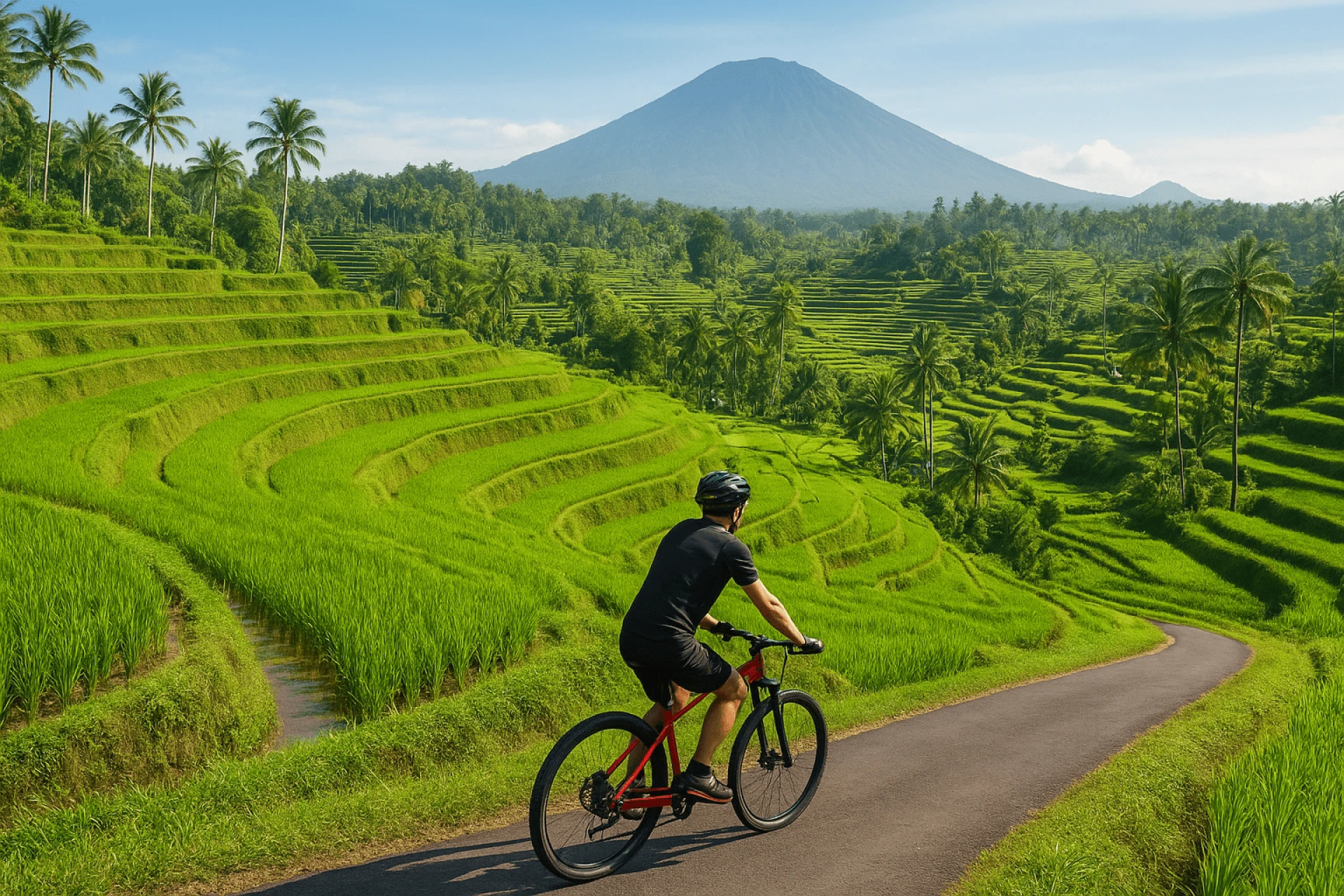
If you’re a cyclist who loves mixing nature, culture, and adventure, then exploring the best cycling routes through rice terraces Bali has to be on your bucket list. Bali’s rice fields aren’t just postcard-perfect—they’re alive with daily rituals, water flowing through ancient irrigation channels, farmers waving as you ride past, and that earthy smell of fresh mud after rain. Riding through them feels less like a workout and more like slipping into the rhythm of rural Balinese life.
I’ve been lucky enough to cycle these routes multiple times, and every single ride gave me something new—a sunrise view over emerald paddies, a steep hill that nearly broke my legs, or a roadside warung where the owner insisted I try her homemade pisang goreng before I could continue. Bali just has a way of turning a regular ride into a story you’ll retell for years.
Let’s dig into the routes, the practicalities, and the little details that will help you get the most out of your cycling journey.
The Charm of Bali’s Rice Terraces
Before we jump into actual cycling routes, it helps to understand why rice terraces are such a big deal here. The terraced fields you’ll see in Bali are part of something called Subak, a traditional water management system that dates back over a thousand years. UNESCO even listed it as a World Heritage cultural landscape because it blends farming, spirituality, and community into one. According to UNESCO, the Subak system is not just about irrigation—it’s a social and religious structure where water temples manage distribution fairly among farmers.
When you cycle through these fields, you’re not just passing pretty scenery; you’re riding through a living heritage that shapes Balinese daily life. Farmers still plant by hand, families still gather by the fields, and ceremonies still happen to bless the water before it’s used. This is why cycling here feels so different compared to riding past vineyards in France or wheat fields in Australia. It’s not just agriculture—it’s culture in motion.
Ubud: The Classic Cycling Hub
If we’re talking cycling in Bali island, we’ve got to start with Ubud. It’s the cultural heart of the island, surrounded by rice fields that go on forever, dotted with temples and small villages. Most cycling tours actually begin here because it’s easy to access, the scenery is varied, and the terrain suits both casual riders and those who like a tougher challenge.
Tegallalang Rice Terraces
You’ve probably seen photos of Tegallalang—steep, dramatic terraces carved into the hillsides just north of Ubud. Cycling here is both breathtaking and, I’ll be honest, a bit intense. The climbs are no joke, especially if the sun’s out in full force. But the payoff is huge. You’re riding with layers of rice terraces on one side and jungle valleys on the other. There are plenty of stops too, where you can grab a fresh coconut from a roadside stall.
Campuhan Ridge
For something gentler, the Campuhan Ridge walk (which doubles as a bike-friendly path early in the morning) is perfect. Smooth trails, golden grass swaying on either side, and sunrise views over Mount Agung if you start early enough. It’s short, but it links up nicely with other roads that cut through smaller rice paddies and villages.
What I love about Ubud cycling is that you can do a two-hour casual loop or a full-day push all the way into Kintamani’s highlands. And after? There’s no shortage of warungs, smoothie bowls, or strong Balinese coffee waiting for you back in town.
Sidemen: The Quiet East
Now, if Ubud feels a bit too busy for your liking, head east to Sidemen. This area is still relatively untouched by mass tourism, and cycling here feels like stepping back in time. The roads wind through terraced rice fields, bamboo forests, and tiny hamlets where kids will run alongside your bike yelling “Hello!”
The highlight here is riding with Mount Agung looming in the background. On clear mornings, the volcano looks impossibly huge, and when the light hits the rice terraces just right, it’s the kind of scene you’ll never forget. The climbs here are longer compared to Ubud, but the roads are quieter and the views more open.
One of my favorite memories was stopping mid-ride at a small warung overlooking the fields, sipping kopi Bali while an old man told me about the last big eruption of Mount Agung. It’s moments like this that make Sidemen special—you’re not just cycling; you’re connecting with stories that go beyond the ride.
Jatiluwih: The UNESCO Darling
If you want to tick off the most iconic rice terrace ride in Bali, Jatiluwih is the place. The name literally means “real beauty,” and once you see it, you’ll get why. We’re talking massive terraces stretching across the entire slope of a mountain, neatly layered and shimmering in different shades of green depending on the season.
Cycling here isn’t just scenic—it’s structured. The Jatiluwih area has mapped cycling trails ranging from easy 5 km loops to challenging 20 km circuits. The trails cut right through the terraces, meaning you’re pedaling alongside farmers, ducks waddling in the mud, and streams of water flowing into bamboo pipes.
The longer routes will push you uphill, but there’s usually a cool breeze thanks to the altitude. The area sits about 700 meters above sea level, so it’s much fresher compared to Ubud. And unlike Tegallalang, which can get crowded, Jatiluwih has this wide-open, peaceful vibe.
Plus, there are cafes perched on ridges where you can stop for a cold Bintang or fresh juice while looking over the fields. To me, that combo—sweat, scenery, and a cold drink—is cycling happiness in a nutshell.
Kintamani: For the Hardcore Riders
If you’re up for serious climbs and jaw-dropping panoramas, make your way to Kintamani. This highland area circles around Mount Batur and its crater lake, but the roads leading up to it pass through some of the most dramatic rice terraces in northern Bali.
The ride from Ubud to Kintamani is about 35 km uphill, and while that doesn’t sound too crazy, the elevation gain will test your legs and lungs. But along the way, you’ll get glimpses of tiered rice fields, small temples, and eventually the black lava fields near Batur.
Once you’re up there, the reward is insane. You can cycle around the caldera rim with views of the lake on one side and volcanic terraces on the other. It’s less about casual sightseeing and more about pushing yourself while still soaking in the rural beauty.
For those who like downhills more than uphills (I feel you), there are tours that drive you up and let you ride down, passing through villages, terraces, and coffee plantations all the way back to Ubud.
Tabanan: Off the Beaten Track
Not many travelers make it to Tabanan for cycling, but honestly, it’s one of the best-kept secrets. The terrain here is rolling rather than mountainous, so it suits riders who don’t want extreme climbs but still love variety. The rice terraces in Tabanan aren’t as famous as Jatiluwih, but they’re just as beautiful and way less crowded.
The roads are quiet, and you can link rice field rides with detours to hidden waterfalls or black sand beaches on the southwest coast. It’s the kind of area where you can ride for hours and barely see another tourist.
What’s cool too is that many homestays in Tabanan offer rental bikes and maps, so you don’t even need a full-on cycling tour to explore. It’s flexible, and the locals are super welcoming if you stop to ask directions or grab a snack.
When’s the Best Time to Cycle Bali’s Rice Terraces?
Timing matters big time here. The rice terraces change with the growing cycle, and each stage has its own charm. When the fields are freshly planted, you’ll see mirror-like water reflecting the sky. A month later, the paddies are lush green carpets. By harvest time, they turn golden, and farmers are busy cutting stalks by hand.
Generally, April to October (dry season) is the best window for cycling. The roads are drier, the air clearer, and the risk of heavy rain lower. If you’re into cooler rides, early mornings are perfect—less traffic, softer light, and you’ll often get mist hanging over the terraces.
Rainy season (November to March) isn’t off-limits, though. I’ve cycled during drizzle, and while it was muddy, the rice terraces looked more vibrant than ever. Just be ready with a poncho and a sense of humor when the skies open up suddenly.
Gear, Bikes, and Practical Tips
One of the mistakes I made on my first ride was underestimating how hot and humid Bali gets. Even on short routes, you’ll sweat buckets. Hydration is key—carry water, but also stop at roadside warungs. They’re lifesavers when you’re overheating.
Most routes are doable on a mountain bike or a hybrid. Road bikes are fine for some stretches, but keep in mind that many paths cut through dirt trails, and not all surfaces are smooth. If you’re renting, check the gears and brakes carefully. A wobbly bike can turn a dream ride into a nightmare when you’re bombing down a hill.
Cycling jerseys are nice, but honestly, you’ll see plenty of people just riding in T-shirts and shorts. Do bring sunscreen, though—the tropical sun doesn’t mess around. Gloves are also handy for grip because sweaty palms and brake levers aren’t a good mix.
Meeting Locals Along the Way
One of the best parts of cycling Bali’s rice terraces isn’t just the scenery—it’s the people. Balinese villagers are warm and curious, and they’ll often wave, shout greetings, or even offer fruit if you stop near their homes. Kids in particular love high-fives as you pass.
I once paused to catch my breath in Sidemen, and a farmer came over, pointed at my bike, and started laughing, then motioned as if to say, “Why not just walk?” We both cracked up, and he handed me a piece of sugarcane to chew on before I continued. Those small exchanges make the rides feel less like tourism and more like genuine connection.