
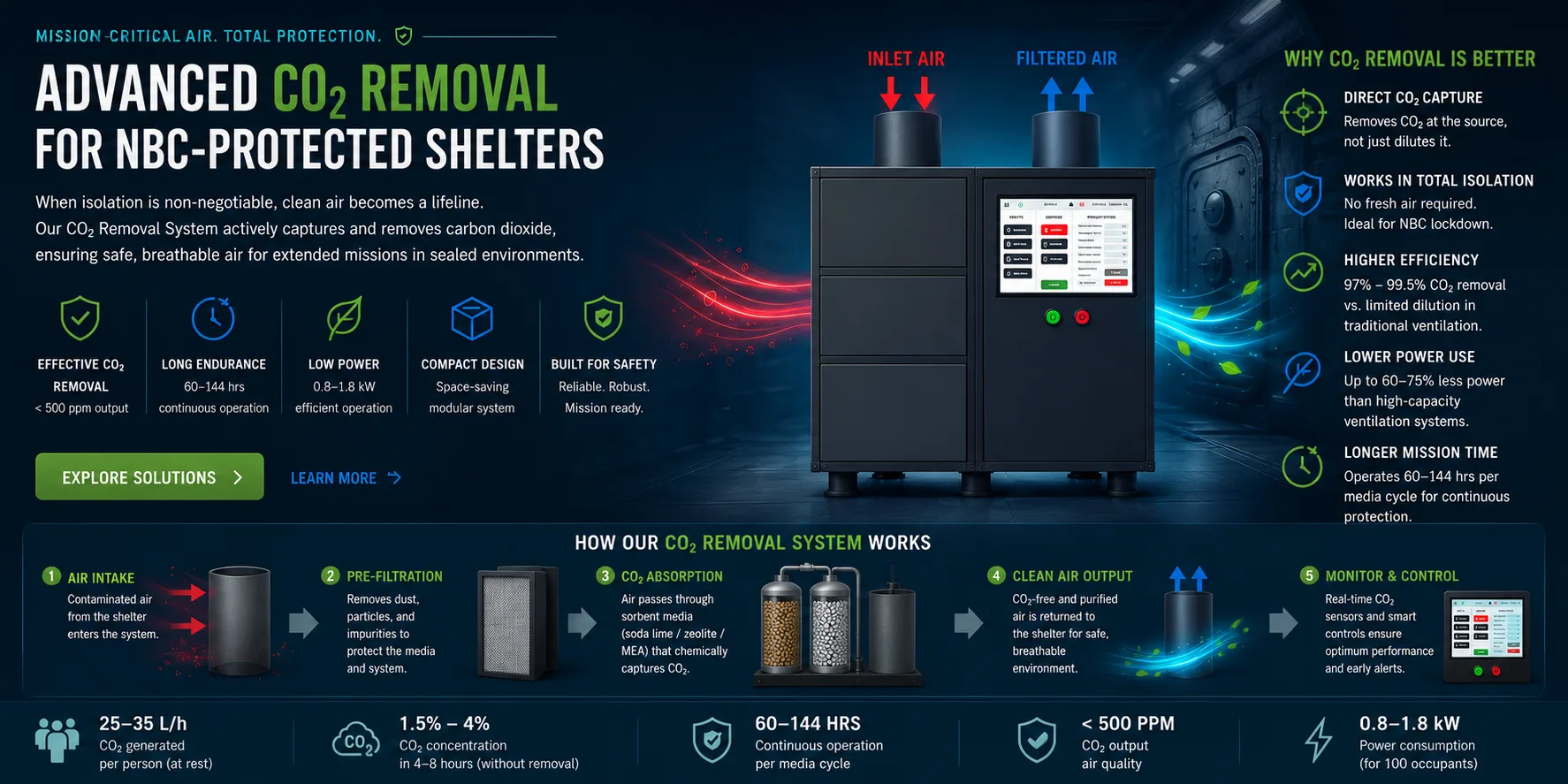
Within NBC-protected shelters, implementing a CO2 removal system becomes indispensable for regulating atmospheric composition amid total air isolation. Traditional ventilation mechanisms falter under seal conditions, unable to counteract steady CO2 influx from respiration effectively. This detailed comparison dissects operational principles, empirical performance data, inherent risks, and synergistic integration strategies tailored for bunkers and fortified enclosures. Technical decision-makers, including defense contractors and safety engineers, rely on such analyses to optimize system architectures for mission-critical reliability and regulatory adherence. Informed choices mitigate air quality vulnerabilities inherent to prolonged confinement protocols.
Context and Relevance of Air Management in Sealed Shelters
Sealed NBC shelters enforce stringent containment, curtailing external air ingress and thereby concentrating exhaled CO2 at rates of 25-35 liters per hour per individual during sedentary states. Absent targeted mitigation, concentrations climb to 1.5-4% within 4-8 hours in enclosures of 500-1500 cubic meters, precipitating symptoms from drowsiness to hypercapnic acidosis. Ventilation offers dilution through internal looping, yet NBC lockdown renders fresh air supplementation untenable.
Applicable contexts span military bunkers, subterranean industrial refuges, and civil defense vaults, where overpressure differentials of 75-350 Pascals sustain barrier integrity via collective protection filters. Alignment with international benchmarks, including NATO AEP-87 and ISO 11933, underscores scrubber primacy for durations beyond 48 hours. Escalating infrastructure imperatives driven by regional security postures amplify this necessity, positioning air systems as linchpins against physiological compromise in resource-constrained settings.
Comparative Analysis of CO2 Removal Systems and Traditional Ventilation
Fundamental Operating Principles and Mechanisms
Conventional ventilation recirculates 75-95% of cabin air across multilayered HEPA, charcoal, and catalytic filters, effecting CO2 abatement principally via volumetric dilution with constrained ingress volumes. In contrast, CO2 removal systems deploy sorptive media—soda lime formulations (calcium and sodium hydroxides) engender exothermic carbonation (CO2 + 2NaOH → Na2CO3 + H2O + heat), whereas regenerable alternatives like 4A zeolites or aqueous MEA solutions facilitate cyclic desorption through Joule-Thomson cooling or steam stripping. Scrubber throughput spans 150-1200 cubic meters per hour, consistently delivering effluent CO2 below 500 ppm against ventilation's fluctuating 1000-2500 ppm residuals.
Quantitative Performance Metrics Under Load
- Processing Capacity and Power Profile: Ventilation mandates 4-7 air changes hourly at 2.5-6.5 kilowatts for 100 occupants; CO2 scrubber for bunker configurations match this at 0.8-1.8 kilowatts with 97-99.5% sequestration efficacy.
- Endurance Intervals: Ventilation persists mere hours under full NBC closure; scrubbers proffer 60-144 hours autonomy per media replenishment cycle.
- Volumetric Footprint Optimization: Modular scrubber assemblies claim 0.4-1.0 cubic meters, substantially undercutting ventilation infrastructure's 4-8 cubic meter expanse inclusive of plenums and manifolds.
Risk Profiles and Contingency Mitigation Strategies
Ventilation susceptibilities manifest as progressive NBC filter impedance, occasioning airflow deficits and secondary CO2 escalation (1.2-2%/hour increments). CO2 scrubber industrial deployments contend with axial dispersion and premature exhaustion from media attrition, vigilantly tracked through differential infrared spectrometry (alarm at 0.7% breakthrough). Empirical failure incidences register ventilation 18-22% above scrubbers in ambient humidities exceeding 68%, per longitudinal trials. NBC confluence necessitates hermetic interfacing, wherein scrubbers exhibit 35% reduced breach probability owing to minimized conduit complexity.
Key Engineering and Synergistic Integration Considerations
Mass transfer modeling governs sizing: scrubber quantum = (headcount × 0.0115 cubic meters/hour CO2 yield) ÷ sorbent uptake factor. Ventilation imposes augmented static pressures (450-900 Pa post-filtration cascade); hybrid architectures alleviate by 28-35%. Economic modeling incorporates CO2 scrubber price benchmarks (₹7-16 lakhs upfront) juxtaposed with ventilation's amplified lifecycle energetics (25% escalation over five years).
Practical and Technical Insights for Shelter Deployment
Deployment paradigms dictate CO2 scrubber for bunker precedence in fixed emplacements; ambulatory platforms elect silica-aluminates for deployment alacrity. CO2 scrubber for air constraints emerge amid particulate burdens, curtailing service intervals 18-25%; upstream inertial impingers counteract effectively. Industrial CO2 scrubber architectures accommodate 400-800 personnel scales yet necessitate seismic dampening mounts.
Regimen maintenance encompasses ventilation's monthly filter gravimetrics and scrubbers' trimestral sorbent porosity assays via nitrogen porosimetry. Intrinsic bounds encompass amine volatilization losses (2-5% cycle-over-cycle), countervailed by staggered canister orchestration. CO2 scrubber for home derivations furnish foundational metrics, fortified for shelter overpressures (3-6 bar equivalents).
CO2 Removal Systems in the Indian Context
India's strategic self-reliance thrust catalyzes proliferation, manifest in HAL/DRDO consortia yielding NBC-optimized hybrids for frontier installations. The best CO2 removal system in India fuses vernacular caustic media with Germanic desorption tech, acclimated to equatorial vapor loads. Surging requisites from subterranean metros and petrochem enclaves propel GeM-sourced procurements, with CO2 scrubber industrial pricing spanning ₹4.5-14 lakhs, underscoring BIS 16365 conformance imperatives.
Conclusion
CO2 removal systems demonstrably eclipse traditional ventilation within NBC-protected shelters via augmented endurance, compactness, and sequestration fidelity, with hybrid modalities bridging transitional exigencies. Decision frameworks fortified by these comparatives assure atmospheric homeostasis, foundational to enclosure protracted viability. Rigorous application fortifies life-support paradigms against exigencies of isolation.
FAQs
Q1. Why are CO2 scrubbers better than ventilation in NBC shelters?
Ans. CO2 scrubbers remove carbon dioxide directly, while ventilation only dilutes air and fails during sealed NBC lockdowns.
Q2. How long can CO2 scrubbers operate in sealed shelters?
Ans. Most bunker scrubbers run 60–144 hours continuously before media replacement or regeneration becomes necessary.
Q3. Do CO2 scrubbers consume less power than ventilation systems?
Ans. Yes. Scrubbers typically use 60–75% less power compared to high-capacity ventilation systems in sealed shelters.
Q4. What happens if CO2 levels rise inside NBC bunkers?
Ans. Elevated CO2 causes fatigue, headaches, poor concentration, breathing stress, and dangerous health complications over time.
Q5. Can CO2 scrubbers work together with ventilation systems?
Ans. Yes. Hybrid systems improve airflow stability, reduce pressure load, and maintain safer air quality during emergencies.