
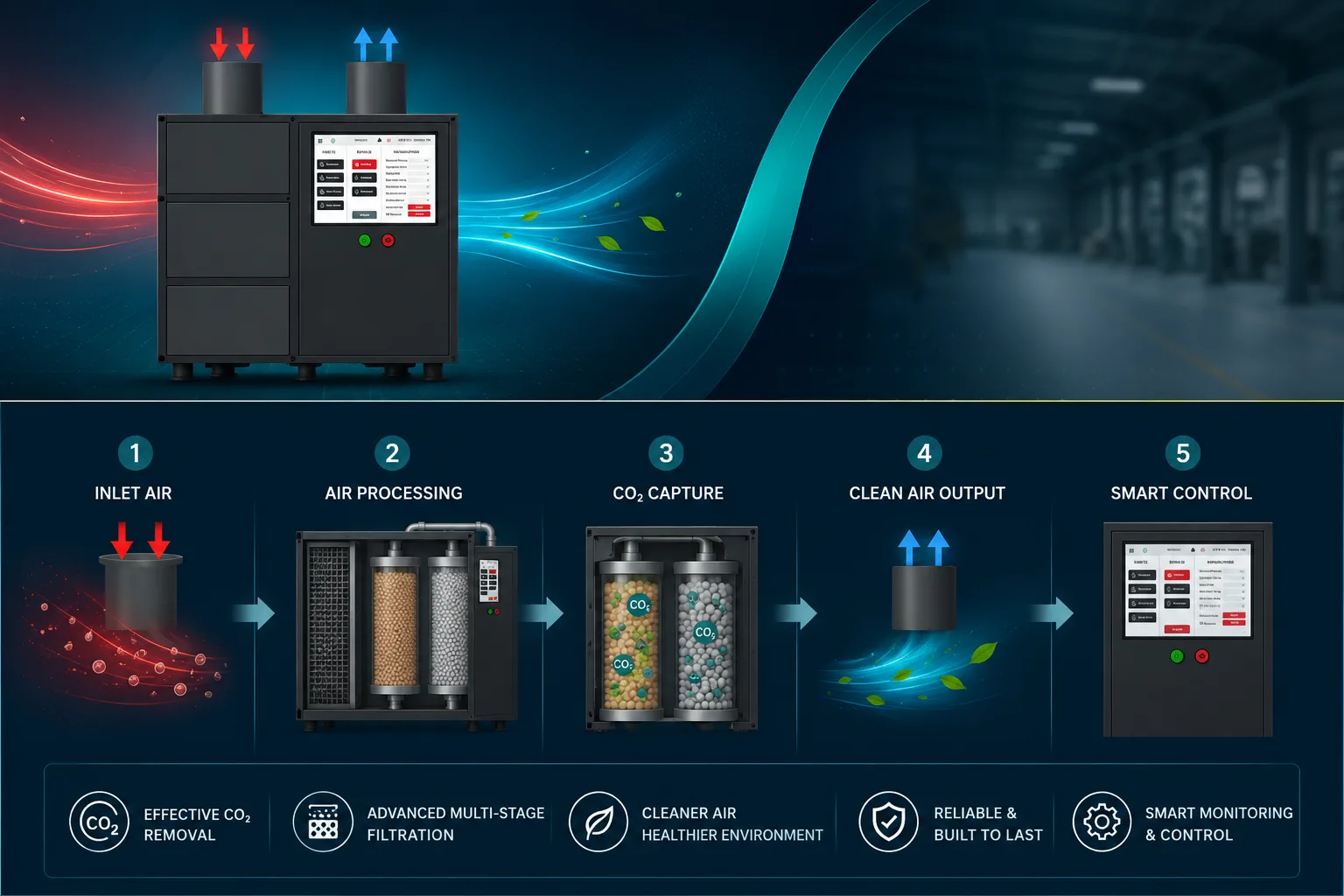
In enclosed environments such as bunkers and shelters, a reliable CO2 removal system is essential for maintaining breathable air during extended occupancy. CO2 buildup from human respiration poses a direct threat to occupant health, reducing oxygen availability and impairing cognitive function. This guide outlines the step-by-step process for sizing bunker air systems focused on CO2 control, drawing from engineering standards used in defense and industrial applications. Infrastructure planners and safety engineers must account for occupancy duration, space volume, and system efficiency to ensure operational reliability. Proper sizing prevents hypoxia risks and supports life-support integrity in high-stakes scenarios.
Context and Relevance of CO2 Control in Enclosed Spaces
CO2 levels exceeding 1% in confined areas trigger physiological effects, including headaches, fatigue, and diminished decision-making—critical concerns for bunkers designed for prolonged use. In military shelters or industrial vaults, where natural ventilation is absent, air quality hinges on mechanical systems. Bunkers, submarines, and sealed industrial facilities share similar challenges: metabolic CO2 production scales with occupant numbers and activity levels.
Global infrastructure trends, including war preparedness and disaster shelters, underscore the need for robust air management. A single adult exhales approximately 0.5 kg of CO2 daily, accumulating rapidly in volumes under 1000 cubic meters without intervention. System failures here amplify risks, as partial pressure imbalances can lead to rapid incapacitation. For defense contractors and government teams, integrating CO2 removal into overall ventilation ensures compliance with standards like ASHRAE 62.1 for enclosed habitats. This relevance extends to urban bunkers and remote industrial sites, where power reliability and redundancy define system viability.
Step-by-Step Sizing Process for Bunker Air Systems
Step 1: Calculate Occupancy and CO2 Generation Rate
Begin with occupant load and metabolic rates. Use 0.01 m³/h per person at rest for CO2 output, scaling to 0.02 m³/h for moderate activity. For a 50-person bunker, daily generation reaches 24 m³. Factor in duration: short-term (72 hours) versus long-term (30+ days) occupancy adjusts for cumulative buildup.
Step 2: Determine Bunker Volume and Air Changes
Measure total volume, including void spaces. Target CO2 threshold is 0.5% (5000 ppm). Required air changes per hour (ACH) follow: ACH = (CO2 generation rate × occupancy) / (allowable CO2 rise × volume). A 500 m³ bunker with 20 occupants needs 2-4 ACH to maintain levels below 1%.
Step 3: Select CO2 Removal Technology
Core to bunker air systems is the CO2 scrubber, typically lithium hydroxide (LiOH) beds or amine-based regenerable units. LiOH suits short missions (non-regenerable, high capacity per kg), while molecular sieves or soda lime enable reuse in extended scenarios. Efficiency metrics: scrubbing capacity in kg CO2 per liter media, regeneration energy (0.5-1 kWh/kg for amines).
Step 4: Integrate with Ventilation and Filtration
Size blowers for 10-20 CFM per person, ensuring scrubber flow matches. Couple with HEPA and NBC filters for particulate and toxin control. Redundancy: dual trains prevent single-point failures. Power draw for a 100-person system: 5-10 kW, mandating backup generators.
Step 5: Account for Environmental and Failure Factors
Incorporate temperature (optimal 20-30°C for scrubber media) and humidity (40-60% RH). Model worst-case: 110% occupancy, power loss. Validation via CFD simulations predicts hotspots. Maintenance cycles: replace media every 24-48 hours based on saturation monitors.
Step 6: Validate and Scale System Capacity
Final capacity = (total CO2 load × safety factor 1.5) / scrubber efficiency. Test under load per ISO 16890 standards. Iterative scaling ensures modularity for expandable bunkers.
These steps yield precise specifications, minimizing oversizing costs while averting underperformance.
Practical and Technical Insights for Implementation
Selection criteria prioritize scrubber type: CO2 scrubber for bunker applications favors compact, low-power units like zeolite-based systems for space constraints. Industrial CO2 scrubber variants handle higher loads but require robust framing. Limitations include media saturation (monitor via IR sensors) and byproduct disposal—LiOH yields water vapor, needing dehumidification.
Maintenance involves quarterly inspections of seals, fans, and valves, with annual media performance tests. CO2 scrubber for air integration demands compatibility with O2 generators, as removal alone depletes oxygen. Engineers should specify flow rates (50-200 CFM/module) and pressure drops (<2 in. wg) to avoid system strain.
CO2 Removal Systems in the Indian Context
India's growing focus on civil defense and industrial safety drives demand for localized CO2 removal solutions. The best CO2 removal system in India combines imported tech with domestic manufacturing, such as DRDO-inspired scrubbers for strategic bunkers. Procurement via GeM portal favors vendors offering CO2 scrubber for home-scale prototypes alongside industrial models. With urban expansion and disaster-prone regions, pricing for CO2 scrubber starts at ₹5-10 lakh per unit, balancing import duties and customization for tropical climates.
Conclusion
Sizing bunker air systems for CO2 control demands methodical engineering, from load calculations to integration testing. A well-dimensioned CO2 removal system safeguards air quality, enabling sustained operations in enclosed environments. Infrastructure professionals benefit from adhering to these steps, ensuring resilience against metabolic and environmental stressors. Prioritize validated designs to meet procurement and operational standards effectively.
FAQs
Q1. Why is CO2 control critical in bunkers?
Ans. High CO2 levels reduce oxygen quality, causing fatigue, headaches, poor focus, and dangerous health risks in sealed shelters.
Q2. Which CO2 scrubber suits long-term bunker use?
Ans. Regenerable amine or molecular sieve scrubbers work best for extended occupancy due to reusable media and lower waste.
Q3. How often should bunker scrubber media be replaced?
Ans. Disposable media typically lasts 24–72 hours, depending on occupancy load, airflow rate, and bunker operating conditions.
Q4. Can ventilation alone manage bunker CO2 levels?
Ans. No. Sealed bunkers require dedicated CO2 removal systems because limited fresh air exchange cannot control buildup effectively.
Q5. What factors determine bunker air system sizing?
Ans. Occupancy count, bunker volume, CO2 generation rate, airflow capacity, humidity, and emergency backup requirements matter most.