CRM vs Excel: Which Solution Supports Business Growth Better?
As businesses expand, managing customer information becomes increasingly challenging. What starts as a simple spreadsheet for tracking contacts and sales often grows into a complex system of multiple files, manual updates, and scattered data.
For many startups and small businesses, Excel is the first tool used to organize customer information. It's familiar, affordable, and flexible. However, as the customer base grows, businesses often begin to question whether spreadsheets are enough to support their operations.
This raises an important question: CRM vs Excel—which is the better choice for growing businesses?
Why Excel Works in the Early Stages
Excel is widely used because it's easy to set up and requires little training. Businesses can quickly create spreadsheets to store customer details, monitor sales activities, and organize contact information.
For companies with a small number of customers, this approach may work well. However, manual processes become increasingly difficult to manage as business operations expand.
Understanding the Role of CRM Software
A Customer Relationship Management (CRM) system is designed specifically to help businesses manage customer relationships throughout the sales journey.
Unlike spreadsheets, CRM software centralizes customer data, tracks interactions, automates follow-ups, and provides visibility into sales activities. Instead of simply storing information, a CRM helps businesses organize and manage customer relationships more efficiently.
CRM vs Excel: The Key Difference
The biggest difference between CRM vs Excel is functionality.
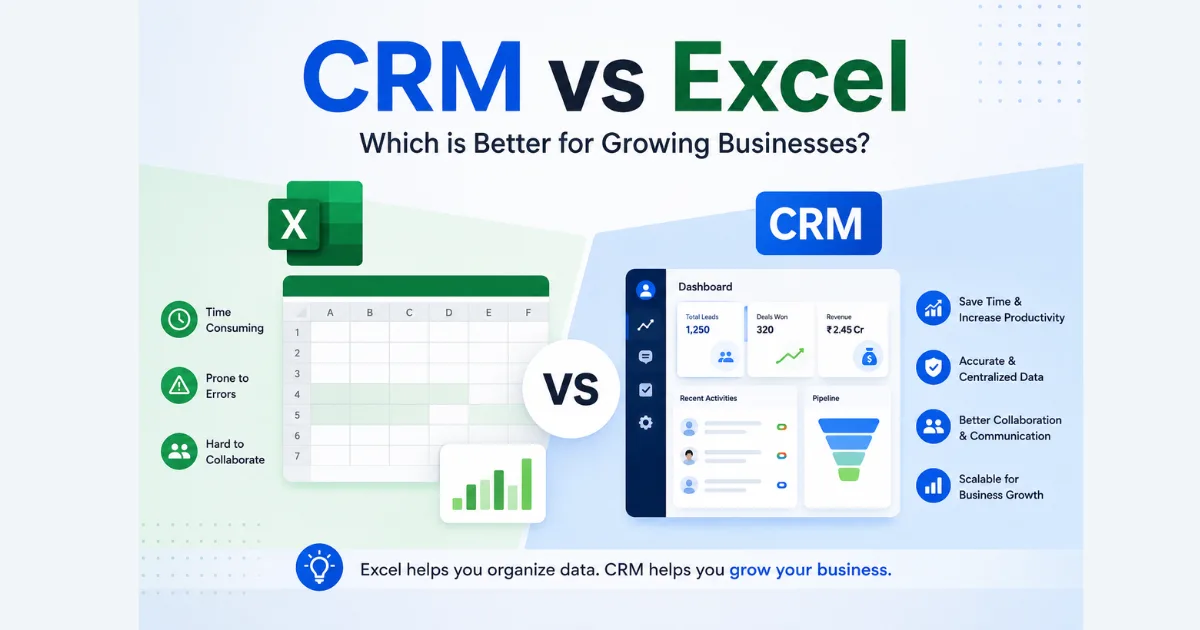
Excel is primarily a spreadsheet application used for organizing data. A CRM, on the other hand, is built to manage leads, customer communication, sales pipelines, and business workflows.
As organizations grow, this distinction becomes increasingly important because customer management requires more than just storing information.
Challenges of Managing Customers with Excel
Although spreadsheets are useful, they also have limitations.
Manual data entry increases the chances of errors, and updating multiple spreadsheets can become time-consuming. Tracking customer conversations, managing follow-ups, and collaborating across teams are also difficult when information is stored in separate files.
Businesses may also struggle with limited reporting capabilities and reduced visibility into their sales pipeline.
How CRM Software Improves Business Operations
CRM software addresses many of these challenges by bringing customer information into a single platform.
Businesses can automate follow-ups, manage leads more effectively, monitor sales progress, and generate reports that support better decision-making.
Other advantages include:
- Centralized customer information
- Automated reminders and workflows
- Better collaboration between teams
- Improved lead management
- Real-time reporting and analytics
- Greater scalability for business growth
These capabilities help organizations improve efficiency while delivering a better customer experience.
When Should a Business Move Beyond Excel?
Many businesses continue using spreadsheets longer than necessary.
However, certain signs indicate that it's time to consider a CRM solution:
- Customer information is spread across multiple files.
- Sales teams frequently miss follow-ups.
- Reporting takes too much time.
- Business growth makes spreadsheets difficult to maintain.
- Collaboration between departments becomes challenging.
Recognizing these signs early can help businesses build more efficient processes before operational issues become larger problems.
Final Thoughts
The discussion around CRM vs Excel isn't about choosing the better software—it's about selecting the right tool for the stage of your business.
Excel remains an excellent option for organizing small amounts of data, but it has limitations when customer relationships become more complex.
As businesses grow, CRM software provides automation, visibility, collaboration, and scalability that spreadsheets cannot offer. Investing in structured customer relationship management helps businesses improve efficiency, strengthen customer engagement, and prepare for long-term growth.
For organizations planning to scale in today's competitive environment, choosing the right customer management system can make a significant difference in operational success.