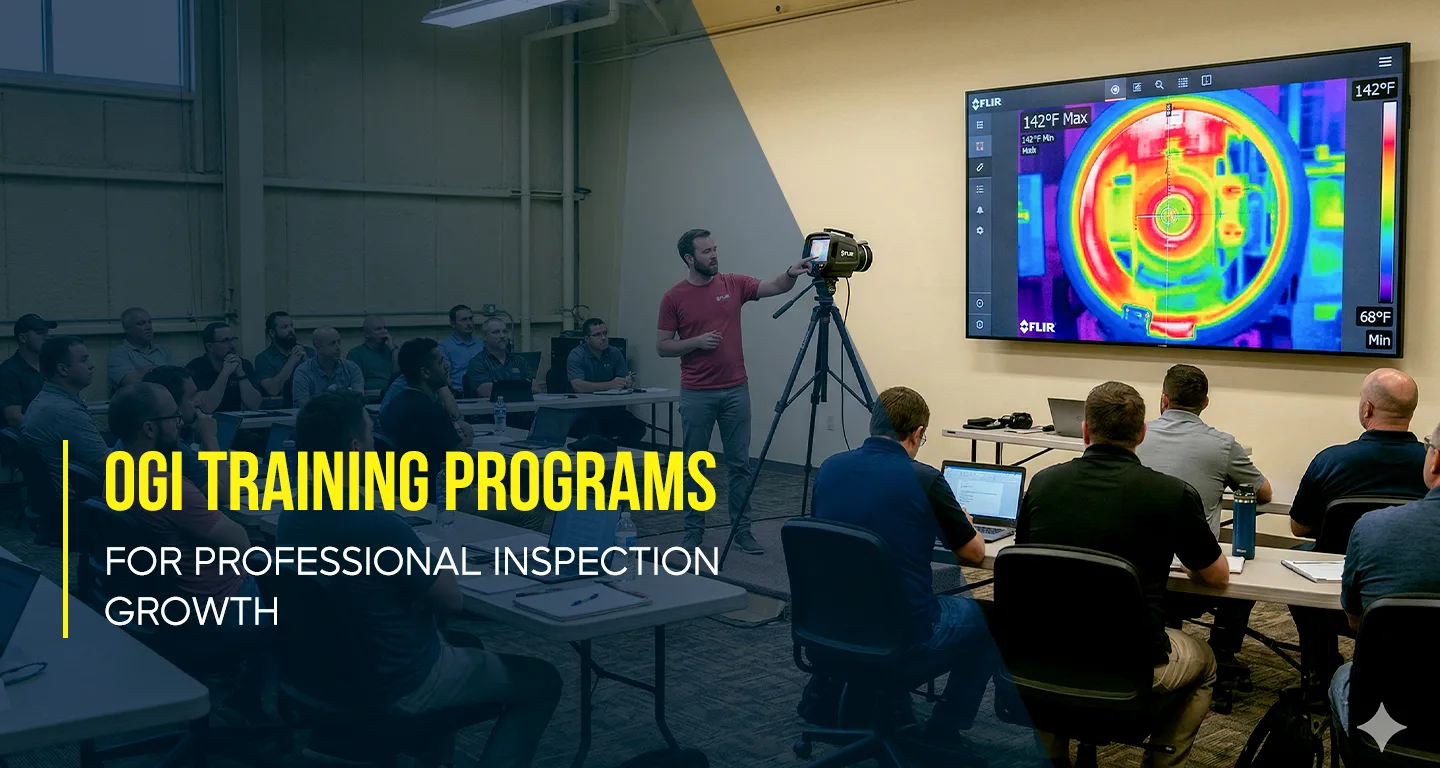
The inspection industry is evolving rapidly as safety regulations tighten and industrial assets become more complex. One of the most impactful advancements supporting this shift is Optical Gas Imaging (OGI), a technology that allows professionals to visualize gas leaks that are otherwise invisible. For inspectors, engineers and reliability professionals, specialized training in this field is no longer optional, it is a career differentiator.
What Is Optical Gas Imaging and Why Does It Matter?
Optical Gas Imaging is a non-contact inspection method that uses infrared cameras tuned to specific wavelengths to detect hydrocarbon and other industrial gas emissions in real time. Unlike traditional leak detection methods, OGI enables inspectors to scan large areas safely, without shutting down operations.
This matters because industries such as oil and gas, power generation, chemical processing and manufacturing are under continuous pressure to improve safety, environmental compliance and operational efficiency. Professionals trained in optical gas imaging (OGI) are better equipped to identify fugitive emissions early, reduce risk and support regulatory compliance while adding measurable value to inspection programs.
How OGI Training Elevates Inspection Careers
OGI training directly enhances an inspector’s technical credibility and employability. By learning how to properly operate OGI cameras, interpret thermal patterns and document findings accurately, professionals move beyond basic inspections into advanced diagnostic roles.
Employers increasingly look for inspectors who understand not just how to collect data, but how to translate it into actionable insights. OGI-trained professionals can support leak detection and repair (LDAR) programs, safety audits and environmental monitoring initiatives. This expanded skill set often leads to higher responsibility, cross-functional roles and stronger career stability.
The Role of Infrared Fundamentals in OGI Success
Optical Gas Imaging does not exist in isolation; it is built on the principles of infrared thermography. Understanding heat transfer, emissivity, reflectivity and atmospheric effects is essential for accurate gas detection and interpretation.
Professionals who pursue a recognized infrared certification gain this foundational knowledge, ensuring that OGI inspections are technically sound and defensible. Certification demonstrates that an inspector meets established competency standards, which is especially important when inspection data is used for compliance reporting or safety decision-making.
Why Structured Training Outperforms On-the-Job Learning
While hands-on experience is valuable, relying solely on informal, on-the-job learning can lead to inconsistent results and missed detections. Structured training programs provide standardized methodologies, real-world case studies and controlled practice scenarios that accelerate learning.
Formal infrared thermography training helps professionals understand not only how to use OGI equipment, but also why certain gases appear the way they do under infrared imaging. This deeper understanding reduces false positives, improves reporting accuracy and builds confidence when inspections are reviewed by regulators or management.
Online Learning: Expanding Access Without Compromising Quality
Modern inspection careers demand continuous learning, but travel and time constraints can be barriers. This is where a high-quality online thermography course becomes especially valuable. Online training allows professionals to build core knowledge at their own pace while maintaining job responsibilities.
Distance learning programs are designed to cover theory, application and interpretation in a structured format. When combined with practical field experience, online education ensures inspectors stay current with evolving standards and technologies without sacrificing accessibility or quality.
Industry Demand and Professional Credibility
The demand for skilled Optical Gas Imaging (OGI) professionals is driven by real-world needs, not trends. Regulatory bodies worldwide require improved monitoring of industrial emissions and companies are investing in advanced inspection methods to reduce environmental impact and operational risk.
Professionals who invest in OGI-focused training position themselves as specialists rather than generalists. This specialization enhances credibility with employers, clients and regulatory authorities, making trained inspectors valuable assets in safety, reliability and compliance-driven environments.
Turning Training into Long-Term Career Growth
The true value of OGI training lies in its long-term impact. It equips professionals with transferable skills that apply across industries and asset types. As inspection programs mature, trained inspectors often transition into senior technical roles, program management, or consulting positions. By combining OGI expertise with a strong foundation in infrared principles, professionals create a career path that adapts to industry change rather than being disrupted by it.
In today’s inspection landscape, investing in the right training is a strategic decision. If you are ready to strengthen your technical capabilities and advance your inspection career, explore specialized learning opportunities or reach out to us to learn how professional training programs can support your goals.