
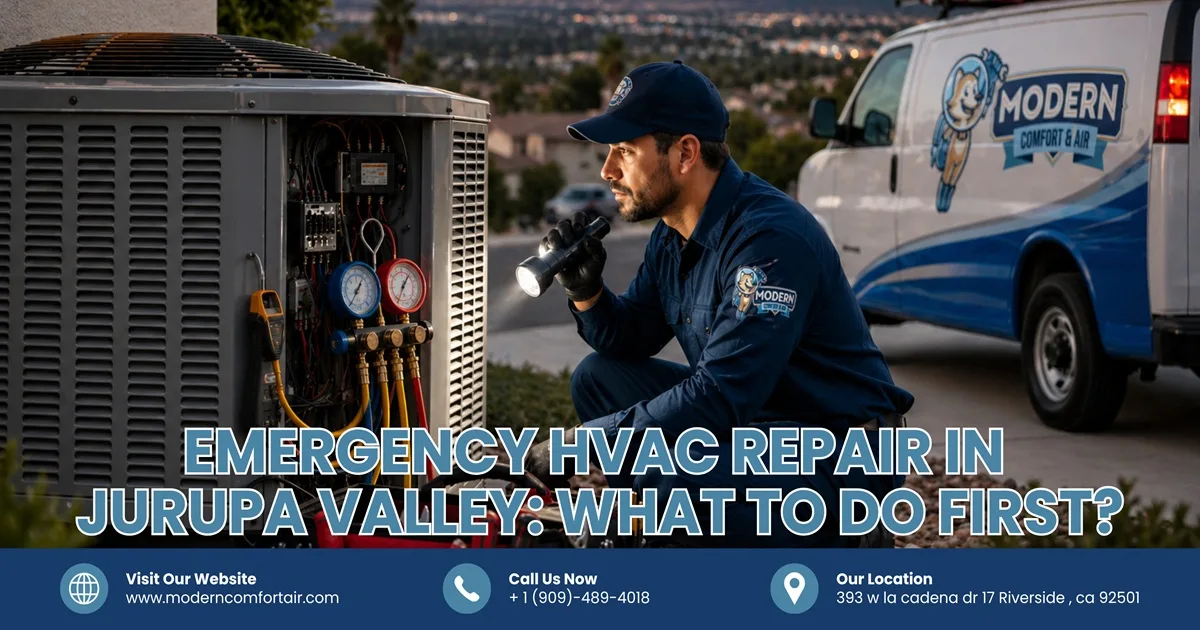
When your air conditioner suddenly stops working in the middle of a hot Jurupa Valley afternoon, panic is usually the first reaction. And honestly, that’s understandable. Inland Empire summers don’t play around. A failed HVAC system isn’t just uncomfortable. It can quickly become a health and safety issue.
The difference between a minor repair and a full system breakdown often comes down to what you do in the first 30-60 minutes after the problem starts.
This guide walks you through exactly what homeowners should do first during an HVAC emergency, how to avoid costly mistakes, and when it’s time to call for emergency HVAC repair Jurupa Valley services.
What Causes Most HVAC Emergencies in Jurupa Valley Homes?
Jurupa Valley homes rely heavily on air conditioning for most of the year. High temperatures, dust buildup, electrical strain, and aging equipment push HVAC systems to their limits.
Most emergency calls happen because:
- Systems run continuously during heatwaves
- Air filters clog faster due to dust and dry conditions
- Outdoor condenser units overheat
- Electrical components fail under heavy load
HVAC professionals consistently report that many emergency visits start with simple issues homeowners never checked first, like basic thermostat settings or power supply problems. Yes, it happens more often than people think.
9 Steps to Take Before Calling Emergency HVAC Repair in Jurupa Valley
Step 1: Stay Calm and Assess the Situation
Before assuming your system is destroyed, pause. An HVAC emergency does not always mean catastrophic failure. Many no-cooling situations are caused by small, fixable problems.
Ask yourself:
- Is the entire home without power?
- Is the thermostat on “Cool” mode?
- Is the air blowing but not cold?
- Did the issue start suddenly or gradually?
Experts recommend starting with a quick system check before calling for AC Repair in Jurupa Valley because minor issues can sometimes be resolved immediately.
Step 2: Check the Thermostat
This sounds obvious, but HVAC technicians repeatedly say thermostat errors are one of the most common emergency calls.
Check:
- Thermostat set to “Cool.”
- Temperature set lower than the room temperature
- Fan set to “Auto” instead of On. “
- Batteries working properly
Homeowners frequently mistake thermostat problems for system failure. Fixing this alone can restore cooling instantly.
Step 3: Inspect the Power Supply
Your HVAC system depends on multiple electrical components. Check these immediately:
- Circuit breaker panel
- AC disconnect switch near the outdoor unit
- Power outage in the neighborhood
A tripped breaker often shuts down the entire system. Resetting it once may solve the issue. If the breaker trips again, stop resetting it.
Step 4: Replace or Check the Air Filter
Dirty air filters are silent HVAC killers. When airflow gets blocked, the system overheats, coils freeze, and cooling stops completely. Industry guidance suggests filters should be replaced every 1-3 months, especially in dusty climates.
If your filter looks gray, clogged, or dusty, replace it immediately. This single step prevents a surprising number of emergency service calls.
Step 5: Look at the Outdoor Condenser Unit
Go outside and inspect your AC condenser. Check for:
- Leaves or debris blocking airflow
- Dirt buildup on coils
- Objects placed too close to the unit
- Ice forming on refrigerant lines
- Outdoor units need space to breathe. Restricted airflow causes overheating and shutdowns.
If you notice ice buildup, turn the system off and let it thaw. Running a frozen system can permanently damage components.
Step 6: Turn the System Off if You Notice Warning Signs
Here’s where many homeowners make expensive mistakes. If you hear loud buzzing or any burning smells. Turn the system off immediately.
Continuing to run a failing system often turns a small repair into a multi-thousand-dollar replacement. Emergency services exist for a reason; make use of them.
Step 7: Determine if It’s a True HVAC Emergency
Not every issue needs midnight service, but some absolutely do. A real emergency usually includes:
- Indoor temperature is rising rapidly during extreme heat
- Elderly residents, children, or medical conditions in the home
- Complete system shutdown
- Electrical burning smells
- Refrigerant leaks or a frozen system
- No airflow at all
When safety or health is involved, calling a 24-hour emergency AC repair in Jurupa Valley becomes essential.
Step 8: Avoid DIY Repairs Beyond Basic Checks
YouTube has convinced many homeowners that they can repair HVAC systems themselves. They shouldn’t.
Modern HVAC systems involve:
- High-voltage electricity
- Pressurized refrigerant
- Sensitive electronic boards
- Specialized diagnostic tools
Attempting DIY refrigerant or electrical repairs often causes more damage and sometimes voids warranties.
Step 9: Call Emergency HVAC Repair
When contacting a technician, provide clear information:
- System age
- Symptoms noticed
- Strange noises or smells
- When the problem started
- Thermostat readings
This helps technicians arrive prepared, speeding up repairs and reducing downtime. Professional emergency technicians often carry failed parts specifically for fast-response situations.
What Happens During a Same-Day HVAC Emergency Service Visit?
Many homeowners fear emergency visits because they don’t know what to expect. Typically, technicians will:
- Perform electrical diagnostics
- Test refrigerant pressure
- Inspect the compressor and capacitors
- Check airflow and duct performance
- Verify thermostat communication
- Run full operational testing
Most emergency repairs involve fixable issues like failed capacitors or airflow restrictions, especially when addressed quickly.
What Common Mistakes Make HVAC Emergencies Worse?

Homeowners often unintentionally worsen the problem. Avoid these costly mistakes:
- Lowering the Thermostat Repeatedly: This doesn’t cool faster. It only overworks the system.
- Ignoring Weak Cooling: Poor airflow today becomes total system failure tomorrow.
- Running the System While Frozen: Ice equals airflow restriction. Continued operation destroys compressors.
- Waiting Too Long to Call: Small repairs will turn to large breakdowns, ultimately leading to system replacement.
Emergency HVAC problems rarely appear overnight. Warning signs almost always show up first.
How to Prevent Future Emergency HVAC Repairs?
Emergency calls are stressful, but many are preventable. Smart homeowners follow these habits:
- Replace filters regularly
- Schedule annual HVAC tune-ups
- Keep outdoor units clear
- Monitor unusual noises early
- Avoid extreme thermostat changes
- Address minor cooling issues immediately
Routine maintenance dramatically lowers the chances of needing emergency HVAC repair in Jurupa Valley.
Wrapping Up
An HVAC emergency can feel overwhelming, but the right response makes all the difference. Start with basic checks like your thermostat, power supply, and air filter, and turn the system off if you notice unusual noises, smells, or overheating. Acting early helps prevent small issues from turning into expensive repairs.
When cooling fails during extreme heat, professional help becomes essential. For fast, reliable 24-hour emergency AC repair in Jurupa Valley, contact Modern Comfort and Air to restore comfort and safety to your home quickly.
FAQ
Q1. How do I know if my AC problem is an emergency or a normal repair?It becomes an emergency when your system completely stops cooling during extreme heat, produces burning smells, makes loud electrical noises, or causes indoor temperatures to rise rapidly. If comfort or safety is at risk, you should request emergency HVAC repair Jurupa Valley services immediately.
Q2. Why is my AC running but not cooling my houseThis is one of the most searched HVAC problems. Common causes include a dirty air filter, frozen evaporator coil, low refrigerant levels, thermostat issues, or compressor failure. Professional AC repair in Jurupa Valley is usually required if airflow exists, but cooling does not.
Q3. What is the most common cause of sudden HVAC failure?The most frequent causes are failed capacitors, clogged air filters, electrical issues, refrigerant leaks, and overheating due to restricted airflow, especially during peak summer demand.
Q4. How much does emergency HVAC repair usually cost?Costs vary depending on the issue, time of service, and parts required. Minor electrical repairs are typically less expensive, while compressor or refrigerant problems cost more. Early diagnosis generally keeps repairs affordable.