
Modern businesses don't struggle with a shortage of data — they struggle with data that's scattered, disconnected, and hard to use. Every application, transaction, or user action generates its own stream of information, but these streams rarely talk to each other. This fragmentation is the hidden problem ETL quietly solves.
What is ETL?
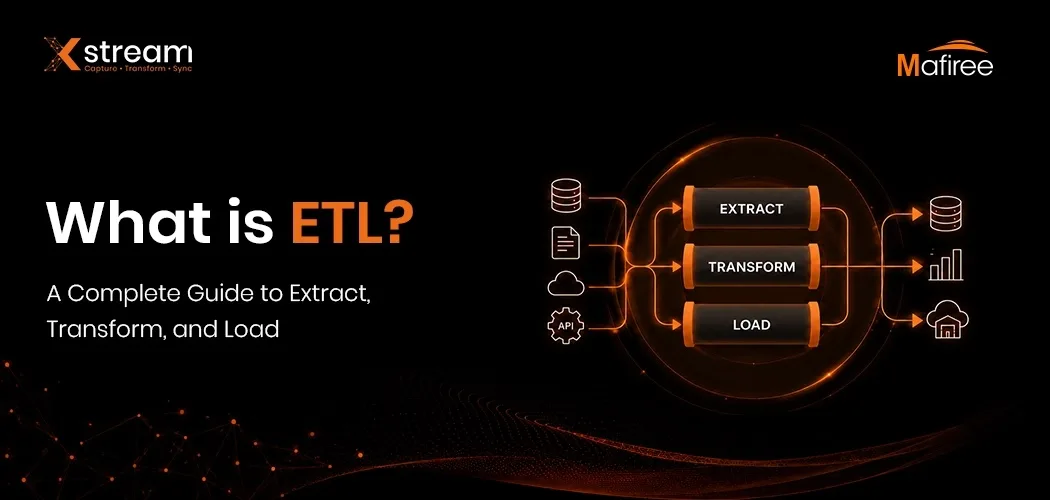
ETL stands for Extract, Transform, Load — a data integration process that collects data from multiple sources, cleans and standardizes it, and moves it into a destination system such as a data warehouse, analytics platform, or operational environment. In short, it turns disconnected raw data into trusted, usable insights. The three steps are straightforward: first, data is extracted from databases, APIs, applications, and logs; then it is cleaned, validated, and restructured; finally, it is delivered to warehouses, dashboards, or real-time systems.
Why ETL Matters: A Real-World Example
Consider a payment happening on an app. At the same moment, the transaction is stored in a database, the user's action is recorded as an event, and a fraud system logs signals in the background. All this data exists, but in different places, in different formats, and at different speeds. No single system can answer whether the transaction is safe on its own. ETL connects these pieces — collecting data from all the sources, aligning it so it makes sense together, and delivering it to a place where it can be analyzed instantly. The result is a complete picture: what happened, who did it, and whether it looks risky.
Data Ingestion: Capturing Changes Continuously
Older systems extracted data in bulk — large queries, scheduled jobs, periodic pulls. But modern systems don't wait. Data is now captured as it occurs: database updates are recorded through change logs using Change Data Capture (CDC), application events are streamed the moment they happen, and system actions are pushed into a pipeline instantly. Only what changes is captured and moved forward. This makes data ingestion continuous, lightweight, and non-disruptive to running systems.
Transformation: Making Data Trustworthy
Raw data in its natural state is unreliable. Two systems may store timestamps differently, identifiers may not align, duplicates creep in, and critical context is often missing. The transformation stage is where discipline is applied — data is cleaned to remove inconsistencies, standardized to common formats, and enriched by connecting it with other datasets. A transaction alone is just a record, but when combined with user data, location, and behavioral patterns, it becomes actionable insight. This stage defines whether data can be trusted at all.
From Batch Processing to Real-Time Loading
There was a time when pipelines processed data in batches — hourly, nightly, or even less frequently. But modern systems demand instant decisions. So instead of waiting to accumulate data, modern pipelines push data forward the moment it's ready. Dashboards update continuously, alerts trigger as events occur, and systems respond without pause. The shift is from data that informs later to data that acts immediately.
The Role of Change Data Capture (CDC)
CDC is one of the most important technologies powering real-time ETL. Rather than re-reading entire databases, CDC captures only inserts, updates, and deletes as they happen. Its benefits include lower database load, faster synchronization, real-time analytics readiness, better pipeline efficiency, and reduced infrastructure costs. CDC is especially valuable for MySQL, PostgreSQL, Oracle, and other enterprise transactional systems.
How ETL Pipelines Are Built Internally
ETL pipelines are not linear scripts — they are distributed, fault-tolerant architectures. Data enters through ingestion layers, moves through parallel processing engines that apply transformations, is managed by orchestration systems that handle retries and execution flow, and finally lands in storage systems optimized for querying and analysis. These pipelines are designed to handle scale, failure, and speed simultaneously.
Common Challenges
As systems scale, ETL pipelines must handle rapidly increasing data volumes, constant schema changes, strict performance requirements, and the need for high reliability. Without the right approach, ETL can become a bottleneck instead of a bridge.
Real-World Use Cases
The practical impact is already visible across industries: payment anomalies are detected before a transaction completes, a user's experience adapts in real time based on behavior, and operational systems trigger alerts before failures escalate. All of this depends on data that is not just available, but instantly usable.
The Future of ETL
ETL is no longer just a backend process — it is becoming the foundation of how systems operate. In the future, data pipelines will be intelligent, adaptive, and always running. Data will not need preparation; it will already be ready. The role of ETL is not shrinking — it is becoming central to everything. Continuous data flow is no longer an advantage; it is becoming the standard