
ntroduction
As digital assets become an integral part of global finance, crypto wallets are evolving far beyond simple tools for storing cryptocurrencies. In 2026, businesses, institutional investors, fintech companies, and Web3 platforms are demanding wallet solutions that prioritize security, intelligent automation, and consistent user experiences. Traditional wallet architectures, while effective in the early days of blockchain, are increasingly challenged by sophisticated cyber threats, phishing attacks, private key compromises, and growing regulatory expectations.
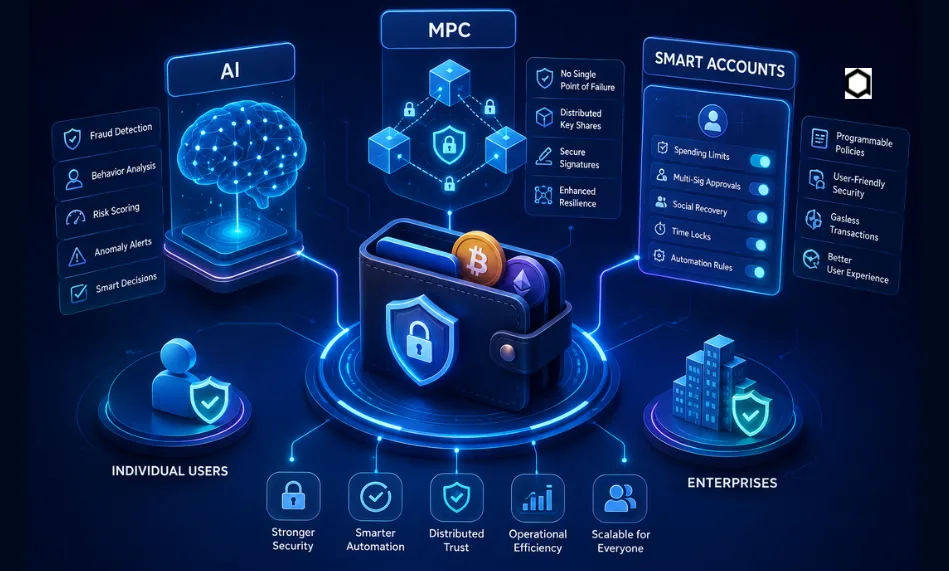
To address these challenges, the next generation of crypto wallets is being powered by three transformative technologies: Artificial Intelligence (AI), Multi-Party Computation (MPC), and Smart Accounts. Together, these innovations are redefining how digital assets are protected, managed, and accessed without compromising usability.
Rather than relying solely on a single private key, modern wallets distribute trust, automate security decisions, and enable programmable account management. This shift is creating a new standard for digital asset security that benefits both individual users and enterprises.
Why Traditional Crypto Wallets are No Longer Enough
The first generation of crypto wallets focused primarily on giving users complete control over their assets through private key ownership. While self-custody remains one of blockchain’s greatest strengths, it also places the full responsibility of security on the user.
Common challenges include:
- Private key theft
- Seed phrase loss
- Phishing attacks
- Malware targeting wallet credentials
- Human errors during transactions
- Lack of intelligent fraud detection
As blockchain adoption accelerates across decentralized finance (DeFi), tokenized assets, stablecoin payments, gaming ecosystems, and enterprise finance, wallet security must evolve beyond static authentication methods.
Modern crypto wallets are becoming intelligent security platforms rather than simple storage applications.
AI is Making Crypto Wallets Smarter Than Ever
Artificial Intelligence is transforming crypto wallet security by introducing predictive intelligence instead of reactive protection.
Conventional wallets that simply sign transactions, AI-powered wallets continuously analyze user behavior, transaction patterns, device fingerprints, and blockchain activity to detect suspicious behavior before assets are at risk.
AI-driven capabilities include:
- Real-time fraud detection
- Behavioral authentication
- Wallet risk scoring
- Smart phishing detection
- Transaction anomaly analysis
- Automated scam contract identification
- Gas fee optimization
- Personalized security recommendations
For example, if a user suddenly attempts to transfer a large amount of cryptocurrency from a new device located in another country, an AI engine can recognize the abnormal behavior and require additional verification before approving the transaction.
Instead of relying on predefined rules, machine learning models continuously improve by analyzing evolving attack patterns across blockchain networks.
Multi-Party Computation (MPC): Eliminating the Single Point of Failure
For years, private keys have represented both the greatest strength and greatest vulnerability of crypto wallets.
Traditional wallets generate a complete private key that must remain secret forever. If the key is stolen or lost, the associated digital assets may become permanently inaccessible.
Multi-Party Computation (MPC) fundamentally changes this security model.
Rather than storing one complete private key, MPC mathematically divides cryptographic control into multiple independent shares. No single share contains enough information to reconstruct the private key.
When a transaction is initiated:
- Multiple parties securely participate in cryptographic signing
- The full private key is never assembled
- Key shares remain isolated
- Attackers cannot compromise funds by stealing one device or server
This significantly reduces the attack surface while maintaining decentralization and user control.
For enterprises managing treasury assets worth millions of dollars, MPC has become a preferred security architecture because it removes dependence on one administrator, one device, or one storage location.
Smart Accounts are Revolutionizing Wallet Functionality
Smart Accounts represent one of the most important innovations in blockchain usability.
Traditional externally owned accounts (EOAs), Smart Accounts introduce programmable wallet logic that allows accounts to execute predefined rules automatically.
This creates a dramatically improved user experience.
Examples include:
- Social recovery without seed phrases
- Multi-factor authentication
- Spending limits
- Time-locked withdrawals
- Automatic recurring payments
- Multi-signature approvals
- Subscription management
- Gasless transactions
- Session keys for gaming applications
Instead of forcing users to remember a 12- or 24-word recovery phrase, Smart Accounts allow secure account recovery through trusted guardians or approved devices.
This removes one of the biggest barriers preventing mainstream adoption.
Combining AI, MPC & Smart Accounts Creates a Powerful Security Stack
Individually, each technology offers significant advantages.
Combined, they create an intelligent security ecosystem.
Imagine a business wallet handling international stablecoin payments.
Before every transaction:
- AI evaluates the transaction for fraud.
- MPC securely authorizes the transfer without exposing private keys.
- Smart Account policies verify spending limits and approval workflows.
If any abnormal activity is detected, the transaction can automatically pause until additional verification is completed.
This layered architecture dramatically improves both security and operational efficiency.
Real-World Applications Across Industries
The integration of AI, MPC, and Smart Accounts is reshaping multiple industries beyond cryptocurrency trading.
FinTech Platforms
Digital payment providers are using intelligent wallets to automate compliance, reduce fraud, and simplify global transactions.
Institutional Asset Management
Investment firms require advanced authorization workflows where multiple stakeholders approve transactions without exposing sensitive credentials.
MPC enables secure treasury management while Smart Accounts automate governance rules.
Web3 Gaming
Gaming ecosystems increasingly rely on Smart Accounts that eliminate repetitive wallet approvals, allowing players to interact consistently without sacrificing ownership of in-game assets.
NFT Marketplaces
AI helps detect suspicious collections, counterfeit NFTs, and phishing marketplaces before users authorize transactions.
Enterprise Treasury
Businesses handling digital assets can automate payroll, vendor payments, and treasury operations using programmable wallet policies while AI continuously monitors transaction risks.
Crypto Wallet Market Growth Reflects Industry Transformation
The rapid adoption of AI, MPC, and Smart Accounts aligns with the accelerating growth of the global crypto wallet market.
Several factors are driving this expansion:
- Rising institutional investment
- Increasing stablecoin adoption
- Growth of decentralized finance
- Expansion of tokenized real-world assets
- Enterprise blockchain integration
- Demand for self-custody solutions
- Cross-border crypto payments
- Improved regulatory clarity in major markets
Organizations are no longer viewing crypto wallets as standalone products. Instead, wallets have become foundational infrastructure for digital finance ecosystems.
This shift is encouraging technology providers to invest heavily in intelligent wallet architecture capable of supporting millions of users while maintaining enterprise-grade security.
The Future of Crypto Wallet Security
The next generation of crypto wallets will move beyond protecting assets, they will actively assist users in making safer decisions.
Future innovations are expected to include:
- AI-powered autonomous transaction monitoring
- Predictive fraud prevention
- Decentralized identity integration
- Biometric behavioral authentication
- Cross-chain asset management
- Quantum-resistant cryptography
- Automated compliance verification
- Intelligent financial assistants built directly into wallets
As blockchain technology matures, users will expect wallets to function like secure digital financial operating systems rather than simple storage tools.
Conclusion
The future of crypto wallet security is being shaped by intelligence, decentralization, and automation. Artificial Intelligence is enabling proactive threat detection and personalized security, Multi-Party Computation is eliminating single points of failure through distributed cryptography, and Smart Accounts are introducing programmable features that make digital asset management safer and more intuitive.
Together, these technologies are setting a new benchmark for secure Crypto Wallet Development in 2026. Whether for enterprises managing institutional funds, fintech platforms facilitating global payments, or individuals seeking greater control over their digital assets, the adoption of AI, MPC, and Smart Accounts is no longer a competitive advantage, it is becoming the foundation of modern crypto wallet security.
Organizations that embrace these innovations today will be better equipped to navigate the evolving Web3 landscape, build user trust, and deliver resilient, future-ready wallet solutions for the digital economy.