Most people don't think twice about the environmental cost of mowing the lawn. You pull the cord, do the job, and move on. But if you're in Canada and trying to reduce your household footprint, the machine sitting in your garage deserves a closer look.
Your Weekend Mow Has a Bigger Carbon Footprint Than You Think
A traditional gas-powered lawn mower runs for roughly 45 minutes to an hour per session. Across a full Canadian mowing season — typically May through October — that's 20 to 30 hours of engine time per year. It adds up fast, and not just in fuel costs.
The EPA estimates that one hour of gas mower operation produces as much pollution as driving a car for 45 miles. That's not a typo. Small engines run without the catalytic converters and emissions controls that modern vehicles require, which makes them disproportionately dirty relative to their size.
Gas Mowers by the Numbers
A typical gas mower burns about 0.5 to 1 litre of fuel per hour. Multiply that across a season, and you're looking at 10–25 litres of gasoline per year for an average suburban lot — plus the associated CO₂, nitrogen oxide, and hydrocarbon emissions.
There's also the less obvious stuff: fuel spills during refilling (estimated at 17 million gallons spilled annually in the US alone), oil changes, and the manufacturing footprint of the engine itself. In provinces like Ontario or British Columbia, where air quality advisories already affect summer outdoor activities, these emissions aren't abstract — they're local.
How Electric Mowers Compare
Corded and cordless electric mowers produce zero direct emissions at the point of use. In provinces with cleaner electricity grids — Quebec's hydro-powered grid, for instance, is among the lowest-carbon in North America — an electric lawn mower has a genuinely small operational footprint.
The catch is grid dependency. In Alberta, where natural gas still dominates electricity generation, charging an electric mower isn't as clean as it looks on paper. The environmental benefit of an electric lawn mower varies significantly depending on where in Canada you live.
Battery degradation is also worth factoring in. Lithium-ion packs on consumer cordless mowers typically last 3–5 years of regular use before capacity drops noticeably. Replacement adds both cost and material waste to the lifetime equation.
That said, for most Canadian homeowners in provinces with moderate-to-clean grids, switching from gas to electric delivers a meaningful emissions reduction.
Why Robotic Mowers Often Win on Overall Efficiency
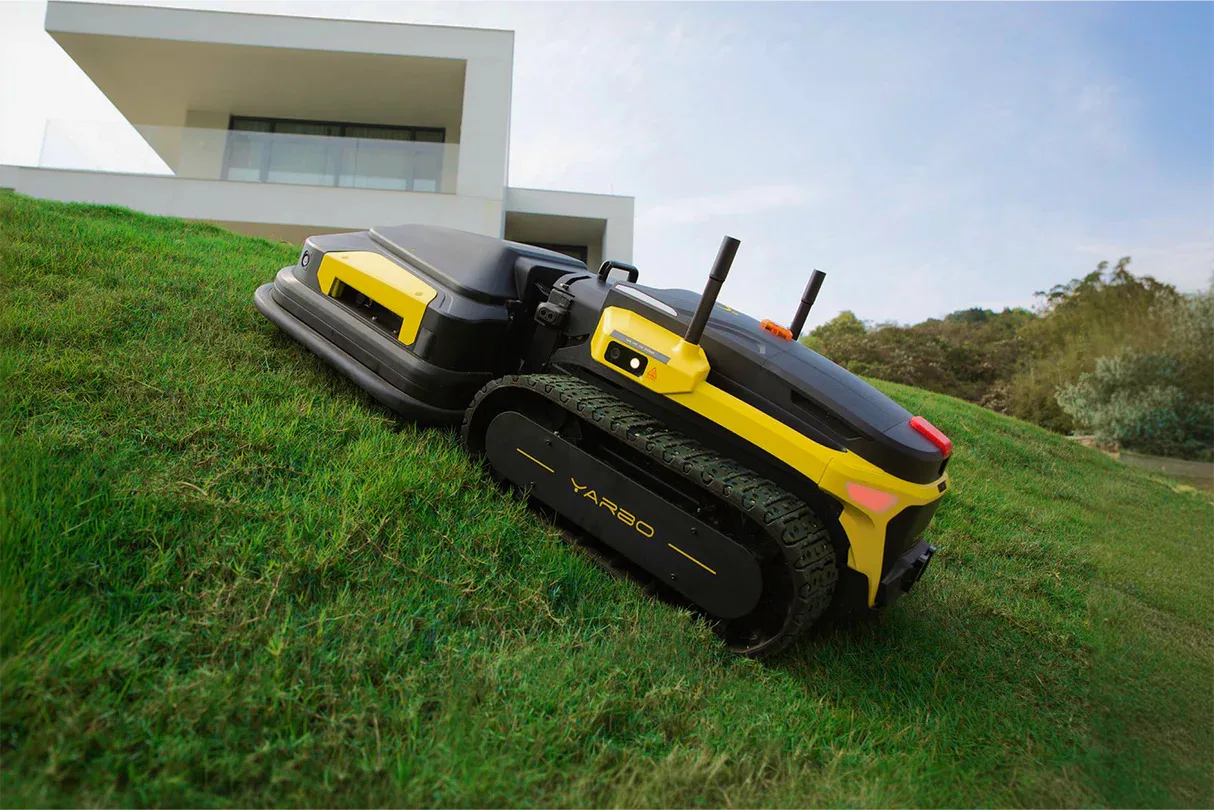
A robot lawn mower uses far less energy than either alternative — typically 5 to 25 watts during operation, compared to 1,000–1,800 watts for a corded electric mower and the equivalent of several hundred watts in gas combustion energy.
The reason is the operating strategy. Instead of mowing once a week at full cut depth, a robot mows frequently in short sessions, removing only a few millimetres at a time. This requires less motor effort per pass, and the clippings are fine enough to mulch back into the soil — reducing the need for fertilizer and improving lawn health over time.
For a season of Canadian lawn care, a robot lawn mower might consume 20–50 kWh total. A gas mower, converted to equivalent energy terms, uses several times more. The efficiency gap is significant.
Battery Production and Disposal: The Honest Tradeoff
No electric or robotic mower is impact-free. Lithium, cobalt, and other materials used in batteries carry extraction and processing costs. Manufacturing a battery pack requires energy and produces emissions before the mower ever runs.
The honest answer is that battery production does carry an upfront environmental cost — but studies on electric vehicles consistently show that this cost is offset within 1–3 years of use compared to combustion alternatives. Robotic mowers, with lower energy consumption and longer product lifespans, are likely to reach that break-even point at least as quickly.
Responsible disposal matters too. Most municipalities in Canada have e-waste collection programs that handle lithium-ion batteries. Using them is part of closing the loop.
When Switching Makes the Most Difference
The environmental case for switching away from gas is strong almost everywhere in Canada — but the degree of benefit depends on your province's electricity grid and your lawn size.
If you're in Quebec, BC, or Manitoba, electric or robotic mowing is genuinely low-carbon from day one. If you're in Alberta or Saskatchewan, you'll still reduce local air pollutants even if grid emissions blunt some of the carbon benefit.
For larger properties where a robotic mower can run autonomously and frequently, the efficiency advantage grows further. The cumulative reduction in emissions, fuel use, and maintenance waste over a 5–10 year ownership period is substantial.
The lawn isn't the first place most of us look when thinking about sustainability. But with options that are quieter, cleaner, and increasingly capable, it's worth a second look.