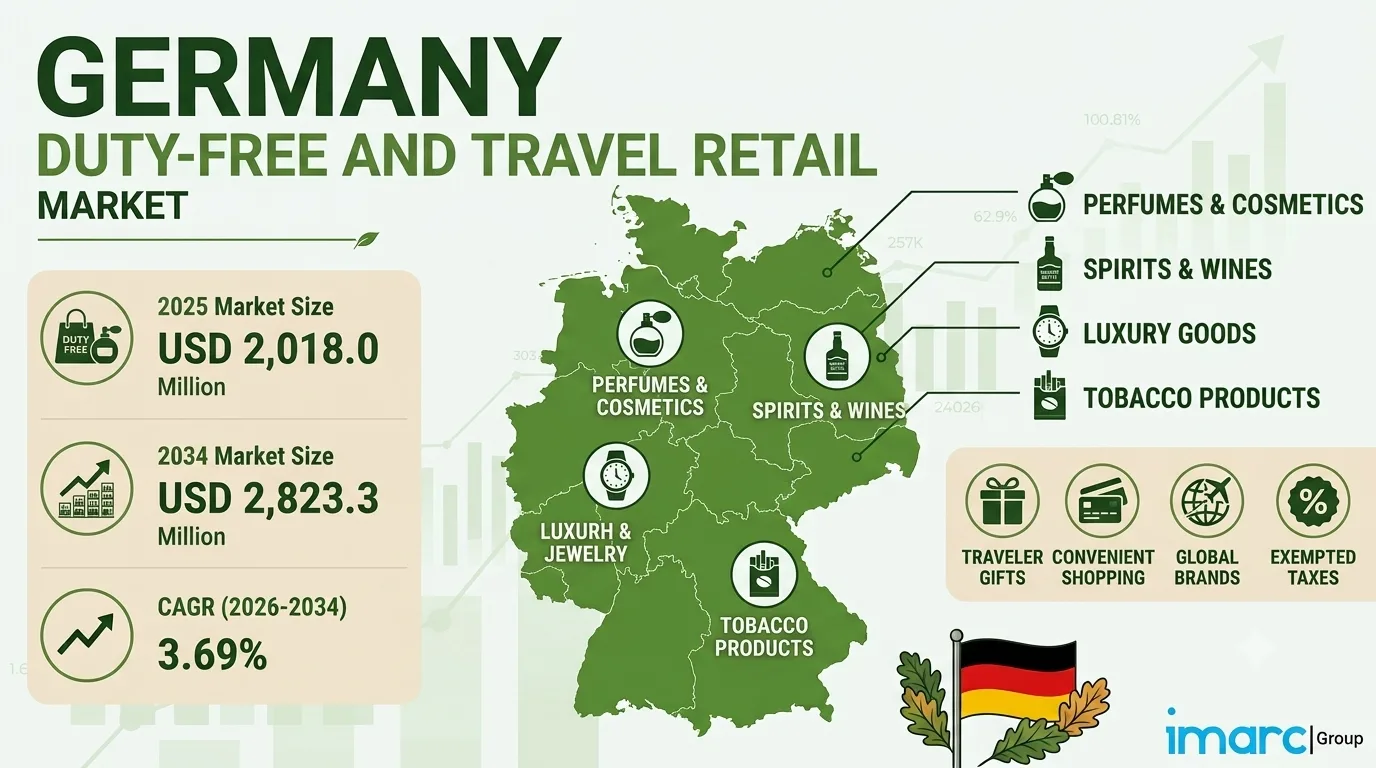
The Germany duty-free and travel retail market is experiencing robust growth, driven by strong tourism inflows, high passenger traffic at German airports, growing premiumization of alcoholic beverages, and rising demand for luxury goods. The market size reached USD 2,018.0 Million in 2025 and is projected to reach USD 2,823.3 Million by 2034, exhibiting a compound annual growth rate (CAGR) of 3.69% during 2026-2034. Airport retail expansions, improved retail design, and strategic brand collaborations further boost consumer engagement and impulse purchases in Germany. The market is strategically important to Germany's position as a major European travel hub and its well-developed transportation infrastructure, which attracts a large number of tourists and business travelers looking to shop for a wide range of products including cosmetics, fashion, electronics, and souvenirs.
The Germany duty-free and travel retail market is poised for sustained expansion, driven by increasing disposable income levels, expanding aviation industry, and the rise of duty-free shopping at airports and border crossings. With a projected CAGR of 3.69% through 2034, the market presents significant opportunities for established operators and new entrants focused on enhanced traveler experiences and premium product offerings.
GERMANY DUTY-FREE AND TRAVEL RETAIL MARKET SUMMARY
The Germany duty-free and travel retail market encompasses a wide range of products sold to international travelers, exempt from certain local taxes and duties. The ecosystem includes global brand owners, duty-free operators, airport authorities, and end-use consumers. Major segments identified in the market include product type (beauty and personal care, wines and spirits, tobacco, eatables, fashion accessories and hard luxury, and others), and distribution channel (airports, airlines, ferries, and others). Airports represent the dominant distribution channel, serving as primary touchpoints for duty-free shopping, with Frankfurt Airport being a major hub for luxury retailing and electronics. Foodservice is increasingly becoming a central part of the traveler experience, with airports evolving into lifestyle destinations offering varied, culturally rich culinary offerings that blend local identity with international appeal.
PORTER'S FIVE FORCES ANALYSIS -- GERMANY DUTY-FREE AND TRAVEL RETAIL MARKET
The competitive dynamics of the Germany duty-free and travel retail market can be analyzed using Porter's Five Forces framework.
- Competitive Rivalry: High, with intense competition between global duty-free operators such as Gebr. Heinemann, Lagardère Travel Retail, and Avolta AG. Rivalry is driven by contract renewals at major airports, brand partnerships, and the need to offer compelling shopping experiences. Business implication: Operators must differentiate through exclusive product offerings, store design, digital engagement, and service quality to win and retain concession contracts.
- Supplier Power (Brand Owners): Moderate to High. Leading global brands in beauty, wines and spirits, and luxury goods have significant negotiating power due to their brand equity and consumer demand. Business implication: Duty-free operators must cultivate strong relationships with brand owners to secure exclusive launches, product ranges, and favorable commercial terms.
- Buyer Power (Travelers): Moderate. Travelers have increasing choices and expectations, with access to online price comparisons and alternative shopping channels. However, the captive airport environment and price advantages of duty-free shopping maintain buyer appeal. Business implication: Operators must focus on enhancing the customer experience, offering competitive pricing, and creating unique retail environments to drive impulse purchases and customer loyalty.
- Threat of Substitutes: Moderate. Online duty-free pre-order services, downtown duty-free shops, and e-commerce platforms offering tax-free shopping pose substitution threats. Additionally, travelers may delay purchases to their destination. Business implication: Operators must integrate digital channels, offer seamless pre-order and collection services, and create experiential shopping environments that online alternatives cannot replicate.
- Threat of New Entrants: Low to Moderate. High barriers to entry exist due to the need for large-scale airport concession contracts, significant capital investment, and established brand relationships. However, specialist operators and joint ventures can enter niche segments. Business implication: Established players should build defensible positions through long-term airport partnerships, brand exclusivity, and operational excellence.
Competitive Rivalry -- High
- Multi-tier competition spans global leaders (Gebr. Heinemann, Lagardère Travel Retail, Avolta AG), specialized luxury retailers, and regional operators -- driving differentiation through store design, digital innovation, product exclusivity, and customer service rather than pure price competition.
- Gebr. Heinemann, founded in 1879, remains the leading travel value and duty-free operator in Germany, with 10,351 employees and turnover of EUR 4.3 billion in 2024. The company operates duty-free and travel value shops, fashion boutiques under license, and concept stores at international airports, as well as shops at border crossings and onboard cruise ships.
Request for Sample Report: https://www.imarcgroup.com/germany-duty-free-travel-retail-market/requestsample
MARKET GROWTH DRIVERS:
Several key factors are propelling the expansion of the Germany duty-free and travel retail market. The expanding culinary experiences in travel hubs serve as a powerful demand driver for food and beverage offerings, transforming airports into lifestyle destinations. For instance, in January 2025, Lagardère Travel Retail Germany won a batch of 10 foodservice outlets in the international tender for Frankfurt Airport's new Terminal 3, operating nine distinct concepts under the 'Heart of Europe' theme to offer diverse culinary traditions. Government support for tourism infrastructure is evident through ongoing airport terminal developments, including significant expansions at major hubs like Frankfurt, which create new retail and dining spaces.
MARKET GROWTH DRIVERS:
The Germany duty-free and travel retail market is also benefiting from accelerating integrated retail and hospitality concepts and evolving consumer demands. There is an accelerating shift toward mixed-use concepts where foodservice, retail, and brand storytelling coexist in shared spaces, creating more immersive environments that encourage longer dwell times and increased spending. Themed environments reflecting local culture or broader European influences are gaining traction, giving travelers a sense of place even during layovers. Infrastructure expansion, including the development of new airport terminals and expansion of transportation hubs, is driving increased passenger traffic and retail opportunities. Furthermore, the rising demand for premium and luxury goods among travelers, particularly from emerging markets, continues to be a significant driver for the market, with categories like fashion accessories, hard luxury, and electronics showing strong growth.
GERMANY DUTY-FREE AND TRAVEL RETAIL MARKET SEGMENTATION
Segmentation analysis provides a detailed view of the Germany duty-free and travel retail market by category:
- Product Type Insights: Beauty and Personal Care, Wines and Spirits, Tobacco, Eatables, Fashion Accessories and Hard Luxury, Others.
- Distribution Channel Insights: Airports, Airlines, Ferries, Others.
- Regional Insights: Western Germany, Southern Germany, Eastern Germany, Northern Germany.
COMPETITIVE LANDSCAPE
The Germany duty-free and travel retail market features a moderately consolidated competitive landscape, with multi-tier competition spanning global leaders and strong regional players. Key companies operating in the market include:
- Gebr. Heinemann SE & Co. KG
- Lagardère Travel Retail
- Avolta AG (Dufry)
- DFS Group
- Lotte Duty Free
Strategic developments are shaping the competitive arena, notably Lagardère Travel Retail's expansion in Frankfurt Airport's new Terminal 3 and Setur Duty Free's expansion with new Victoria's Secret and Sun&Shine stores at Düsseldorf Airport's Pier C in April 2025, catering to non-Schengen travelers. Gebr. Heinemann's strategic investments and joint ventures also demonstrate active repositioning in the market.
REGIONAL ANALYSIS:
Regional dynamics within the Germany duty-free and travel retail market are shaped by varying levels of airport traffic and tourism concentration. Western Germany, anchored by Frankfurt International Airport, emerges as a critical demand center due to its position as a major European aviation hub and high concentration of luxury retailing and electronics. Southern Germany benefits from strong tourism inflows and major airports in cities like Munich, while Eastern Germany shows growth from expanding infrastructure and connectivity. Northern Germany, with Hamburg as a key port and airport location, contributes to the market through both air and ferry travel retail channels.
RECENT INDUSTRY DEVELOPMENTS
April 2025: Setur Duty Free expanded in Germany with new Victoria's Secret and Sun&Shine stores at Düsseldorf Airport's Pier C, catering to non-Schengen travelers, strengthening its travel retail presence in the German market.
January 2025: Lagardère Travel Retail Germany won a batch of 10 foodservice outlets in the international tender for Frankfurt Airport's new Terminal 3, operating nine distinct concepts that reflect European and global culinary traditions.
May 2025: Gebr. Heinemann completed a USD 726 million debt refinancing transaction, demonstrating financial strength and commitment to its duty-free operations.
December 2024: Lagardère Travel Retail won the duty-free concession at Amsterdam Schiphol Airport, reinforcing its position as the leading duty-free operator across the European market.
Key Aspects Required for the Germany Duty-Free and Travel Retail Market
- Market Performance: USD 2,018.0 Million in 2025, with a projected trajectory to USD 2,823.3 Million by 2034.
- Market Outlook: A 3.69% CAGR through 2034 indicates robust growth across all product categories and distribution channels.
- Growth Drivers: Strong tourism inflow and high passenger traffic in German airports; growing premiumization of alcoholic beverages and rising demand for luxury goods; airport retail expansions and strategic brand collaborations; increasing disposable income levels and preference for international travel; expansion of airport infrastructure and transportation hubs; growing focus on enhancing shopping experience of travelers.
- Competitive Landscape: A distinctive multi-tier structure with global duty-free giants (Gebr. Heinemann, Lagardère Travel Retail, Avolta AG) and regional operators, with moderate concentration at the operator level.
- Value Chain Analysis: From brand owners and product suppliers through duty-free operators and airport authorities to end-use consumer travelers.
- Industry Trends: Integrated retail and hospitality concepts on the rise; culinary experiences expanding in travel hubs; shift toward experiential shopping environments; growing focus on digital engagement and omnichannel retail; increasing demand for sustainable and locally sourced products.
- Strategic Recommendations: Focus on airport concession contracts at major hubs; develop integrated retail and foodservice concepts; invest in digital and omnichannel capabilities; build strong relationships with luxury and premium brand owners; expand sustainable product offerings and eco-friendly store designs; leverage data analytics to personalize traveler experiences.
Note: If you need any specific information that is not covered currently within the scope of the report, we will provide the same as a part of customization.
Request Customization: https://www.imarcgroup.com/request?type=report&id=40525&flag=E
- Report Format, Delivery, and Customization Details
- Report Format Mode: PPT, PDF, and Excel
- Report Delivery Mode: Online Delivery, Physical Delivery
- Report Delivery Time: Report Delivered Over Email within 24 to 48 hours. If requested by the client, a physical copy will be delivered within three to ten days.
- Report Confirmation Mode: Yes via Email
- Report Customization Mode: Yes via Email / Call
- Report Table of Content: Yes
- Report List of Figures: Yes
- Report Methodology Mode: Yes
- Request For Sample Report: Yes