
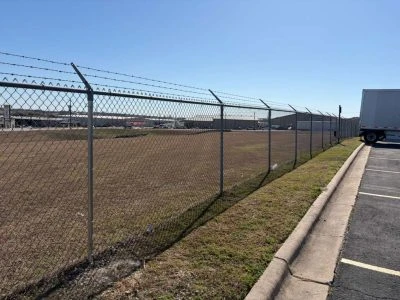
When you walk through any industrial area late in the evening, you’ll notice a pattern. Some properties are wide open, parking lots blending into the street, equipment visible from the sidewalk, nothing separating private ground from public space. Others feel different the moment you approach them.
That difference matters more than it might seem.
For businesses, security rarely depends on a single system. Cameras record activity. Lighting discourages hiding places. Alarm systems respond after something goes wrong. But before any of those systems come into play, there’s a simpler question: can someone step onto the property without effort?
Commercial property fencing in Austin, TX, answers that question immediately.
Creating a Physical Boundary
Every effective security strategy starts with boundaries. Without a fence, the edges of a property blur into the surrounding environment. Delivery drivers pull through parking areas they don’t belong in. Pedestrians cross private lots on their way to somewhere else. Sometimes vehicles use commercial spaces as shortcuts between roads.
Most of this activity isn’t malicious. But it establishes a habit, people begin to treat the property as if it’s public.
A fence resets that expectation. Once a perimeter exists, entry happens through defined points. Visitors naturally move toward gates rather than wandering across the property. Employees notice unfamiliar vehicles more easily because the space itself feels controlled.
Discouraging Opportunistic Theft
A large percentage of commercial theft isn’t carefully planned. It’s opportunistic.
Someone notices tools left near a loading dock. A contractor’s equipment sits overnight in an open yard. Scrap metal, copper wiring, machinery parts, items with resale value can disappear quickly when access is easy.
Criminals tend to look for convenience. A solid perimeter fence complicates that convenience. Climbing, cutting, or forcing entry requires time and effort. It also increases the risk of being seen. When someone weighing their options encounters a secured property, the calculation often changes: this one might not be worth the trouble.
In practice, that hesitation prevents more incidents than most business owners realize.
Protecting Outdoor Equipment and Materials
Not everything a business owns fits neatly inside a building. Construction companies store heavy equipment outdoors. Distribution centers keep trailers lined up across large lots. Manufacturers often maintain outdoor storage areas filled with materials waiting for processing.
These spaces are particularly vulnerable without fencing. Even large equipment can become a target, batteries, catalytic converters, copper components, or specialized tools attached to machinery. Smaller items vanish easily if someone can simply walk onto the property.
A commercial fence creates distance between valuable assets and the outside world. It forces access through monitored areas rather than leaving equipment exposed to anyone passing by.
Controlling Entry Points
Fencing does something security cameras alone cannot: it directs movement. When vehicles or pedestrians approach a property, they follow the path that’s easiest to enter. If the perimeter is open, that path could be anywhere. Once fencing is installed, the options narrow quickly.
Entry points become predictable. That predictability allows businesses to manage access more effectively. Gates can be locked after hours. Security personnel can monitor specific entrances instead of watching an entire open property. Delivery vehicles know exactly where to arrive.
From a security standpoint, fewer entry points mean fewer opportunities for problems.
Reducing Trespassing
Trespassing often begins with something minor, a person cutting across a property to shorten their walk. Someone parking briefly in a commercial lot while running errands nearby. Over time those small actions create patterns.
And patterns invite risk. When people become comfortable entering a property without permission, it becomes harder to notice when someone with less innocent intentions does the same. The difference between casual trespassing and criminal activity isn’t always obvious at first glance.
Fencing restores that distinction.
Bottom Line
Commercial fencing rarely draws attention once it’s installed. It sits at the edge of the property, doing its job quietly while daily operations continue inside. But its impact is constant.
Whether you are looking fir wrought iron fencing solutions or steel fence installation in Austin, TX, we at Spartan Custom Fencing are here to help you.
Our fencing solutions discourage trespassing before it begins. They complicate theft by removing easy access and help cameras, lighting, and security staff work more effectively.