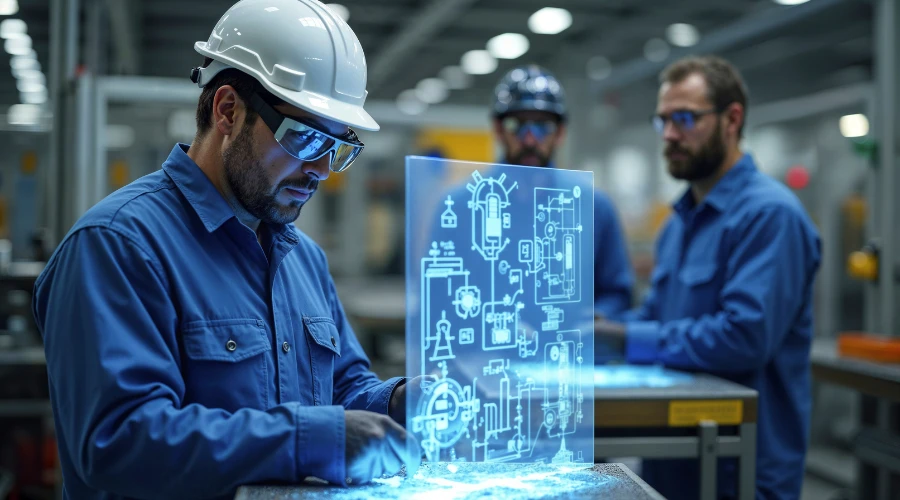
Surprising machine failures and factory inefficiencies not explicitly planned burn billions of dollars out of contemporary manufacturers struggling with increased production costs and recurrent supply chain limitations. To withstand this incessant pressure, it is critical to remove the operational blind spots that continue to lower productivity and profit margins day in day out.
Using the manual approach of performance tracking machines to use clipboards and end-of-shift reports to figure out the actual performance of the machine will ensure you find out about production losses at the time when it is already too late. These manual and inaccurate methods are completely insufficient to meet the real time tracking functions required by the fast processes of Industry 4.0.
The instant solution to this gap is to deploy sensor networks of Industrial Internet of Things (IIoT), which will connect physical assets of the shop floor directly to useful digital information. IoT-driven Overall Equipment Effectiveness (OEE) is not a mere IT buzzword; it is a strategy, ROI-generating device that transforms machine monitoring into an active, accurate science.
Demystifying OEE in the Age of Industry 4.0
The most effective KPI in manufacturing is the Overall Equipment Effectiveness (OEE). It also displays the actual percentage of the time you are productive in manufacturing by tracking three key pillars:
- Availability: How much of your time are you down compared to taking into account both planned changeovers and unplanned machine failures.
- Performance: Your real operating speed versus the recommended cycle time, showing slow cycles, and short, un-doctored micro-stops.
- Quality: The number of flawless units that are manufactured as compared to the amount of rework or scrap that needs an expensive fix.
It is simple math OEE = Availability x Performance x Quality.
Computation of these variables manually over a busy plant floor immediately causes a data bottleneck. Human operators just cannot note all machine jams and little variations of speed after every two seconds. Data collection to capture OEE on a large scale and with accuracy, the ongoing, automated data collection that IoT networks alone can provide is necessary.
How IoT Revolutionizes OEE Monitoring
The IoT directly addresses the fundamental elements of OEE by transforming physical machine activities into constant and exploitable digital information streams.
Maximizing Availability via Predictive Maintenance
- Sensory Insights: IoT sensors record real-time vibration, acoustic and temperature images of important machine parts.
- Preempting Failure: Maintenance Teams Maintenance teams are alerted in real-time about any unusual wear patterns before a disastrous failure happens.
- Eliminating Reactivity: This paradigm shift in which troubleshooting is replaced by proactive maintenance eliminates unplanned downtime by a significant margin, which has your assets running precisely at the scheduled time.
Optimizing Performance with Granular Tracking
- Catching the Invisible: human operators rarely log into two second machine jam or small feed delay. IoT networks can identify every single micro-stop.
- Stopping the Bleed: These tiny undocumented pauses only contribute to massive time wastage in an eight-hour shift.
- Instant Visibility: Live dashboards instantly reveal hidden slow points in the speed and will allow engineers to correct the root cause of the slow cycles rather than speculating why a shift has failed to meet its quota.
Ensuring Quality with Automated Control
- Double Losses: It is a waste of twice the profit in a defective product, wasted raw material and wasted machine time.
- Inline Detection: IoT-based vision systems and inline sensors identify anomalies in the exact second that they appear on the production line.
- Automated Intervention: When environmental conditions such as humidity or heat go out of spec, the system will stop production or give you a warning so that your bad batches do not proceed to the next step and jeopardize your OEE Quality mark.
The Tangible Business Benefits of IoT-Driven OEE
Installing sensor-based OEE monitoring will change how things are done way beyond the maintenance department. It provides tangible, bottom-line value which is scalable to your entire manufacturing enterprise.
Real-Time Data & Remote Visibility
- Centralized Control: A shift to the IoT means centralizing your operational footprint. Plant managers and operations directors are now able to track numerous international plants at the same time at one mobile or desktop dashboard.
- Instant Intervention: Even physical distance is no longer a cause of immediate decisions that are crucial in production. Leaders do not even have to visit the shop floor to observe operative KPIs and assess the wellbeing of the machines and organize the responses.
Data-Driven Decision Making
- Eradicating Guesswork: The use of intuition or hindsight at the end of the shift reports to manage a factory is incredibly risky in terms of financials. IoT creates an unchangeable, uninterrupted single source of truth.
- Strategic Alignment: This accurate information bridges the gap between C-suite strategy and the realities on the shop floor. Capital investments and maintenance budgets attack the very bottlenecks that are crippling your OEE and totally removes gut feeling management.
Empowering Workers & Lean Manufacturing
- Frontline Ownership: Operational excellence involves providing the persons involved in operating the machines. Having live performance information in the hands of the operators will assist them to normalize operations and reveal process wastage on a real-time basis.
- Accelerating Continuous Improvement: This is a self-sustaining feedback loop, which in turn is a natural driver of Lean and Six Sigma programs. It turns your day-to-day workforce of machine operators into problem solvers.
Real-World Applications
Theoretical ideas are merely important when they bring results to the ground. The following is the way IoT-based OEE works:
Automotive Industry: Precision at Scale
- The Application: Individual machine cycles can be traced and timed to the milliseconds through sensor networks built into robot assembly lines.
- The Impact: Identifying micro-delays within individual welding or stamping operations means that process engineers can focus on improving individual line layouts, which will immediately increase the throughput and the OEE Performance Indicator.
Food & Beverage: Compliance as Quality
- The Application: Sensors of IoT are used to constantly check whether environmental standards, e.g., temperature and hygiene, are met directly in mixing vats.
- The Impact: When a vat falls to unsafe conditions, this system notifies operators immediately or turns the production off. This is a direct measure to guarantee high food safety and avoid disastrous batch wastage, directly safeguarding the OEE Quality score.
Overcoming Implementation Hurdles
The shift to a smart factory is accompanied by plausible opportunities, which must be planned.
Integration with Legacy Systems
All the plants do not use new equipment. The 30-year-old analog machines are also capable of connecting to the cloud. By retrofitting these assets with IoT gateway and standard communication protocols such as OPC UA, the retrofitting of these assets puts the legacy iron into a digital world.
Data Security
Exposing industrial control systems to external networks may be dangerous. This is to ensure the protection of these assets; this needs to be done through strong cybersecurity with encrypted transmission of data, stringent access controls and the separation of the network architecture between the shop floor and the enterprise network.
Where OEE and IoT are Heading
The convergence of IoT and Artificial Intelligence (AI) is moving manufacturing to the next level of visibility and autonomy in its optimization.
- The Power of AI and ML: Large volumes of ongoing IoT data are now the basis of new sophisticated Machine Learning algorithms, enabling the discovery of new performance trends that remain unnoticed by human analysts.
- From Predictive to Prescriptive: The industry is also shifting quickly beyond predictive analytics, which only alerts you that a failure is on its way. The new standard is prescriptive analytics, in which the system gives you the precise way to remedy the situation prior to its occurrence.
- Autonomous Operations: AI-based systems are now starting to modify machine parameters automatically in real time to maximize OEE. It is not far off when equipment will automatically repair small malfunctions on its own, and will completely optimize the cycle time, completely without human intervention, making it a self-healing factory floor.
Conclusion
OEE monitoring with the help of IoT has ceased to be a far-off concept, but a dire competitive requirement that converts raw data into factories into profit. Don't continue to lose money to unknown downtime by evaluating what you are currently measuring in your organization and booking an appointment with a specialist in IoT to jumpstart your digital transformation.