You're halfway through a hat, 60 stitches in, and the whole thing keeps sliding off the needle tip. Sound familiar? That's not a skill problem — it's a needle length problem. As a knitter, do you remember those days of frustration in using the wrong needle length? Stitches falling off, or an aching wrist, all your hard work goes in vain.
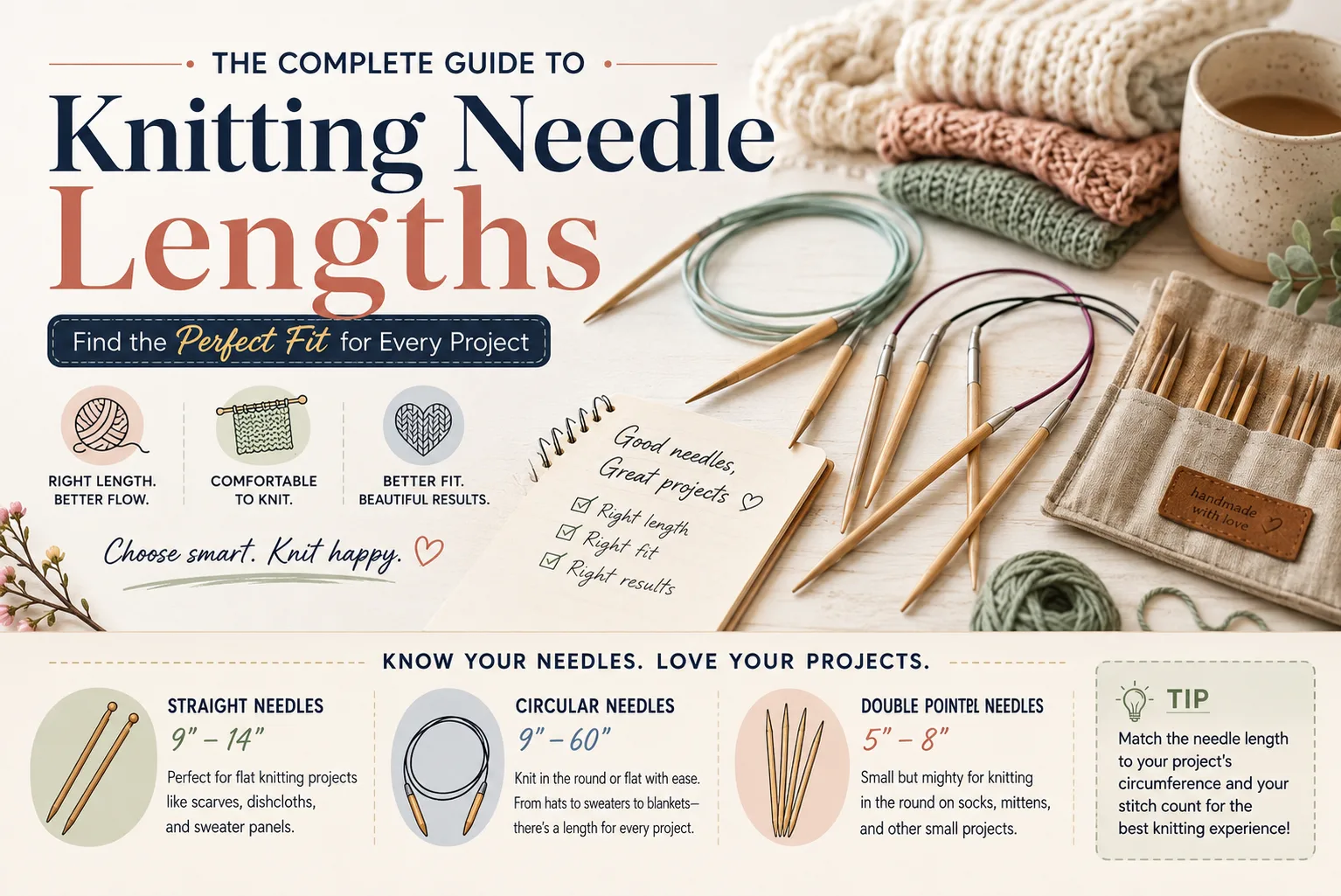
Standard knitting needles range from about 9 inches (23 cm) to 14 inches (35 cm) for straight needles. Circular needles come in cord lengths ranging from 9 inches to 60 inches (150 cm). Double-pointed needles (DPNs) are generally 5 to 8 inches (13–20 cm) long.
Here's the full range at a glance — but what matters is matching these numbers to your specific project, which is what the rest of this guide covers. Length matters because of what you're knitting, and once you understand why, every project becomes a lot less confusing.
Types of Knitting Needles
So which length do you actually need?
1. Straight Knitting Needle- The Classic Choice
Most of us remember that two needles mean two long sticks, one project, and colorful hand-dyed yarns. Straight needles come in two lengths:
9-inch (23 cm) needles are the shorter option. These are ideal for small projects such as scarves, swatches, dishcloths, or the individual pieces of a flat-knit sweater. If you are working on a project with fewer than 80–100 stitches, short straights are comfortable and manageable. They're also a favourite for knitters who find long needles awkward or who knit in tight spaces (yes, including on trains — been there).
14-inch (35 cm) needles are the go-to for wider projects. Blankets, shawls, and adult sweater panels allow for handling more stitches. The extra length gives your dominant hand more to grip.
But straight or single-pointed needles have their limits. More than 200 stitches across — think a full adult sweater panel or a large blanket border — and even a 14-inch needle starts to feel cramped. That's your signal to switch to circulars.
Once your stitch count outgrows what a straight needle can handle — or you want to knit in the round — circular needles become your best friend.
2. Circular Needles
Circular needles are two short needle tips connected by a flexible cord. They can knit in the round (for hats, socks, sweaters, and seamless construction) or flat ( like straight needles, just held differently). The total knitting needle length of a circular is measured by the cord, not the tips.
9–12 inches (23–30 cm) — the specialist's choice. These short circulars are designed for small circumference knitting — the crown of a hat, the cuff of a sleeve, or the thumb of a mitten. Many knitters prefer these over DPNs for small-diameter work, since you're handling one needle instead of juggling four.
16 inches (40 cm)
This is probably the most-used circular needle length in any knitter's collection. A 16-inch circular is the standard choice for knitting hats in the round. The circumference is just right — enough room for a standard adult hat without the work bunching up or the cord being too long. The 16-inch circular is the needle you'll reach for at 10 pm when you're knitting a birthday gift that needs to be done by morning.
24 inches (60 cm)
A brilliant all-rounder. The 24-inch circular handles adult sweater bodies, cowls, medium shawls, and larger hat crowns with ease. If you're only going to own one circular needle in each size, make it a 24-inch.
32 inches (80 cm)
Ideal for larger sweater bodies, big shawls, and the magic loop technique. If you haven't tried magic loop yet — it's a method of using a long circular to knit small-diameter items without DPNs — a 32-inch needle is your starting point.
3. Double Pointed Needle: Small but Mighty
These short needles are available in 4 or 5 packs- used for knitting in the round on small circumferences. They look a little intimidating if you've never used them, but they're comfortable once you get the hang of it.
5-inch (13 cm) DPNs are used for the tiniest projects: the toes of socks, the fingers of gloves, or the spout of a teapot cozy if that's your thing.
6-inch (15 cm) DPNs are the sweet spot for most sock knitters. They're long enough to hold a comfortable number of stitches but short enough to manoeuvre without constantly stabbing yourself (which, early on, happens more than you'd like to admit).
8-inch (20 cm) DPNs. These needles suit projects with 40–60 stitches in the round — mittens, the body of a sock before you reach the toe, or baby hats up to about a 14-inch circumference.
How to Choose the Right Knitting Needle Length
- Match the cord length to the circumference of your project: When knitting in the round, the circular needle cord should be shorter than the circumference of what you're making. If you're knitting a hat with a 22-inch circumference, a 16-inch circular works perfectly. A 24-inch cord would be too long and create a floppy, unworkable loop.
- For flat knitting, go longer. You want to be able to spread all your stitches across the needle without them bunching at the tips. As a rule of thumb, your needle should hold your full stitch count with at least 10–15 extra stitches of space — enough that stitches slide freely without crowding the tips or risking a drop.
- For magic loop or two-at-a-time knitting, go with 32–40 inches. Magic loop is a method where you fold a long circular needle cord into a loop at the midpoint of your stitches, effectively splitting them into two groups. This lets you knit small circumferences — socks, sleeves, hat crowns — on a single long circular instead of DPNs. The extra cord length is what makes the technique work — you're folding that cord to create a loop that allows two sections of knitting to progress simultaneously.
Consider your knitting style. Continental knitters (who "pick" the yarn) tend to prefer shorter needles because they use less wrist motion. Throwers often like a bit of extra length to brace the right needle against their body or thigh. Neither is wrong — knitting is one of the few crafts that genuinely rewards you for doing it your way. As a starting point: if you're a continental knitter, try a 9–16-inch needle for small projects and a 24-inch circular for larger ones. If you throw a 14-inch straight or a 32-inch circular gives you enough length to brace comfortably without fighting the needle.
Knitting Needle Length Kit
NeedleProjectsWhy16-inch circular HatsMatches standard adult head circumference 24-inch circular Cowls, smaller sweater sleeves Versatile mid-size, avoids bunching 32-inch circular Sweater bodies, magic loop for socks Long enough for 200+ stitches or folded technique 40-inch circular Big shawls, blankets Only length that fits 300+ stitches comfortably 6-inch DPNs Socks Ideal for 60–72 sock stitches across 4 needles 9-inch straight needles Swatching and the occasional flat dishcloth Short enough for under 80 stitches with no crowdingTip: You don't need all these needles at one go. Start with a 16-inch and a 32-inch circular needle in your most-used needle size and build from there.
Final Thought
Knitting needle length isn't the most glamorous topic in the craft — it doesn't have the appeal of a beautiful yarn or a complex lace pattern — but it's one of those foundational things that quietly determines whether a project is a joy or a slog.
Once you understand that needle length is about fit — fitting your stitch count, fitting your project's circumference, fitting your knitting style — it stops being confusing and starts being intuitive. You'll find yourself reaching for the right needle almost automatically.
Tell us in the comments — what needle length tripped you up the most when you started?