Introduction: The Stockout Problem That Keeps FMCG Leaders Awake
A field sales representative walks into a kirana store on a Tuesday morning. The retailer points to an empty shelf where the top-selling SKU should be. He says he asked for a refill four days ago. The distributor logged it. Nobody actioned it in time.
This is not a logistics failure. It is an intelligence failure.
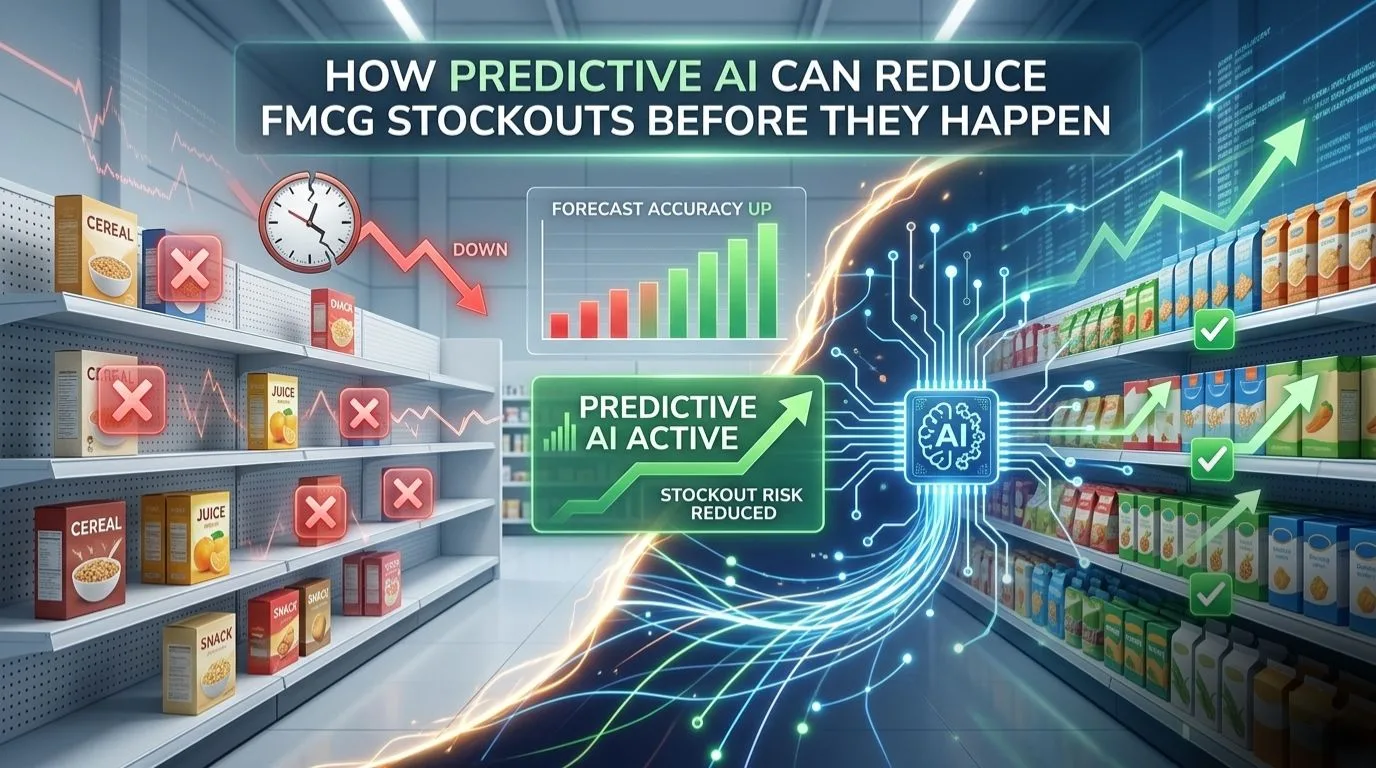
A sudden, unpredictable spike in demand rarely causes stockouts in FMCG. They are caused by a gap between what the data already knew and what the decision-making system was able to act on quickly enough. That gap is exactly what predictive AI closes.
According to IHL Group, FMCG and retail companies collectively lose over USD 1 trillion annually to stockouts and overstock situations. For a mid-size FMCG brand operating across 50,000 retail outlets, even a 2% improvement in stockout rate can translate into several crores of recovered revenue per quarter.
This blog breaks down how predictive AI models work inside FMCG supply chains, why conventional replenishment logic keeps underperforming, and what it actually takes to operationalize AI-driven stockout prevention at the outlet level.
What Is Predictive AI in the Context of FMCG Inventory?
Predictive AI, in the FMCG inventory context, refers to machine learning models that analyze historical sales patterns, distributor stock levels, field activity data, external demand signals, and supply-side variables to forecast SKU-level demand at the outlet or region level, days or weeks in advance.
This is fundamentally different from rule-based reorder logic or average demand forecasting. Here is the practical distinction:
- Rule-based reorder: triggers a replenishment order when stock drops below a fixed threshold. It reacts after the signal appears.
- Statistical forecasting: uses historical averages or moving averages to project demand. It works reasonably well under stable conditions and fails when demand is seasonal, promotional, or geographically variable.
- Predictive AI: reads dozens of variables simultaneously including sell-out velocity, days of stock at distributor, field visit frequency, weather, nearby competitive activity, upcoming festival calendars, and trade scheme schedules. It generates a stockout probability score per SKU per location, ahead of the event.
The key word is ahead. That is what changes the operational response from reactive to pre-emptive.
Why Traditional Replenishment Logic Keeps Failing
Before understanding what AI adds, it helps to understand why traditional approaches have persistent blind spots. There are three structural reasons.
1. Primary Sales Data Is a Proxy, Not a Signal
Most FMCG planning teams rely on primary sales, meaning how much the company sold into its distributors, as the main demand input. But primary sales data reflects channel inventory movements, not actual consumer demand. A distributor buying 500 cases this week tells you nothing about whether those 500 cases will move to retailers in the next 10 days or sit in a godown.
When demand planning is built on primary sales, the supply chain is always one step removed from what the market is actually doing.
2. Replenishment Cycles Are Fixed; Demand Is Not
Most FMCG distribution systems run on fixed replenishment cycles: weekly, biweekly, or monthly. The distributor places an order. The company fulfills it. The cycle repeats.
The problem is that demand does not follow fixed cycles. A regional cricket tournament, a sudden price drop by a competitor, or three consecutive dry days in summer can each shift demand by 20 to 40% within 72 hours. Fixed-cycle planning cannot absorb that variability fast enough.
3. Data Arrives Too Late to Act On
Secondary sales data, which is what distributors actually sold to retailers, typically reaches planning teams with a one-to-two week lag in manual or semi-connected setups. By the time the data shows a stockout building, the window to prevent it has already closed.
The companies running on weekly or monthly secondary data reports are not managing their supply chains. They are auditing them after the fact.
How Predictive AI Models Stockout Risk Before It Materializes
Predictive AI addresses these structural failures by operating on real-time, multi-signal data rather than lagged, single-source reports. There are three core mechanisms worth understanding.
1 Demand Signal Fusion: What AI Actually Reads
A well-built predictive model does not forecast demand from one data source. It fuses signals from multiple layers:
- Sell-out velocity at outlet level: how fast specific SKUs are moving at specific stores, captured through distributor billing or POS data.
- Distributor days of cover: current stock at the distributor divided by average daily offtake. This tells the model how many days of supply remain before the distributor runs dry.
- Field rep visit patterns: outlets that have not been visited in several days often show deteriorating order placement. Irregular field coverage is itself a leading indicator of availability risk.
- Seasonal and event calendars: the model ingests known demand multipliers: festival dates, school reopening, harvest seasons, weather patterns.
- Scheme and promotion schedules: active trade schemes accelerate offtake. If a scheme goes live and the distributor is already at 8 days of cover, the model flags a high stockout probability within the promotion window.
- Competitor activity signals: price changes or new launches by competitors can shift category demand rapidly. Some models ingest competitor signals through field rep annotations or syndicated market data.
When these signals are processed together, the model produces a composite risk score per SKU per geography. High-risk combinations receive replenishment alerts days before a stockout would otherwise occur.
2 Lead Time Variability Modelling
One underappreciated dimension of predictive stockout prevention is lead time modelling. Replenishment is not just about when demand will spike. It is about how long it will take to restore supply once an order is placed.
Lead times in Indian FMCG distribution vary significantly by route, season, and carrier. A distributor in a Tier-3 city may have a reliable 48-hour lead time in October but a 5-day lead time during peak festive season when every logistics provider is overloaded. A static reorder point that assumes constant lead times will systematically underperform in these conditions.
Predictive models that incorporate historical lead time variability, flagging high-risk periods where supply delays compound demand surges, enable far more accurate safety stock calibration at the distributor level.
3 Outlet-Level Replenishment Intelligence
Most replenishment decisions in FMCG happen at the distributor or territory level, not the outlet level. This creates a fundamental mismatch: the company knows a territory is running low but does not know which specific outlets are most at risk, so it cannot prioritize intelligently.
Predictive AI changes this by generating stockout risk scores at the outlet level. Field reps can then prioritize their beat visits based on which outlets have the highest AI-assessed risk scores for which SKUs. This transforms field activity from a coverage exercise into a targeted intervention.
This capability is directly enabled by connected field force infrastructure. When a Sales Force Automation platform captures real-time order data, visit records, and outlet-level stock observations, those inputs feed the predictive model continuously.
The Data Layer: What Needs to Be in Place First
Predictive AI is only as accurate as the data it trains on. This is where many FMCG organizations hit a practical constraint. The ambition is real, but the data infrastructure is not yet ready.
There are four non-negotiable data prerequisites for a functional predictive stockout system:
Real-Time Secondary Sales Capture
The model cannot forecast sell-out velocity without knowing what distributors are actually selling to retailers, per day. This requires either a connected Distributor Management System that logs every sales invoice as it happens, or a field SFA system where reps input order data at the point of visit.
Weekly or monthly secondary data extracts are insufficient. The model needs near-real-time feed to generate accurate days-of-cover estimates.
Clean, Live Outlet and Distributor Master Data
Predictive models are geography-specific. A risk score for SKU X in Pune Zone 2 means nothing if the outlet master is incomplete, GPS coordinates are missing, or distributor-to-outlet mapping has not been maintained. Dirty master data produces noisy predictions that field teams quickly stop trusting.
Historical Demand Data at Appropriate Granularity
Models trained on aggregate weekly data learn aggregate weekly patterns. For outlet-level predictions, training data needs to be at outlet level or at least at the beat or distributor zone level. Most FMCG companies have 12 to 24 months of usable historical data. That is sufficient for initial model training if it is disaggregated enough.
Field Activity Data as a Behavioural Signal
This input is often overlooked. When field reps visit an outlet regularly, and order placement is normal, the model interprets that as a healthy signal. When visit frequency drops, order placement skips, or the rep logs a note about shelf gaps, those are early warning inputs that the model should be incorporating.
The data infrastructure question is also a field operations question. FMCG companies that have already invested in Sales Force Automation and DMS have a significant head start on predictive AI readiness because the data pipelines are already running.
Real-World Impact: Where Predictive AI Changes the Numbers
The business case for predictive AI in FMCG inventory management is well-documented across multiple markets. Below are the outcome areas where the impact is most consistently measurable.
Stockout Rate Reduction
Brands that move from reactive replenishment to AI-driven demand sensing typically report stockout rate reductions of 25 to 40% within the first two quarters of implementation. The gains are highest in high-velocity SKUs with seasonal demand and in markets with variable distributor lead times, exactly the conditions where static reorder logic underperforms most.
Fill Rate Improvement
Order fill rate, meaning the percentage of orders fulfilled completely and on time, improves when replenishment is triggered before stock reaches critical levels rather than after. AI-driven replenishment reduces the frequency of partial fulfillments, which retailers and distributors treat as a reliability signal.
Reduction in Emergency Dispatches
One of the most visible costs of poor demand sensing is emergency dispatching: urgent, unplanned transfers from the CFA to a distributor or from one distributor to another to cover a shortfall. These transfers are expensive, operationally disruptive, and often arrive too late. Predictive models that flag risk 5 to 7 days in advance give the planning team time to respond through normal logistics channels.
Distributor Inventory Efficiency
When distributors carry excess safety stock as a hedge against unpredictable demand, capital gets locked in slow-moving inventory. AI-optimized safety stock levels, calibrated to actual demand variability rather than conservative rules of thumb, free up working capital at the distributor level without increasing stockout risk.
Common Objections (And Honest Answers)
Predictive AI adoption in FMCG supply chains raises genuine questions. Here are the most common ones, answered without oversimplification.
"Our distributor data is too incomplete for AI to work."
This is the most common objection, and it has merit. However, predictive models do not require perfect data to deliver value. They require consistent, real-time data at whatever level of granularity currently exists. Many FMCG companies start with territory-level predictions and progressively move to outlet-level as data coverage improves. The key is to start building the data pipeline now, because data quality improves through use, not through waiting.
"We already use forecasting tools in our ERP."
ERP forecasting modules are typically statistical forecasting engines, not machine learning models. They use historical averages, sometimes with seasonal adjustment, but they do not dynamically incorporate secondary sales velocity, field activity patterns, or external demand signals. They also operate at product or region level, not outlet level. The comparison is between a weather forecast based on last year's calendar and one based on real-time radar and atmospheric models.
"The field team will not trust AI recommendations."
Trust is built through accuracy and simplicity. When field reps see that the risk flags the system generates translate into real stockouts if ignored, and not when they act on them, trust develops quickly. The critical design principle is presenting AI outputs as actionable recommendations, not black-box alerts. Reps should see which SKU is at risk, at which outlet, and what action is needed, not just a score they cannot interpret.
"We do not have the technical capacity to build this."
Building a predictive AI model from scratch requires data science infrastructure that most FMCG operations teams do not have in-house. But they do not need to build it from scratch. Modern distribution management and sales automation platforms embed predictive demand analytics as part of their core feature set. The model is pre-built and trained on industry-specific data. The company's job is to connect its data pipeline to the platform and act on the outputs.
Frequently Asked Questions
What is predictive AI for FMCG stockout prevention?
Predictive AI for FMCG stockout prevention refers to machine learning models that analyze real-time and historical data, including secondary sales velocity, distributor stock levels, field activity, seasonal patterns, and lead time variability, to forecast which SKUs are at risk of running out at which locations before the stockout occurs. The output is an actionable risk score that enables pre-emptive replenishment.
How is predictive AI different from traditional demand forecasting in FMCG?
Traditional FMCG demand forecasting relies on historical averages and seasonal indices, typically at the product or territory level. It operates on lagged data and does not incorporate real-time sell-out velocity, field activity patterns, or external demand signals. Predictive AI models update continuously as new data arrives, operate at outlet or distributor-zone level, and generate risk scores rather than point forecasts. This makes them responsive to conditions that statistical models miss.
What data does a predictive AI model need to reduce FMCG stockouts?
The minimum viable data inputs are: real-time or near-real-time secondary sales data from distributors, current distributor stock levels, historical demand at SKU and geography level (ideally 12 to 24 months), field rep visit and order placement data, and lead time history for key supply routes. Richer inputs, such as seasonal calendars, competitor activity data, and weather patterns, improve prediction accuracy further.
How far in advance can predictive AI flag a stockout risk?
A well-calibrated predictive model can flag high-risk stockout conditions 5 to 14 days in advance, depending on the accuracy of the input data and the lead time in the relevant distribution route. This window is sufficient for a normal replenishment cycle to respond, eliminating the need for emergency dispatching in most cases.
Can small and mid-size FMCG companies use predictive AI, or is it only for large enterprises?
Predictive AI is no longer exclusively an enterprise capability. Modern SFA and DMS platforms increasingly embed AI-driven demand sensing as a core feature available to companies of all sizes. The key prerequisite is not size but data readiness: companies that have digitized their secondary sales capture and field operations are in a position to activate predictive capabilities regardless of their overall scale.
What is the role of a Distributor Management System in predictive stockout prevention?
A Distributor Management System is the primary data source for real-time secondary sales and distributor stock levels, both of which are critical inputs for predictive stockout models. Without a connected DMS, secondary data arrives with a one-to-two week lag, making it impossible to generate accurate days-of-cover estimates or detect sell-out acceleration as it happens.
How does predictive AI connect to field sales rep activity?
Field rep activity data, captured through a Sales Force Automation system, is both an input and an output channel for predictive AI. As an input, visit frequency, order placement patterns, and outlet-level observations feed the demand model as behavioral signals. As an output, the model generates outlet-level stockout risk scores that field reps use to prioritize visits and replenishment conversations with distributors.
What is the typical ROI timeline for implementing predictive AI in FMCG supply chains?
Most FMCG companies see measurable improvements in stockout rate and fill rate within one to two sales cycles after predictive AI is activated, typically 60 to 90 days. Larger gains in distributor working capital efficiency and emergency dispatch cost reduction accumulate over two to three quarters as the model improves with more data and the field team develops trust in AI-generated recommendations.
Conclusion: The Shelf Gap That Should Not Have Happened
Every FMCG stockout is a known-unknown: a gap that the data could have predicted, if the right system had been reading it in time.
Predictive AI does not eliminate uncertainty from demand planning. What it does is dramatically shrink the window between when a risk becomes visible in the data and when a human being can act on it. That window, often measured in days, is where stockouts happen and where revenue is lost.
The technology is mature. The industry-specific models are available. The platforms that carry predictive capabilities are accessible to companies at multiple scales.
What most FMCG organizations still need to close is the data readiness gap: getting secondary sales capture to real-time, connecting field activity to inventory signals, and building the distributor data layer that gives the model what it needs to predict with confidence.
Companies that do this work now will compound the advantage over the next three to five years, when predictive AI shifts from competitive differentiator to category baseline.
The retailer who pointed to that empty shelf on Tuesday morning was giving the brand its clearest performance review. The question is whether the data systems in place are capable of hearing it before he says it.