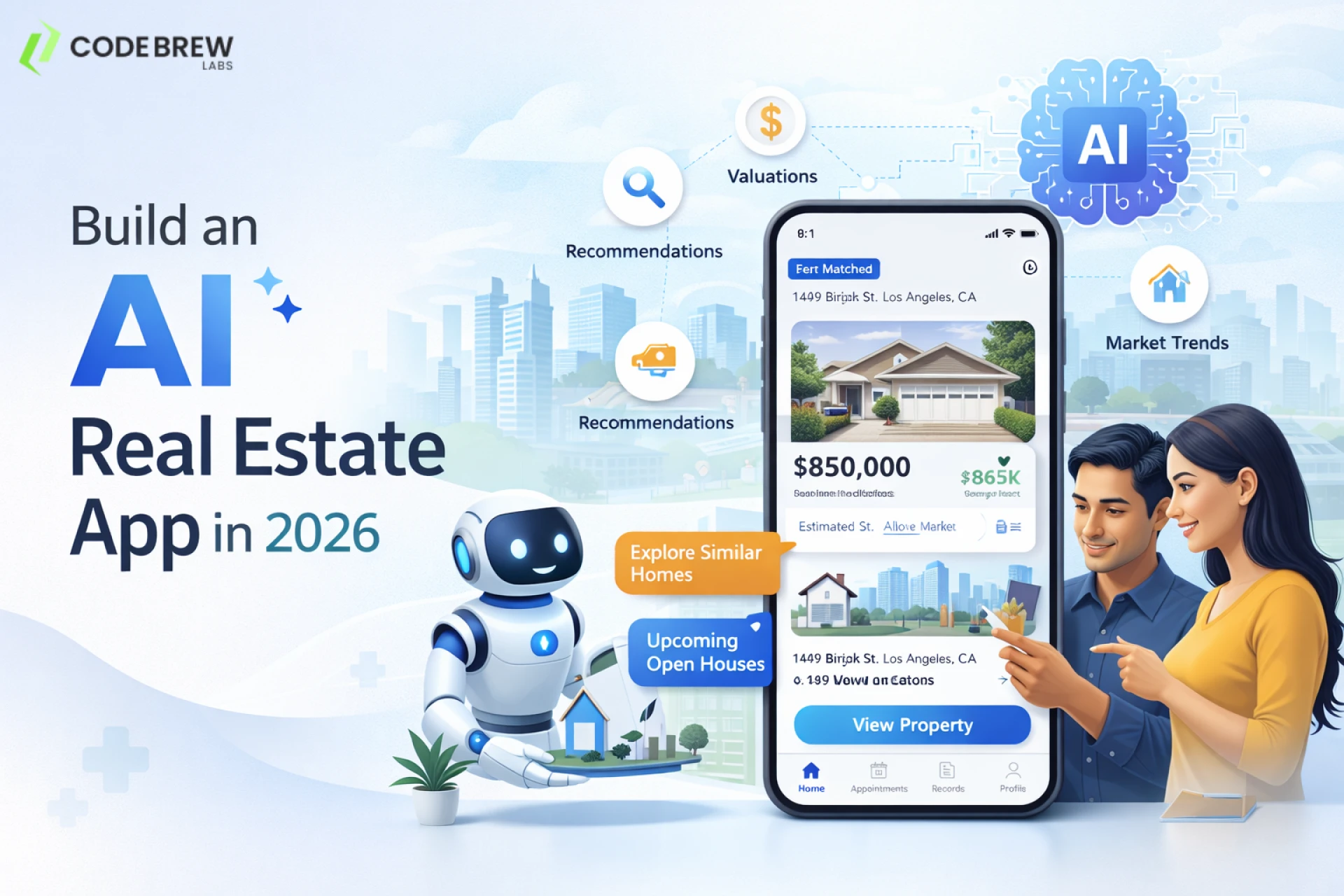
The real estate industry is no longer driven solely by location and listings—it’s driven by data, intelligence, and user experience.
In 2026, Artificial Intelligence (AI) is transforming how people search, evaluate, and invest in properties. From personalized recommendations to predictive pricing and virtual property tours, AI-powered real estate apps are redefining the entire property ecosystem.
For startups, real estate businesses, and entrepreneurs, building an AI real estate app is not just an opportunity—it’s a strategic move to stay ahead in a competitive market.
This guide will walk you through everything you need to know about building an AI real estate app in 2026—from features and technology to cost, process, and future trends.
The Evolution of Real Estate: Why AI MattersTraditionally, real estate transactions were:
- Time-consuming
- Paper-heavy
- Dependent on agents
- Limited by geography
Today, AI is changing the game.
What’s Changing:
- Property searches are personalized
- Pricing is data-driven
- Decisions are faster
- Experiences are digital-first
AI is turning real estate apps into intelligent property platforms rather than simple listing tools.
What Is an AI Real Estate App?An AI real estate app is a digital platform that uses artificial intelligence to enhance property search, analysis, and transactions.
It Can:
- Recommend properties based on user behavior
- Predict property prices and trends
- Offer virtual tours and smart insights
- Automate communication and support
In simple terms, it acts as a smart assistant for buyers, sellers, and investors.
Key Features of an AI Real Estate AppTo stand out in 2026, your app needs to go beyond basic listings.
Core Features
These are essential for any real estate app:
- User registration & profiles
- Advanced property search filters
- Interactive property listings
- Map-based navigation
- Chat and communication tools
AI-Powered Features (Game Changers)
This is where your app becomes truly competitive:
- Smart Property Recommendations
- Suggest properties based on user preferences and behavior
- AI-Based Price Prediction
- Analyze market data to estimate property value
- Virtual Property Tours (AR/VR)
- Allow users to explore properties remotely
- Chatbots & Virtual Assistants
- Provide instant responses and guidance
- Image Recognition
- Enable users to search properties using images
- Sentiment Analysis
- Understand user preferences through interactions
Building an AI-powered app requires a structured approach.
Step 1: Define Your Business Model
Start by identifying:
- Target audience (buyers, sellers, agents)
- Revenue model (commission, subscription, ads)
- Unique value proposition
Step 2: Conduct Market Research
Analyze competitors and identify gaps in the market.
Step 3: Choose the Right Features
Focus on MVP first, then scale with advanced AI features.
Step 4: Design UI/UX
A real estate app must be:
- Visually appealing
- Easy to navigate
- Fast and responsive
Step 5: Select the Tech Stack
Choose technologies that support AI and scalability.
Step 6: Develop the App
- Frontend & backend development
- API integrations
- AI model implementation
Step 7: Testing & Optimization
Ensure performance, security, and usability.
Step 8: Launch & Scale
Deploy your app and continuously improve it.
Technologies Powering AI Real Estate AppsModern real estate apps rely on advanced technologies.
Key Technologies:
Artificial Intelligence & Machine Learning
For predictions, recommendations, and automation
Big Data Analytics
For market insights and pricing trends
Cloud Computing
For scalability and storage
AR/VR Technology
For immersive property tours
Blockchain
For secure transactions
Cost of Building an AI Real Estate App in 2026The cost varies depending on complexity and features.
Estimated Cost:
- Basic App: $25,000 – $60,000
- Mid-Level App: $60,000 – $150,000
- Advanced AI App: $150,000 – $400,000+
Factors Affecting Cost:
- Number of AI features
- App platform (iOS, Android, Web)
- Design complexity
- Development team expertise
- Third-party integrations
While the opportunities are huge, challenges exist.
Key Challenges:
- High development costs
- Data accuracy and quality
- Integration with existing systems
- User trust in AI recommendations
- Data privacy concerns
AI-powered apps provide significant advantages.
For Users:
- Faster property search
- Personalized recommendations
- Better decision-making
For Businesses:
- Increased user engagement
- Higher conversion rates
- Improved operational efficiency
- Data-driven insights
The future of property tech is evolving rapidly.
Top Trends:
- Hyper-personalized property search
- AI-driven investment insights
- Voice-enabled property search
- Smart home integration
- Blockchain-based property transactions
Why You Should Invest Now
The real estate market is becoming increasingly competitive.
Investing in AI apps helps you:
- Stay ahead of competitors
- Attract tech-savvy users
- Improve customer experience
- Scale your business faster
The Future of Property Tech
AI is not just enhancing real estate—it’s redefining it.
The next generation of apps will be:
- Fully intelligent
- Predictive and data-driven
- Seamlessly integrated with smart ecosystems
Real estate apps will evolve into complete digital property platforms.
ConclusionBuilding an AI real estate app in 2026 is no longer just about technology—it’s about crafting intelligent, seamless, and highly personalized property experiences that truly resonate with modern users.
Businesses that embrace AI today won’t just keep up—they’ll lead the future of property tech, setting new standards in innovation, efficiency, and customer engagement. With the right strategy and a trusted partner like Code Brew Labs, turning visionary ideas into powerful, scalable real estate platforms becomes a reality.
The opportunity is massive, the market is evolving fast—and the time to build, innovate, and dominate is now.