Preparing for ISO 13485 certification requires more than having a quality manual and procedures. A medical device organization needs to demonstrate that its quality management system (QMS) is documented, implemented, maintained, and supported by appropriate records.
Before scheduling an ISO 13485 certification audit, performing a QMS readiness review can help identify documentation and implementation gaps.
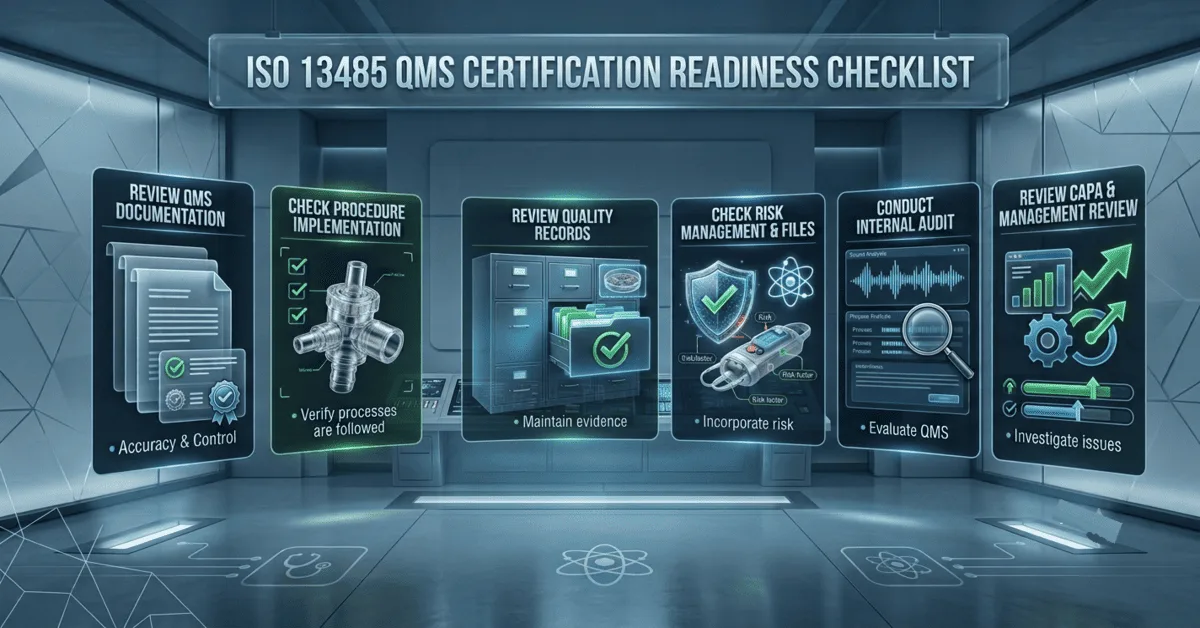
1. Review Your QMS Documentation
Start by checking whether your quality documentation accurately describes how your organization operates. The quality manual should define the QMS scope and documentation structure, while procedures should explain how applicable processes are controlled.
Review document approval, revision status, accessibility, and document control. Also verify that required records are defined and maintained as evidence that processes are being followed.
If your documentation is still being developed, ISO 13485 documents can provide a practical starting point, including a quality manual, procedures, SOPs, formats, records, audit checklist, and medical device documentation that can be customized to your organization.
2. Check Whether Procedures Are Implemented
Having procedures on paper does not demonstrate an effective QMS. Employees should understand their responsibilities and follow approved processes consistently.
If you are developing or reviewing procedures, develop ISO 13485 procedures for a QMS can help you understand how documented processes can be structured around actual organizational activities.
Check key areas such as document control, purchasing, production controls, training, nonconformity control, corrective action, internal auditing, and management review. Ask whether you can provide actual records showing that these processes are being followed.
3. Review Your Quality Records
Quality records demonstrate that your QMS works in practice. Review training records, supplier evaluations, internal audit results, management review records, nonconformities, corrective actions, and other applicable records.
Look for missing information, incomplete approvals, outdated forms, or activities performed without supporting evidence.
4. Check Risk Management and Medical Device Files
Review whether risk management activities have been appropriately incorporated into your medical device processes. Also verify that applicable medical device files contain the required product and process information and are properly maintained.
This is particularly important because ISO 13485 documentation extends beyond general QMS procedures to information associated with individual medical device types or families.
5. Conduct an Internal Audit
An ISO 13485 internal audit should be used as a genuine readiness check rather than simply a compliance formality. The audit should evaluate whether the QMS conforms to planned arrangements, applicable requirements, and the organization's own procedures, and whether it has been effectively implemented and maintained.
Use an ISO 13485 audit checklist to systematically review processes and identify gaps before the certification audit.
6. Review CAPA and Management Review
Check whether identified nonconformities have been properly investigated and whether corrective actions have addressed their causes. Where applicable, verify that effectiveness has been evaluated.
Management review should also be completed with appropriate inputs and outputs documented. Reviewing audit results, process performance, corrective actions, changes affecting the QMS, and improvement opportunities helps demonstrate active management involvement.
7. Perform a Final Certification Readiness Check
Finally, ask a practical question: If an auditor requested evidence of an important QMS process tomorrow, could your team quickly provide the procedure, applicable records, and evidence that the process is working?
If the answer is yes across your major QMS processes, your organization is in a much stronger position for the certification audit. If gaps remain, address them before the audit rather than waiting for the certification auditor to identify them.
A successful ISO 13485 certification preparation approach therefore combines documented procedures, implementation, employee competence, quality records, internal audits, management review, CAPA, risk management, and objective evidence. A structured readiness review helps turn your QMS documentation into a system that can be demonstrated confidently during certification.