Organizations implementing an Information Security Management System (ISMS) often focus on creating policies and procedures, but many overlook an important requirement: ensuring that their ISO 27001 documents fully address the applicable ISO 27001 Annex A controls. Well-structured documentation not only supports ISO 27001 compliance but also makes implementation, internal audits, and certification much easier.
Whether you are building a new ISO 27001 system or improving an existing one, this guide explains how to align your documentation with Annex A in a practical and audit-ready manner.
Why Annex A matters in ISO 27001
The ISO 27001 standard requires organizations to identify information security risks and apply appropriate controls. Annex A contains a comprehensive list of security controls covering organizational, people, physical, and technological security measures. These controls are not mandatory in their entirety; instead, organizations must determine which ones are applicable through risk assessment and justify their decisions in the Statement of Applicability (SoA).
This means your ISO 27001 manual, policies, procedures, and records should clearly demonstrate how selected controls are implemented.
Build documentation around applicable controls
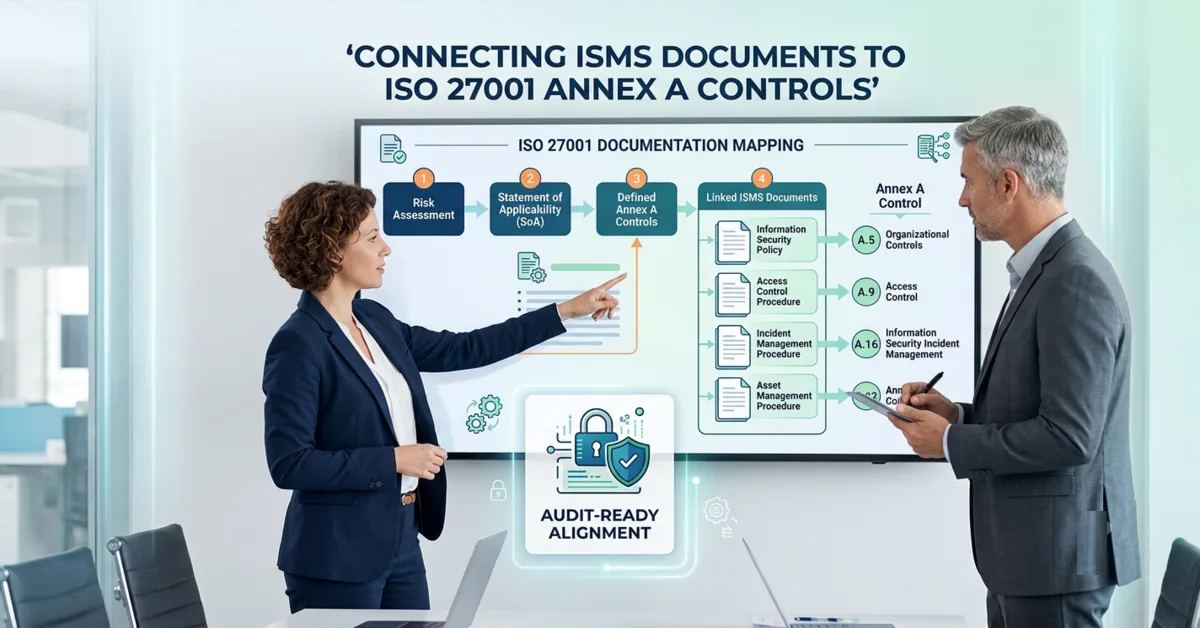
Instead of writing generic procedures, map each applicable Annex A control to specific documents within your ISMS. For example, information security governance can be supported by an ISO 27001 Information Security Policy. Access management can be addressed through a User Access Control Procedure, while asset management can be supported by an Asset Inventory and Classification Procedure. Incident response can be addressed through an Information Security Incident Procedure, and business continuity can be supported by a Backup and Recovery Procedure.
This mapping helps auditors verify that every selected control is supported by documented evidence and that the organization's ISO 27001 documents are aligned with its applicable ISO 27001 Annex A controls.
Essential documents your ISMS should include
A complete ISO 27001 system typically includes:
- ISO 27001 Information Security Policy
- ISMS Manual
- Risk Assessment & Risk Treatment Procedure
- Asset Management Procedure
- Access Control Procedure
- Incident Management Procedure
- Document Control Procedure
- Internal Audit Procedure
- Statement of Applicability (SoA)
Together, these ISO 27001 procedures create a consistent framework that supports implementation and continual improvement.
A well-structured ISO 27001 manual provides the framework for defining the scope, responsibilities, policies, and processes of the ISMS.
Avoid common documentation gaps
Many organizations fail certification because documentation exists but does not reflect actual operational practices. To strengthen your ISMS:
- Link every applicable Annex A control to a policy or procedure.
- Keep responsibilities clearly assigned to process owners.
- Maintain evidence such as logs, approvals, and audit records.
- Review documents regularly after risk assessments or business changes.
- Ensure the Statement of Applicability matches implemented controls.
Consistent documentation reduces audit findings and improves day-to-day information security management.
Simplify implementation with ready-to-use ISO 27001 documents
Developing an ISMS from scratch can require significant time and expertise. Using professionally prepared ISO 27001 documents can help organizations accelerate implementation by providing editable manuals, procedures, policies, formats, and audit-ready templates aligned with the requirements of the ISO 27001 standard.
These ready-to-edit documents can be customized to match your organization's scope, risks, and operational processes, reducing documentation effort while supporting faster ISO 27001 implementation and certification.
Final thoughts
Effective ISO 27001 compliance is not achieved by collecting documents—it comes from creating documentation that accurately reflects how Annex A controls are implemented within your organization. By mapping controls to procedures, maintaining an up-to-date ISO 27001 manual, and supporting implementation with practical records, organizations can build a stronger ISMS and approach ISO 27001 certification with greater confidence.
A well-documented system not only satisfies auditors but also improves security governance, operational consistency, and long-term business resilience.