
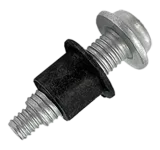
"Learn how the Huck Bolt creates vibration-proof joints. Discover why Huck lockbolts outperform conventional fasteners in heavy industry and infrastructure projects".
Huck Bolt vs. Traditional Fasteners: Key Differences
In heavy engineering, a fastener that loosens over time becomes a liability. Vibration, dynamic loads, and thermal cycling slowly undo the clamping force of conventional threaded bolts, leading to maintenance cycles, safety risks, and unplanned downtime.
An alternative joining technology, that is, the Huck Bolt eliminates these weaknesses through a fundamentally different installation principle.
How a Huck Bolt Works?
Unlike a standard bolt that relies on thread friction and torque, a Huck Bolt uses a two‑piece design: a pin with annular locking grooves and a deformable collar.
During installation, a hydraulic tool pulls the pin while simultaneously swaging the collar into the grooves. The result is a permanent, uniform clamp force that does not depend on operator torque or thread condition. There is no nut to loosen, no lock washer to fatigue, and no need for periodic retightening.
The Vibration Resistance of Huck Lockbolts
Conventional fasteners fail not because of insufficient initial torque, but because micro‑movements between threads gradually reduce tension. Huck lockbolts solve this by eliminating relative movement altogether. The swaged collar conforms perfectly to the pin’s grooves, creating a solid metal‑to‑metal lock.
Independent testing shows that Huck lockbolts retain over 95% of their original clamp load after extreme vibration cycles that would loosen a grade‑8 bolt within minutes.
This characteristic makes them indispensable in railway rolling stock, mining equipment, and heavy truck chassis, applications where welded joints are impractical and standard bolts cannot be trusted.
Industrial Applications beyond Ordinary Fasteners
Engineers choose the Huck system when joint failure is not an option. In bridge construction, the fastener provides consistent tension across thousands of connections.
In wind turbine towers, it handles both dynamic bending and gravitational loads without relaxation. Agricultural machinery, material handling systems, and even offshore platforms rely on the same principle.
Importantly, the installation is quiet, clean, and quick. A typical joint takes two to four seconds to complete, with visual inspection verifying the collar’s deformation. No torque wrench calibration, no thread lubricants, and no cross‑threading risks.
Sourcing from a Huck Bolt Distributor in India
While the technology is well‑established globally, project success also depends on correct product specification and supply chain integrity.
Working with a Huck Bolt Distributor India that stocks genuine, certified fasteners ensures that grip lengths, diameters, and material grades match the engineering design.
A competent distributor also provides access to compatible installation tooling and technical data sheets for different collar materials such as carbon steel, stainless steel, or aluminum.
Long-Term Cost Benefits
Although the initial cost of Huck lockbolts may be higher than conventional hardware, the total cost of ownership is significantly lower. Eliminating routine retorquing, reducing assembly time, and preventing field failures translates into direct savings.
For original equipment manufacturers, the reduced warranty claims and improved safety records further justify the switch.
Conclusion
Choosing the right fastening technology directly impacts structural safety, maintenance frequency, and total project cost. Conventional bolts, while suitable for static, low‑vibration environments, frequently fail in dynamic applications.
The Huck Bolt system offers a permanent alternative that removes the need for retorquing and withstands extreme cyclic loading. For engineers evaluating industrial joints, the combination of rapid installation and proven vibration resistance makes Huck lockbolts a reliable standard.
Partnering with a qualified Huck Bolt Distributor India ensures access to authentic components and technical support. Reputable suppliers consistently demonstrate how proper fastener selection and supply chain integrity improve long‑term joint performance.