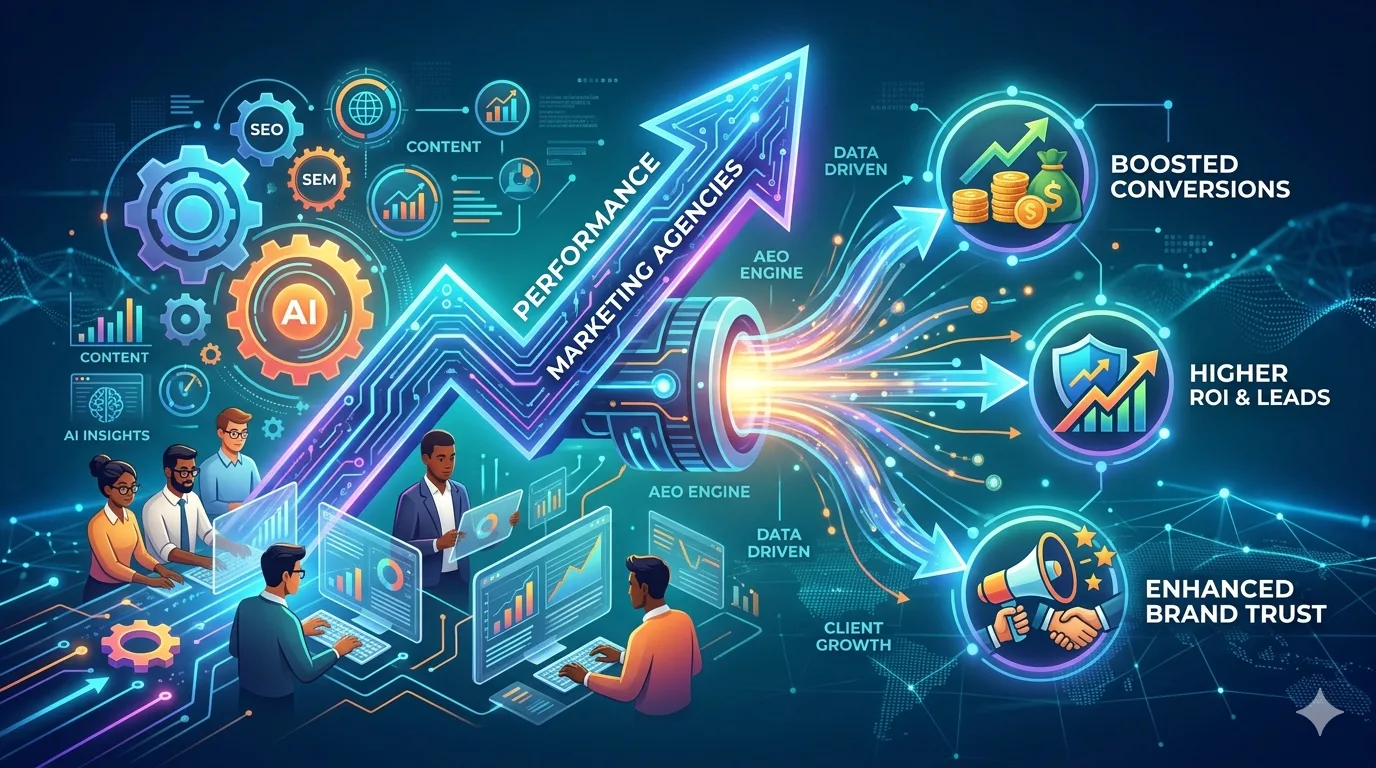
The digital marketing landscape is undergoing one of its most fundamental shifts since the rise of search engines. For more than a decade, performance marketing agencies have built their strategies around traditional SEO, paid ads, and social media algorithms. However, the rapid adoption of AI-powered search assistants and conversational interfaces has introduced a new discipline: Answer Engine Optimization (AEO). This shift is not just an incremental change in tactics—it is a structural transformation in how information is discovered, interpreted, and delivered to users.
For performance marketing agencies, understanding and integrating Answer Engine Optimization into their service offerings is no longer optional. It is becoming a core requirement for maintaining visibility, delivering measurable ROI, and staying competitive in a world where users increasingly rely on AI-driven answers instead of traditional search results.
From Search Engines to Answer Engines
Traditional search engines like Google function by indexing web pages and ranking them based on relevance signals such as backlinks, keywords, and technical SEO factors. Users then browse multiple links to find the information they need.
Answer engines, on the other hand, work differently. AI-powered systems such as ChatGPT-like assistants, Perplexity-style tools, and integrated search copilots aim to provide a direct answer rather than a list of links. These systems synthesize information from multiple sources and present a single, structured response.
This fundamental difference changes how visibility works. Instead of competing for position on a search engine results page (SERP), brands are now competing to be included in the AI-generated answer itself. This is where Answer Engine Optimization becomes essential.
Why Performance Marketing Agencies Must Adapt
Performance marketing agencies are traditionally driven by metrics such as CTR (click-through rate), CPA (cost per acquisition), ROAS (return on ad spend), and conversion rates. These metrics are still relevant, but the pathways leading to them are changing rapidly.
Users no longer always click through websites. In many cases, they make decisions based solely on AI-generated summaries. This means that if a brand is not included in the dataset or content sources that answer engines rely on, it effectively becomes invisible at the decision-making stage.
Agencies that fail to adapt risk losing relevance in three critical areas:
First, traffic acquisition channels are shifting. Organic search traffic may decline as AI-generated answers reduce the need for users to visit websites.
Second, brand authority is increasingly defined by inclusion in AI responses rather than traditional rankings.
Third, client expectations are evolving. Businesses now expect agencies to optimize for visibility in AI-driven environments, not just Google search.
The Strategic Role of AEO in Modern Marketing
Answer Engine Optimization is not just an extension of SEO; it is a strategic discipline that requires a different mindset. While SEO focuses on ranking pages, AEO focuses on making content understandable, extractable, and trustworthy for AI systems.
Performance marketing agencies can leverage AEO in several key ways:
One of the most important aspects is content structuring. AI systems prefer content that is clearly organized, semantically rich, and contextually complete. This means using structured headings, direct answers, and concise explanations that can be easily extracted.
Another important factor is entity clarity. AI models rely heavily on recognizing brands, products, and concepts as distinct entities. Agencies must ensure that their clients are consistently represented across the web in a unified and unambiguous way.
Additionally, trust signals play a crucial role. AI systems prioritize sources that appear authoritative and consistent. This includes mentions in reputable publications, consistent branding, and high-quality informational content.
How AEO Impacts Performance Marketing KPIs
The integration of Answer Engine Optimization fundamentally changes how performance marketing success is measured.
In traditional SEO-driven campaigns, success is often measured by ranking improvements and organic traffic growth. However, in an AEO-driven environment, visibility inside AI-generated answers becomes a more valuable metric.
For example, if a user asks an AI assistant for “best CRM tools for startups,” the goal is no longer just to rank a blog post on Google. The goal is to ensure that the client’s product is included in the AI’s response.
This creates a new layer of performance tracking that agencies must develop. Metrics may include:
- AI citation frequency
- Brand mention rate in AI answers
- Share of voice within AI-generated responses
- Contextual positioning (whether the brand is recommended or just mentioned)
These metrics are still emerging, but they will become central to performance marketing reporting in the near future.
The Role of Content Strategy in AEO
Content remains at the core of all digital marketing, but its role is evolving. In Answer Engine Optimization, content must be designed not just for human readers but also for machine interpretation.
This means moving away from purely keyword-driven content and focusing more on intent-driven content. Articles must directly answer user questions in a clear, structured, and authoritative manner.
Performance marketing agencies should prioritize:
- FAQ-style content that directly answers common user questions
- Deep informational pages that explain complex topics clearly
- Comparison content that helps AI systems differentiate between options
- Data-driven insights that increase credibility
The more structured and semantically rich the content is, the higher the likelihood that it will be used in AI-generated responses.
Technical Optimization for Answer Engines
Beyond content, technical optimization plays a significant role in AEO. AI systems rely on clean, accessible, and well-structured data.
Key technical factors include:
- Schema markup for structured data interpretation
- Fast-loading, mobile-optimized websites
- Clean HTML structure with semantic tags
- Internal linking that reinforces topical authority
These elements help answer engines better understand and categorize content, increasing the likelihood of inclusion in generated responses.
Competitive Advantage for Agencies
Performance marketing agencies that adopt Answer Engine Optimization early will gain a significant competitive advantage. Just as early SEO adopters dominated search rankings in the 2000s and 2010s, early AEO adopters will dominate AI-driven discovery channels.
Agencies can differentiate themselves by offering AEO audits, AI visibility reports, and optimization strategies tailored specifically for answer engines. This positions them not just as media buyers or SEO providers, but as next-generation visibility consultants.
In fact, many forward-thinking agencies are already integrating tools such as answer engine optimization tools into their workflow to analyze how brands appear across AI platforms and conversational search systems.
Challenges and Limitations
Despite its potential, AEO is still an evolving discipline with several challenges.
One of the main issues is lack of transparency. Unlike traditional SEO, where ranking factors are relatively well understood, AI systems operate as black boxes. It is difficult to know exactly why a brand is included or excluded from an answer.
Another challenge is volatility. AI-generated responses can change frequently based on model updates or data refreshes, making long-term optimization more complex.
Finally, measurement remains an ongoing challenge. Since AI platforms do not always provide referral data, tracking direct impact requires new methodologies and analytical frameworks.
The Future of Performance Marketing with AEO
The future of performance marketing will be shaped by the convergence of SEO, paid media, and Answer Engine Optimization. Instead of treating these as separate channels, agencies will need to integrate them into a unified visibility strategy.
In this future, success will not only depend on how well a brand ranks or how efficiently ads convert, but also on how frequently and accurately it appears in AI-generated answers.
Performance marketing agencies that embrace this shift early will be better positioned to deliver value in a world where discovery is increasingly conversational, personalized, and AI-driven.
Ultimately, Answer Engine Optimization is not just a new tactic—it is the foundation of the next era of digital visibility.