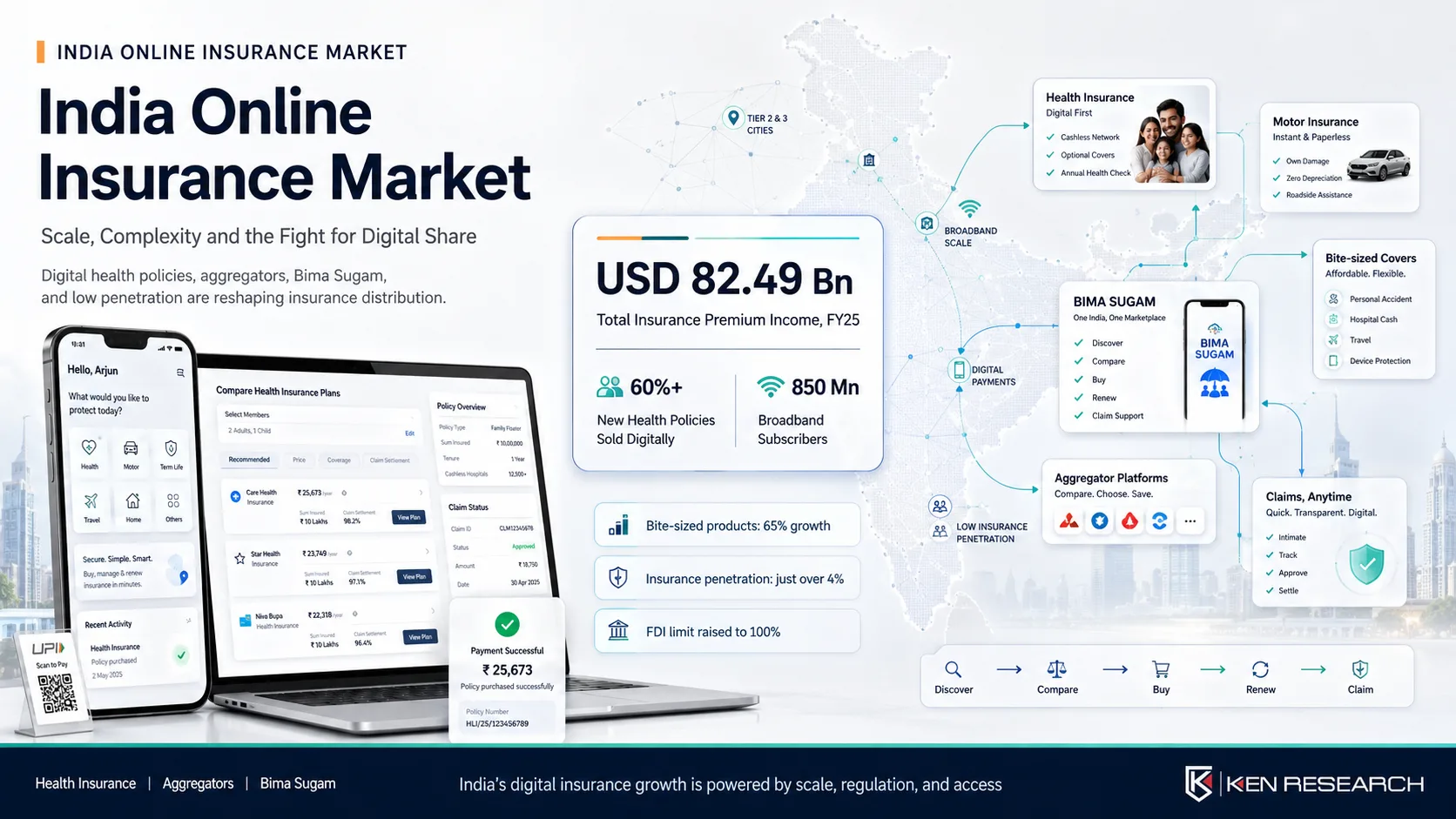
India's online insurance market sits at a structural inflection point. The broader insurance sector recorded a total premium income of approximately Rs. 7.05 lakh crore (USD 82.49 billion) in FY25, reflecting a 5.6% year-on-year increase, per IBEF citing IRDAI data. The digital channel's share within this is growing fast: per IRDAI's 2023 Annual Report, over 60% of new health policies were sold digitally, and bite-sized insurance products grew 65% in premium volume in the same period. Broadband subscribers crossed 850 million in 2023, per the Telecom Regulatory Authority of India (TRAI), creating the addressable infrastructure for digital insurance at a scale no other market outside China can match. Yet insurance penetration in India sits at just over 4%, per IRDAI, with non-life penetration stagnant at 1%, meaning the online channel is growing rapidly into a market that is structurally underpenetrated. The India Online Insurance Market report by Ken Research covers market sizing, segmentation by product and distribution channel, competitive landscape, and demand outlook.
Key Insights: India Online Insurance Market
- India's total insurance premium income reached USD 82.49 billion in FY25, growing 5.6% year-on-year, per IRDAI via IBEF
- Over 60% of new health policies sold digitally in 2023, per IRDAI Annual Report
- Bite-sized insurance products grew 65% in premium volume in 2023, per IRDAI
- Broadband subscribers crossed 850 million in 2023, per TRAI, anchoring digital insurance addressable market
- Insurance penetration stands at just over 4%, with non-life at 1%, per IRDAI, signalling vast untapped potential
- India predicted to be the fastest-growing insurance market among G20 nations at 7.1% average growth from 2024 to 2028, per IRDAI
- IRDAI's Bima Sugam digital marketplace launched in 2024, expected to accelerate online adoption further
- FDI limit in insurance raised from 74% to 100%, enabling full foreign ownership and fresh capital inflows
- Key players: Policybazaar, Acko, HDFC Ergo, ICICI Lombard, Star Health, Bajaj Allianz, Digit Insurance
What Is Driving the India Online Insurance Market
India's online insurance channel is being pulled forward by three forces simultaneously: infrastructure expansion, regulatory reform, and product innovation. None of these operates in isolation, and their convergence is what makes the India Online Insurance Market structurally different from every other emerging market digital insurance story.
The infrastructure story is TRAI's. With 850 million broadband subscribers in 2023 and UPI processing billions of transactions monthly, the payment and connectivity rails for digital insurance are already built. What is being layered on top is an increasingly sophisticated product and regulatory stack.
Three structural forces shaping the India Online Insurance Market:
- Bima Sugam and regulatory digitisation: IRDAI's Bima Sugam platform, launched in 2024, creates a unified digital marketplace where consumers can compare, purchase, and manage policies across all insurers from one interface. Separately, IRDAI's 2024 Master Circular on General Insurance mandates insurers to adopt end-to-end technology for the entire customer journey, from purchase to claims. These mandates are not optional; they are structurally shifting the entire distribution model toward digital.
- Aggregator dominance: Per IRDAI's 2023-24 Annual Report, over 40% of digital insurance sales were routed through aggregators like Policybazaar and Coverfox. Policybazaar reported 40% year-on-year growth in policy purchases via mobile apps. InsuranceDekho and RenewBuy entered advanced merger discussions in 2024, potentially creating a consolidated platform valued at Rs. 8,000 crore and signalling the aggregator segment's maturation.
- Health insurance digital dominance: Health insurance is the online channel's anchor product. Medical inflation stood at 14% in 2023, per IRDAI, pushing consumers toward digital health policy purchases for cost comparison and speed. A 2024 Policybazaar survey found 70% of customers prefer buying health insurance online for convenience. ICICI Lombard's AI-driven claims processing and HDFC Ergo's voice-based insurance for vernacular users are expanding the accessible audience beyond urban English-speaking consumers.
Competitive Landscape of the India Online Insurance Market
Policybazaar holds the dominant aggregator position in the India Online Insurance Market, with the deepest brand recognition in digital insurance distribution. Acko operates as a digital-native insurer, bypassing traditional distribution entirely. HDFC Ergo, ICICI Lombard, Star Health, Bajaj Allianz, and Digit Insurance lead among established insurers competing aggressively for digital channel share. The Indian insurtech sector grew 12-fold, reaching USD 750 million in 2023, with the top nine startups contributing 85% of sector revenue. India is the second-largest insurtech market in Asia-Pacific, accounting for 35% of the USD 3.66 billion in insurtech-focused venture investments in the country, per S&P Global Market Intelligence. The FDI limit raised to 100% in 2024 is expected to accelerate foreign capital entry, with Zurich Insurance acquiring a majority stake in Kotak General Insurance marking the first major foreign investment in eight years. For regional context on how other Asian markets are building their digital insurance channels, the Malaysia Online Insurance Market shows how a smaller but higher-penetration Southeast Asian market approaches digital distribution differently.
Conclusion
The India Online Insurance Market is defined by a paradox that few markets present: massive scale, rapid growth, and structural underpenetration all existing simultaneously. Insurance penetration at 4% and non-life at 1% means the online channel is growing into a protection gap of extraordinary size. IRDAI's regulatory reforms, from Bima Sugam to mandatory digital journey requirements to 100% FDI, are systematically removing the structural barriers that kept digital penetration low. The aggregator model has proven itself. The infrastructure is built. What determines who wins the next phase is distribution depth into Tier 2 and Tier 3 cities and vernacular-language product accessibility. The India Online Insurance Market Outlook maps the full competitive and regulatory trajectory in detail.
FAQs
1. How large is the India Online Insurance Market?
India's total insurance premium income reached USD 82.49 billion in FY25, per IRDAI data cited by IBEF, growing 5.6% year-on-year. The online channel accounts for a rapidly growing share: over 60% of new health policies were sold digitally in 2023, per IRDAI. The India Online Insurance Market is predicted to be among the fastest growing globally, with India's insurance market overall forecast to grow at 7.1% annually from 2024 to 2028, per IRDAI projections, making India the fastest-growing insurance market among G20 nations.
2. What is IRDAI's Bima Sugam and why does it matter for the India Online Insurance Market?
Bima Sugam is IRDAI's unified digital insurance marketplace, launched in 2024, designed to let consumers compare, purchase, renew, and manage policies across all insurers from a single platform. It directly addresses the fragmentation that has historically limited online insurance adoption in India. IRDAI has also mandated that insurers adopt end-to-end digital customer journeys per its 2024 Master Circular on General Insurance. Together, these reforms are structurally shifting the entire Indian insurance distribution model toward digital channels, creating a regulatory tailwind for the India Online Insurance Market that is unique among emerging market peers. For full coverage, the India Online Insurance Industry Analysis by Ken Research covers regulatory dynamics in detail.
3. Which product segment leads the India Online Insurance Market?
Health insurance is the leading product segment in the India Online Insurance Market by digital sales volume. Medical inflation in India stood at 14% in 2023, per IRDAI, pushing consumers to compare and purchase health policies online. Policybazaar reported a 30% surge in health policy sales in 2024. Motor insurance is the second major segment, driven by mandatory third-party liability requirements and the growth of usage-based insurance products enabled by telematics. Bite-sized insurance products, covering devices, travel, and short-term coverage, grew 65% in premium volume in 2023, representing the fastest-growing product tier.
4. Who are the key players in the India Online Insurance Market?
Policybazaar leads the India Online Insurance Market as the dominant digital aggregator, with 40% year-on-year growth in mobile app policy purchases. Acko General Insurance operates as a digital-native insurer. Among established insurers competing for digital share, HDFC Ergo, ICICI Lombard, Star Health, Bajaj Allianz, and Digit Insurance are the most active in platform and technology investment. The Indian insurtech sector grew 12-fold to USD 750 million in 2023, with the top nine startups driving 85% of sector revenue, per Ken Research data. The merger discussions between InsuranceDekho and RenewBuy signal further consolidation in the digital distribution layer.
5. What are the main challenges facing the India Online Insurance Market?
Two structural challenges constrain growth despite strong demand. First, trust: per the Reserve Bank of India's 2023 Financial Literacy Report, only 38% of surveyed consumers expressed confidence in digital-only insurance transactions. IRDAI blacklisted 14 digital platforms in early 2024 following scams involving fake health insurance apps. Second, claims complexity: 45% of digital insurance complaints in 2023 were claim-related, with average resolution times stretching to 42 days, per IRDAI data. IRDAI's fraud monitoring governance requirements and the NHCX cashless claims infrastructure are both aimed at resolving these trust and claims experience barriers over the medium term.