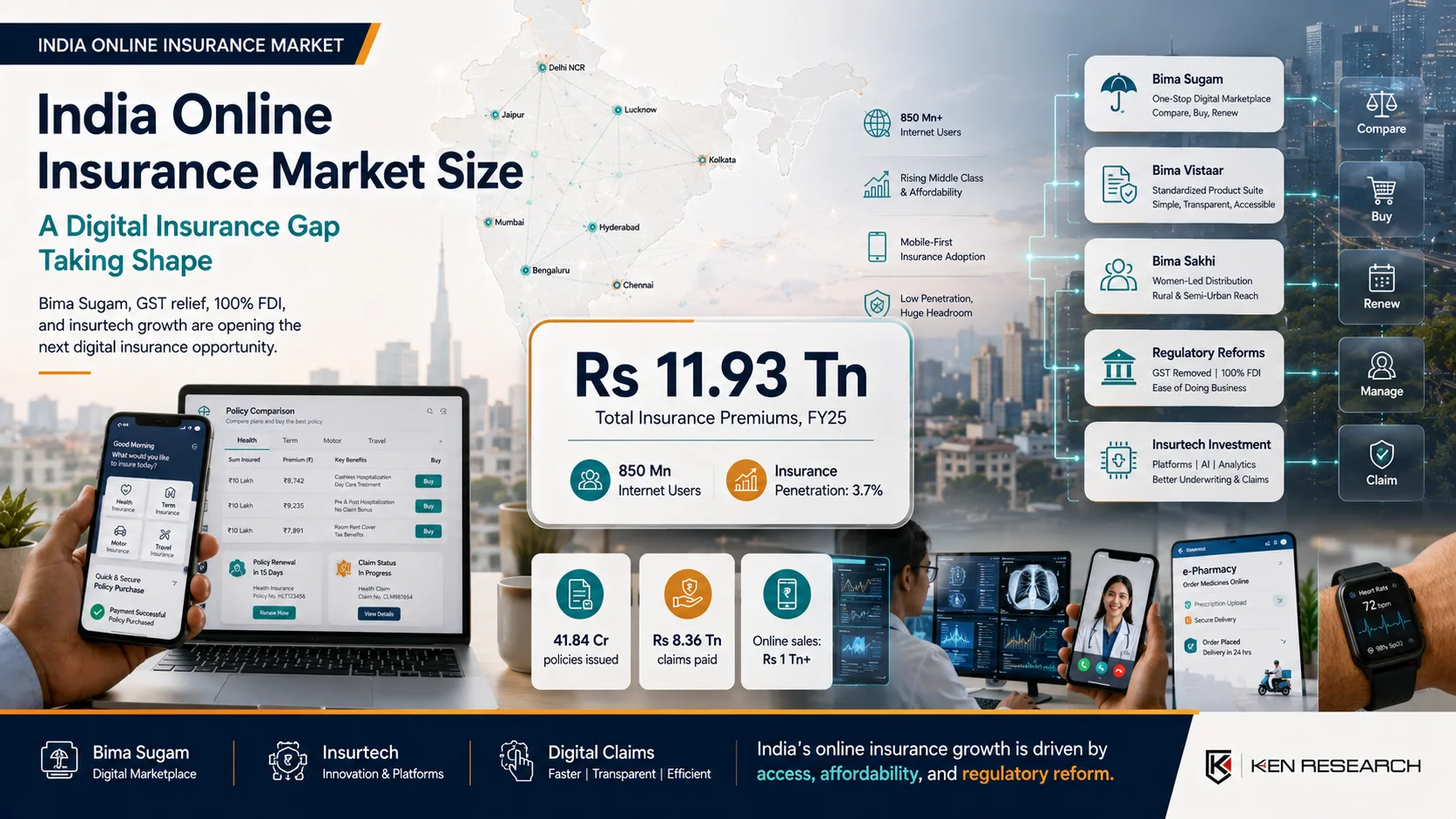
India's insurance market collected total premiums of Rs 11.93 trillion in FY 2024-25, issued 41.84 crore policies, and paid claims of Rs 8.36 trillion, per IRDAI FY25 data. Yet insurance penetration dropped to 3.7% of GDP in FY25, the third consecutive year of decline from the pandemic-era peak of 4.2% in FY21-22, per IRDAI Annual Report 2024-25. Non-life insurance penetration remained flat at 1%, life insurance fell to 2.7%, both well below the global average of 7.3%, per IRDAI. India has approximately 850 million internet users, per Ken Research, yet the majority remain uninsured or underinsured, creating the single largest addressable digital insurance gap in Asia. IRDAI's response is structural: the Bima Sugam digital marketplace was launched September 17, 2025, per IBEF, functioning as the UPI equivalent for insurance, allowing consumers to compare, buy, renew, manage policies, and settle claims on a single platform. The FDI limit in insurance was raised to 100% enabling full foreign ownership, per IBEF, with Jio Financial Services and Allianz launching a joint venture in September 2025 as the first major entrant under this framework. The India Online Insurance Market report by Ken Research covers market sizing, segmentation by product and distribution channel, competitive landscape, and demand outlook.
Key Insights: India Online Insurance Market Size
- Total insurance premiums reached Rs 11.93 trillion in FY25, with 41.84 crore policies issued and Rs 8.36 trillion in claims paid, per IRDAI FY25
- Insurance penetration at 3.7% in FY25, third consecutive year of decline, versus global average of 7.3%, per IRDAI Annual Report 2024-25
- Non-life penetration flat at 1%, life insurance at 2.7%, per IRDAI
- Bima Sugam digital marketplace launched September 17, 2025, per IBEF, creating a UPI-equivalent for insurance across life, health, motor, and general products
- FDI limit raised to 100% in insurance, per IBEF, enabling full foreign ownership
- GST on individual insurance products reduced to zero on term, ULIP, endowment, and health insurance effective September 22, 2025, per Business Standard
- India is the 2nd largest insurtech market in Asia-Pacific, accounting for 35% of USD 3.66 billion in insurtech-focused venture investments, per S&P Global Market Intelligence cited by IBEF
- Online insurance sales expected to exceed Rs 1 trillion (approximately USD 12 billion), per Ken Research
- India projected to be the 6th largest insurance market globally within a decade, leapfrogging Germany, Canada, Italy, and South Korea, per IRDAI
- Key players: Policybazaar, Acko, HDFC Ergo, ICICI Lombard, Star Health, Bajaj Allianz, Digit Insurance, Niva Bupa
Why India's Digital Insurance Gap Is Both the Challenge and the Opportunity
The paradox at the centre of the India Online Insurance Market is stark: India's total insurance premium pool is growing at a CAGR of 17% over two decades, per IBEF, yet penetration is declining because GDP is growing faster than insurance adoption. With 850 million internet users and online sales expected to exceed Rs 1 trillion, the digital channel is not too small. The problem is that it is not reaching deeply enough into the 500 million+ individuals who remain uninsured or underinsured despite having internet access, per Ken Research and World Bank-cited estimates for India's low-income insurance gap.
Three structural forces now converging to close this gap:
- Bima Trinity as structural market infrastructure: IRDAI's Bima Trinity consists of three interlocking digital tools. Bima Sugam is the marketplace, launched September 17, 2025, per IBEF. Bima Vistaar is India's first composite insurance product covering death, personal accident, property damage, and surgical hospitalisation under a single policy priced at Rs 1,500 annually for individuals and Rs 2,420 for families. Bima Sakhi is LIC's women-only distribution scheme that crossed 2 lakh registrations after launching in December 2024. Together, these three initiatives target the semi-urban and rural populations that digital-only channels have historically failed to reach.
- GST removal as a demand accelerator: The reduction of GST on selected individual insurance products to zero effective September 22, 2025, per Business Standard, removes the perception of insurance as a "tax on necessity." Term, ULIP, endowment, and health insurance products, which collectively account for the bulk of digital insurance purchase journeys, are now GST-exempt. This directly improves the price competitiveness of digital channels versus traditional agent-sold products, where the GST burden had historically been absorbed or obscured.
- 100% FDI and M&A consolidation: Full foreign ownership in insurance, permitted from 2024 onward, has triggered immediate deal activity. Zurich Insurance acquired a 70% stake in Kotak General Insurance. Jio Financial Services and Allianz launched Allianz Jio Reinsurance Limited in September 2025. Bajaj Group acquired Allianz SE's 26% stake in Bajaj Allianz. These transactions are bringing global capital and digital distribution capability into the India Online Insurance Market at a pace not seen since the sector opened to private players in 2000.
Competitive Landscape of the India Online Insurance Market
Policybazaar dominates India's digital insurance aggregation with the deepest brand recognition and the largest share of online policy purchases. Acko General Insurance operates as a fully digital-native insurer without traditional agent distribution. Among established insurers, HDFC Ergo, ICICI Lombard, Star Health, Bajaj Allianz, and Digit Insurance lead digital channel investment. Health insurance is the anchor product for online purchases: health insurers processed 26.9 million claims in FY24 with an average claim of Rs 31,086, per IRDAI. The India Online Insurance Market is the 2nd largest insurtech market in Asia-Pacific with 35% of the region's USD 3.66 billion in insurtech venture investments, per S&P Global Market Intelligence. India's insurance market is projected to reach Rs 19,30,290 crore (USD 222 billion) by FY26, per IBEF. For how regional Southeast Asian markets are navigating digital insurance adoption at different income levels, the Malaysia Online Insurance Market and Singapore Online Insurance Market offer instructive comparisons.
Conclusion
The India Online Insurance Market is defined by a gap between digital infrastructure that is already in place and insurance penetration that has stubbornly declined for three consecutive years. The gap is not a technology problem. It is a product, distribution, and affordability problem that IRDAI's Bima Trinity, GST removal, and 100% FDI opening are all designed to solve simultaneously. IRDAI's vision of "Insurance for All by 2047" requires closing this penetration gap at the pace India's GDP growth demands. The Bima Sugam marketplace, now live, is the single most important infrastructure change for the India Online Insurance Market since Policybazaar's launch. Operators who integrate with Bima Sugam, build vernacular-language distribution reach into Tier 2 and Tier 3 cities, and offer Bima Vistaar-compliant composite products will capture the next phase of growth the India Online Insurance Market Outlook projects.
FAQs
1. What is the size of the India Online Insurance Market?
India's total insurance market collected premiums of Rs 11.93 trillion in FY25, per IRDAI, with the market projected to reach Rs 19,30,290 crore (USD 222 billion) by FY26, per IBEF. Online insurance sales are expected to exceed Rs 1 trillion (approximately USD 12 billion), per Ken Research. Insurance penetration stands at 3.7% of GDP in FY25, per IRDAI, versus the global average of 7.3%, signalling the scale of the protection gap. India is the 2nd largest insurtech market in Asia-Pacific with 35% of USD 3.66 billion in regional insurtech venture investments, per S&P Global Market Intelligence. For full market sizing by segment, the India Online Insurance Industry Analysis by Ken Research covers all channels and product categories.
2. What is Bima Sugam and how does it change the India Online Insurance Market?
Bima Sugam is IRDAI's one-stop digital insurance marketplace, launched September 17, 2025, per IBEF, designed to function as the UPI of insurance. It allows policyholders, insurers, intermediaries, and agents to compare, buy, manage, renew, and settle claims across life, health, motor, and general products on a single platform, with phased full transaction capability planned by December 2025. Bima Sugam is part of IRDAI's Bima Trinity alongside Bima Vistaar (composite product) and Bima Sakhi (women's distribution network). Together, these three initiatives represent the most comprehensive structural intervention in India's digital insurance distribution since the sector opened to private players in 2000.
3. Why is India's insurance penetration declining despite strong premium growth?
India's insurance penetration fell to 3.7% in FY25, the third consecutive annual decline from the 4.2% pandemic peak in FY21-22, per IRDAI Annual Report 2024-25. The paradox is that absolute premium volumes are growing, with FY25 collections of Rs 11.93 trillion and a historic CAGR of 17% over two decades, per IBEF. The decline in penetration reflects India's GDP growing faster than insurance adoption, meaning the uninsured population is expanding in absolute terms even as the insured population grows. Non-life penetration flat at 1% and life penetration at 2.7% remain far below the global average of 7.3%, per IRDAI, confirming the structural underinsurance that digital channels must address.
4. How is 100% FDI changing the India Online Insurance Market?
The increase of the FDI limit from 74% to 100% in insurance, per IBEF, has triggered immediate deal activity. Zurich Insurance acquired a 70% stake in Kotak General Insurance. Jio Financial Services and Allianz of Germany launched Allianz Jio Reinsurance Limited in September 2025. Bajaj Group acquired Allianz SE's 26% stake in its joint venture. The NCLT approved the merger of Exide Life Insurance with HDFC Life. Full foreign ownership enables global insurers to bring digital distribution capability, product innovation, and capital into the India Online Insurance Market without sharing control, accelerating the technology investment cycle for the entire sector.
5. What is driving digital insurance adoption in Tier 2 and Tier 3 cities in India?
Digital insurance adoption in Tier 2 and Tier 3 cities is being driven by three forces. First, smartphone penetration projected at 86.7% by 2026, per Ken Research, extending digital reach into smaller cities. Second, IRDAI's Bima Vistaar composite product priced at Rs 1,500 annually for individuals makes comprehensive coverage affordable for lower-income households in smaller cities. Third, the Bima Sakhi initiative's 2 lakh women agents building last-mile physical distribution alongside digital channels. The India Online Insurance Market's Tier 2 and Tier 3 expansion is critical to IRDAI's "Insurance for All by 2047" goal, as over 600 million people in these areas remain largely uninsured, per Ken Research.