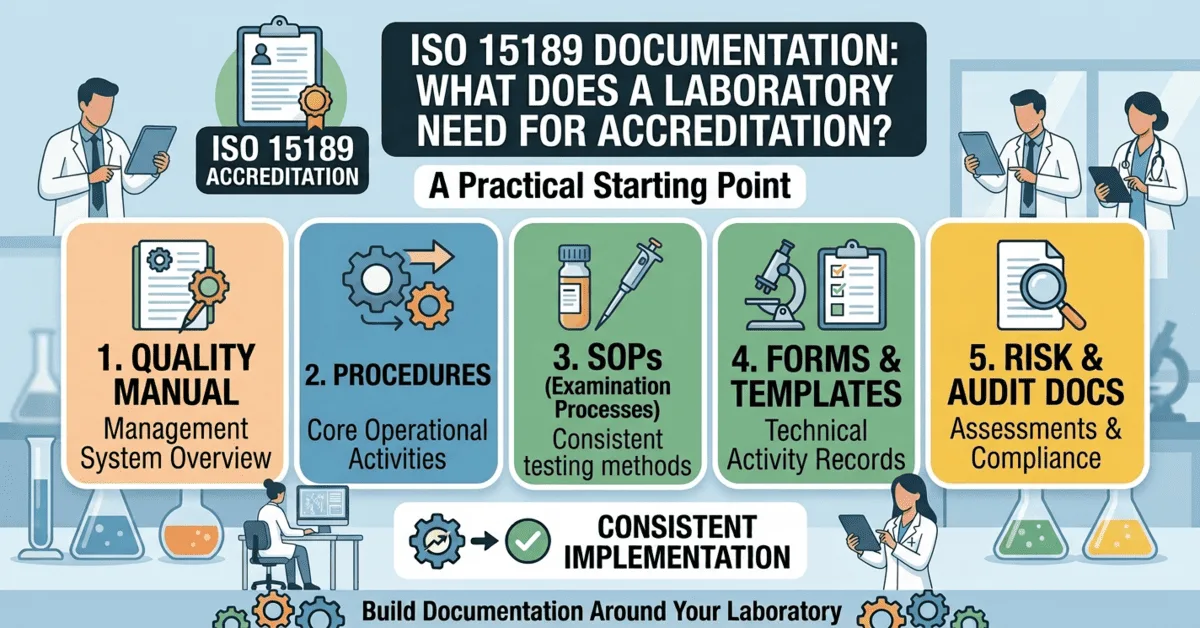
Preparing a medical laboratory for accreditation involves more than creating a few policies and procedures. The laboratory needs documented processes and objective evidence that its quality and technical activities are controlled, consistently implemented, and continually improved. ISO 15189 standard establishes requirements for the quality and competence of medical laboratories and applies to laboratories developing management systems and demonstrating their competence.
What Is ISO 15189 Documentation?
ISO 15189 documentation provides the framework for explaining how laboratory activities are managed and controlled. It should reflect the laboratory's actual processes rather than becoming a collection of generic documents.
A practical ISO 15189 documentation system generally covers management system requirements, personnel, facilities, equipment, examination processes, information management, risks, nonconformities, improvement, and records. Documents should also be controlled so that current versions are available to personnel and obsolete versions are prevented from unintended use.
What ISO 15189 Documents Does a Laboratory Need?
The exact documentation depends on the laboratory's scope, activities, risks, and applicable regulatory requirements. However, laboratories commonly need several interconnected levels of documentation.
1. Quality Manual or Management System Documentation
A laboratory may use a quality manual to provide an organized overview of its management system, responsibilities, policies, and implementation approach. Importantly, ISO 15189:2022 does not prescribe a quality manual specifically; laboratories can organize their management system documentation in a way that effectively addresses the requirements.
2. ISO 15189 Procedures
Procedures explain how important management and operational activities are performed. Depending on the laboratory, these may cover document control, records, risk management, internal audits, corrective actions, management review, personnel competence, equipment, purchasing, complaints, and other processes.
3. SOPs for Laboratory Activities
Technical and examination activities need clear, usable instructions. SOPs can support consistent sample collection, handling, testing, reporting, equipment operation, and other laboratory processes. The documentation should correspond to the laboratory's actual scope and methods.
4. ISO 15189 Forms and Templates
Documents explain what should be done, while completed records provide evidence that activities were actually performed. Useful ISO 15189 forms and templates may include training records, equipment records, quality control records, audit records, complaints, nonconformities, corrective actions, and risk assessments. Record control and retrievability are important parts of a functioning management system.
5. Risk, Audit, and Compliance Documents
Risk assessment, internal audit, management review, corrective action, and compliance records help demonstrate that the laboratory evaluates its system and acts on identified issues. A cross-reference or compliance matrix can also help connect standard requirements with the laboratory's documented processes. Accreditation bodies may request documentation such as a quality manual, cross-reference table, internal audit reports, audit planning, management review records, and technical implementation evidence.
How Can Ready-to-Use Documentation Help?
Creating every document from scratch can be time-consuming for laboratories. A structured set of ISO 15189 documents can provide a practical starting point, including a quality manual, procedures, SOPs, forms and templates, audit checklists, risk assessment tools, and a compliance matrix.
These editable resources can be customized to match the laboratory's scope, processes, responsibilities, and applicable requirements, helping reduce documentation effort and improve preparation for accreditation.
Build Documentation Around Your Laboratory
Effective ISO 15189 accreditation documents should never remain as paperwork prepared only for an assessment. They should support the way laboratory personnel actually work. Before finalizing any document, check whether it reflects your scope, responsibilities, methods, equipment, risks, applicable regulations, and actual records. Understanding the ISO 15189 documentation assessment process can also help laboratories identify gaps before an accreditation assessment.
A well-structured documentation system gives laboratory staff clearer guidance and helps demonstrate consistent implementation during internal reviews and accreditation assessments. For laboratories looking for a practical starting point, ISO 15189 documents can provide editable documentation that can be customized to the laboratory's specific requirements.