If you have spent any time on a foundry floor, you know the reality of the shelling department. It is dusty, repetitive, and critically dependent on the skill and stamina of the operator. For forty years, we have watched talented workers struggle with fatigue, leading to variations in shell thickness that cost us dearly in scrap rates later down the line. This is exactly why the shift toward an industrial robotic shelling system is not just a trend but a necessary evolution for serious manufacturers.
At Laxminarayan Technologies, based in the manufacturing hub of Kolhapur, we do not look at automation as a way to replace people. We see it as a way to protect our workforce and guarantee the quality that our customers demand. When you automate the shelling process, you remove the single biggest variable in investment casting: human inconsistency.
The Real Problem with Manual Shelling
In theory, a skilled operator can produce perfect shells all day. In practice, physics and biology get in the way. By the third hour of a shift, wrist angles change slightly. Dipping speeds vary. Stucco application becomes less uniform. These small deviations accumulate. A shell that is too thin in one spot might crack during dewaxing. A shell that is too thick wastes expensive ceramic material and increases fuel consumption during firing.
We have analyzed thousands of rejected casts over the decades. A significant portion traces back to these minor inconsistencies in the manual shelling phase. An industrial robotic shelling system eliminates this variability. It does not get tired. It does not have an off day. It executes every dip, every turn, and every stucco application with the exact same parameters from the first part to the thousandth.
How the Technology Works in Practice
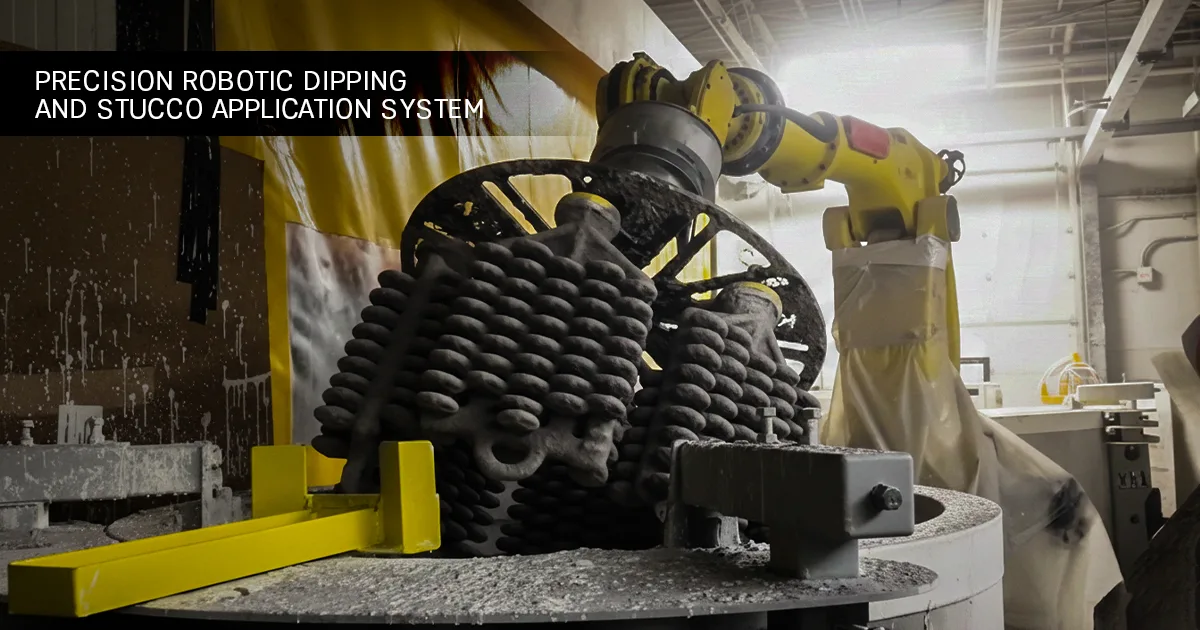
The mechanics of a robotic cell are straightforward, but their application requires deep engineering insight. It starts with a multi-axis robot equipped with a custom end-effector designed to hold delicate wax trees securely without damaging them.
1. The use of Controlled Loading ensures that when the robot lifts the wax assembly it applies just the right amount of force to avoid damaging the assembly.
2. The use of Optimized Dipping allows you to calculate the speed and angle of submersion into the slurry to avoid air pockets (a very common defect associated with manual dipping).
3. The use of Uniform Stuccoing means once the assembly is dipped and still wet, the robot will move the part through the fluidized bed (or rain shower) to ensure that the sand is evenly distributed over the entire part even through complex undercuts.
4. The use of Consistent Drying ensures that once the assembly has been completely coated it is placed on the rack to dry in a manner that allows for proper airflow around the assembly (the rack has been designed to keep parts separated).
5. The use of Repeatable Layering guarantees that this process can be performed automatically and repetitively until the desired shell thickness has been achieved. With a high level of control, you are able to maximize your slurry, and avoid waste by not having any drips, or unevenly coated parts.
In many cases, just the efficiency from this component of the system will account for the majority of the total cost of the system over the course of one year of operation.
Why Foundries Are Making the Switch
We advise our clients to look beyond the initial price tag and focus on operational stability. Here is what changes when you bring a robotic system into your plant:
1. Drastic Reduction in Scrap Rates When every shell is built identically, your furnace yield improves. You stop seeing random cracks or dimensional errors caused by poor coating. This directly improves your bottom line by saving raw metal and energy.
2. Genuine Worker Safety Silica dust and chemical slurries are hazardous. No amount of PPE completely eliminates the risk of long-term exposure. By assigning the dipping and stuccoing tasks to a robot, you move your best people away from the most dangerous part of the process. They can focus on inspection, maintenance, and process control instead.
3. Predictable Throughput Robots do not take breaks, smoke breaks, or shift changes. They run continuously. This allows you to plan your production schedules with confidence, knowing exactly how many shells will be ready for dewaxing each day.
4. Material Savings Precise control over the dipping process means you use only the slurry you need. We have seen foundries reduce their ceramic material consumption by double-digit percentages simply by switching to automated application.
Real Applications: From Turbine Blades to Engine Blocks
Consider the aerospace sector. A turbine blade requires absolute perfection. A variance of a fraction of a millimeter can compromise the entire component. Manual labor simply cannot guarantee this level of repeatability over a long production run. Robotic systems make these high-tolerance parts viable for mass production.
Likewise, automobile parts manufacturers that manufacture components that are part of their engines rely on these systems for producing thousands of pieces of the same kind without deviation. The design of our machinery at Laxminarayan Technologies provides us with the flexibility to meet this challenge no matter if you manufacture large quantities of standard product or small quantities of special alloys.
Addressing the Challenges Honestly
The implementation of automation in your production process includes many challenges. First, there is a significant initial investment for the equipment you will need. Second, you will require a team that is capable of both programming and maintaining your equipment. In many traditional foundries, this specialized programming skill set does not exist.
However, the world has changed. Modern manufacturing systems are much simpler than the more complex systems that have existed over the years. At Laxminarayan Technologies, we provide modular solutions that allow you to get started with a core manufacturing cell now and expand your core cell into a larger cell as your requirements dictate in terms of quantity. In addition, we emphasize that you train your personnel (operators and maintenance) how to use and maintain new automated technology with your team having the confidence to perform new automation technology-related tasks. According to our data, the return on your investment for automation equipment typically occurs within 18 to 24 months based on the fact that your scrap rates will decrease and that you have reduced labor costs.
Moving Forward with Confidence
The industrial robotic shelling system is no longer a luxury for the largest conglomerates. It is a practical tool for any foundry that wants to compete on quality and efficiency. By combining the ancient craft of investment casting with modern robotics, you achieve a balance that was previously impossible.
At Laxminarayan Technologies, we bring four decades of manufacturing experience to every machine we build. We understand the nuances of slurry viscosity, drying times, and production bottlenecks because we have lived them. We are not just selling equipment. We are partnering with you to modernize your operations and secure your future.
If you are ready to eliminate inconsistency and improve your foundry's performance, explore our range of solutions at Laxminarayan Technologies. Let us help you build a better foundation for your business.
FAQ:
Q: How do robotic shelling systems work with complex geometries?
Answer: You bet. Multi-axis robots have the ability to easily access complex angles and deep undercuts far more effectively than manual dipping to impart uniform coverage on even the most complex parts.
Q: Will automation cause people to lose their jobs?
Answer: No. Humans still need to load/unload, inspect quality, maintain and program the system. The robot takes on the most dangerous, repetitive, and physically demanding tasks, freeing your team to focus on higher-value activities.
Q: How has robotic shelling impacted the environmental footprint?
Answer: It generally minimizes waste through precise application of the slurry and enhances dust control versus open manual stations, resulting in a cleaner and more sustainable foundry environment.