In large-scale logistics operations, speed has traditionally been the benchmark of success. Faster truck movement, quicker loading cycles, and tighter dispatch windows have long defined operational efficiency. But today, speed without certainty is proving to be one of the most expensive risks in logistics.
As shipment volumes grow and customer expectations tighten, logistics leaders are facing a critical question: Can you prove that the right goods were loaded onto the right truck, at the right time every single time?
Speed without certainty is no longer enough. What logistics leaders now require is proof — proof that the right load moved on the right truck, at the right time.
This is where Logistics Automation fundamentally changes the game. By automating visibility from gate entry to dock operations and final exit, logistics moves beyond scanner-based checks toward continuous, system-driven verification. Every stage, from entry access, yard movement, and dock activity to dispatch is digitally tracked, validated, and recorded.
According to McKinsey, only 2–6% of organizations have true end-to-end supply chain visibility, leaving most logistics operations exposed to blind spots that lead to disputes, delays, and avoidable losses.
Source: mckinsey
Modern logistics demands a system that not only moves shipments faster, but verifies every step from entry to exit automatically, continuously, and without manual dependency.
Why Proof-Based Dispatch Is the New Standard
Most shipment disputes don’t arise because goods weren’t shipped, they arise because there is no verifiable proof of what actually happened during loading and dispatch.
Manual registers, paper gate passes, and post-event CCTV reviews are reactive tools. They explain problems only after damage has been done. In contrast, proof-based logistics ensures that discrepancies are identified and resolved before a truck ever leaves the facility.
The World Economic Forum, citing McKinsey research, warns that supply chain disruptions and poor operational visibility can erode up to 45% of a company’s annual profits over a decade if left unaddressed.
Source: weforum
The answer is not more manpower or more paperwork. The answer is automation that records operational truth in real time.
Logistics Automation from Automated Entry to Verified Exit
True Logistics Automation does not start at the dock. It starts at the gate.
Before a truck even arrives, transporters upload vehicle and driver documentation digitally. This pre-validation ensures that only authorized vehicles and drivers are allowed entry, reducing delays, manual checks, and security risks.
Once the truck reaches the facility, automated entry access takes over. Using ANPR-based systems, the vehicle number is recognized instantly. The system verifies the truck, driver identity, time of arrival, and assigned gate all without human intervention. Entry is logged automatically, creating the first digital checkpoint in the shipment’s journey.
This seamless entry process eliminates congestion at gates while ensuring that every truck entering the yard is digitally authenticated and time stamped.
Real-Time Truck Tracking and Intelligent Yard Movement
After entry, the system continuously tracks the truck’s movement across the yard. Instead of relying on radio calls or manual coordination, operations teams gain real-time visibility into where each truck is, how long it stays in specific zones, and where congestion is building.
This data-driven visibility allows the system to dynamically assign docks based on real-time conditions rather than static schedules. Trucks are guided to the right dock at the right time, reducing idle time and improving yard throughput.
A digital parking or movement ticket is generated automatically, linking yard movement with the shipment record. Every delay, dwell time, or deviation is captured as data not guesswork.
Accenture highlights that organizations with end-to-end visibility can improve delivery performance by 20–30%, largely due to better coordination and reduced operational friction.
Source: accenture
Industrial Computer Vision at the Dock: Shipping Right, Not Just Shipping
How Industrial Computer Vision Eliminates Loading Errors
The dock is where most costly mistakes occur: wrong SKUs, incorrect quantities, or loading the right goods onto the wrong truck. This is where industrial computer vision becomes critical.
During loading and unloading, AI-powered vision systems monitor every action in real time. SKUs are matched visually, quantities are verified automatically, and the system ensures that the right goods are loaded onto the right truck, at the right dock, at the right time.
This continuous visual validation replaces manual counting and checklist-based verification, which are both slow and error-prone. Instead of discovering mismatches days later at the customer site, discrepancies are flagged instantly while the truck is still at the dock.
IBM emphasizes that digitally enabled supply chains dramatically improve traceability, reduce human error, and strengthen compliance across logistics operations.
Source: ibm
This is the moment where logistics shifts from dispatching fast to shipping right.
Weighbridge Intelligence: Validating What Enters and What Leaves
Weight verification adds another layer of operational proof. At both pre-loading and post-loading stages, the truck passes through a digitally integrated weighbridge.
The system records weight and time automatically, linking this data directly to the shipment record. Any anomalies between expected and actual weight are immediately visible, helping prevent overloading, underloading, and compliance violations.
By capturing both entry and exit weights, the system creates a closed verification loop reinforcing trust in the accuracy of the shipment without slowing operations.
Digital Shipping Certificate: Proof That Travels with the Shipment
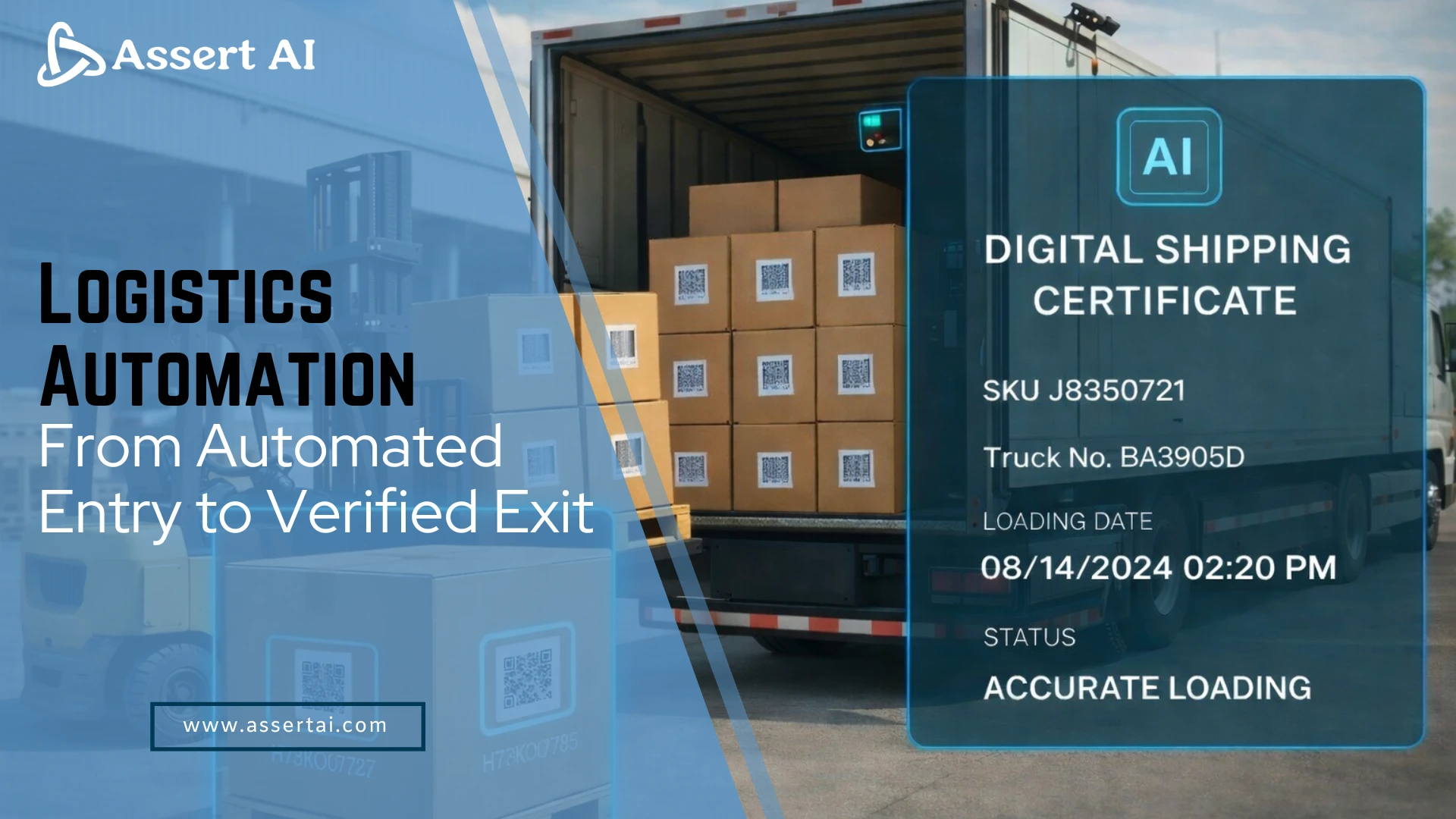
Once loading is completed and all validations are successfully cleared vehicle verification, SKU match, quantity confirmation, and weight validation the system automatically generates a digital shipping certificate.
This certificate is not a static document. It is a comprehensive digital record that includes:
- Verified loading confirmation
- Visual proof of correct SKU and quantity
- Entry and exit timestamps
- Weight validation data
- Dispatch authorization
Simultaneously, a digital exit pass is generated, allowing the truck to leave the facility without manual gate intervention.
The shipping certificate becomes a single source of truth that travels with the shipment, eliminating disputes and reducing dependency on post-dispatch investigations.
Deloitte notes that digitally mature supply chains outperform peers by responding faster to disruptions and delivering higher customer satisfaction.
Source: deloitte
From Speed to Certainty: The Future of Logistics Automation
Modern logistics is no longer about moving trucks faster; it's about moving shipments with certainty.
By unifying automated entry access, real-time yard tracking, industrial computer vision at the dock, weighbridge intelligence, and digital shipping certification, Logistics Automation transforms fragmented operations into a single, intelligent, proof-driven system.
The result is fewer disputes, lower operational risk, stronger compliance, and greater trust both internally and with customers. Because in today’s supply chains, the real competitive advantage is not just delivery. It is delivered with proof.