
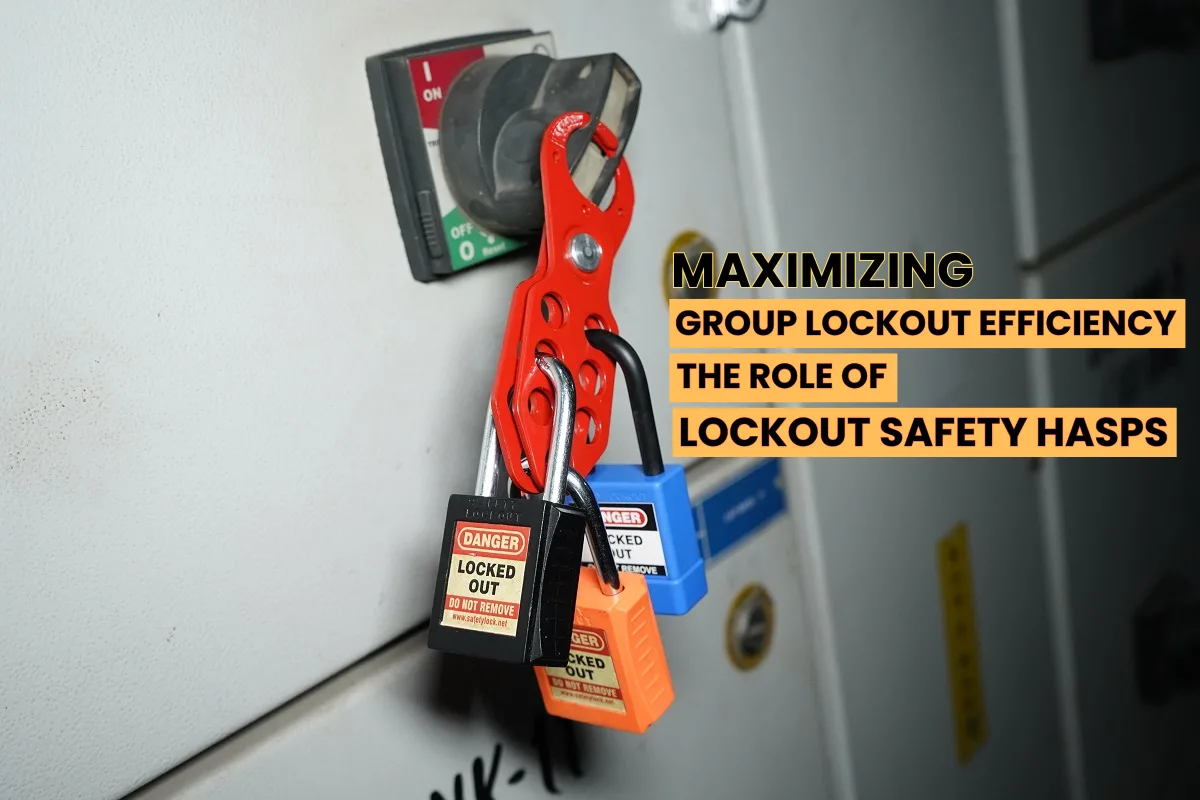
The central question of group safety is this: How do you ensure that the machine cannot be re-energized until the very last person has finished their task and cleared the area? The answer lies in a simple yet ingenious piece of tool: The Lockout Safety Hasp.
The Mechanical Logic of Group Safety:
At its core, a lockout hasp is a "force multiplier" for safety. It serves as the physical bridge between a single energy isolation point and a multi-member team. Without a hasp, a valve or circuit breaker might only have enough room for one padlock. With a hasp, that single point is instantly expanded to accommodate up to six (or more) individual locks.
The logic is foolproof: the hasp cannot be opened, and the energy source cannot be engaged, as long as a single padlock remains in place. This creates a physical "OR" gate for safety - the equipment stays dead until User A and User B and User C have all removed their personal anchors. This preserves the golden rule of Lockout Tagout: One Person, One Lock, One Key.
Material Matters: Choosing the Right Hasp
Manufacturing floors are diverse ecosystems. A tool that works in a clean-room assembly area might fail in a caustic chemical plant. Choosing the right hasp depends entirely on the "where" and the "what" of the task:
- Standard Steel Hasps: Constructed from heavy-duty, zinc-plated steel, these steel lockout hasps are the workhorses of the industry. They offer maximum tamper resistance and are ideal for heavy-duty mechanical isolation.
- Aluminum Hasps: These are lightweight and naturally spark-resistant, making them the preferred choice for refineries or environments with combustible dust.
- Dielectric (Non-Conductive) Hasps: For electrical panels, these are non-negotiable. Typically made from reinforced nylon, they prevent the hasp itself from becoming a conductor in the event of an arc flash or electrical fault.
Efficiency Meets Compliance:
Beyond just being a "good idea," using hasps is a direct path to meeting OSHA 1910.147 requirements for group lockout. OSHA mandates that group lockout must provide a level of protection equivalent to that of a personal lockout. The hasp achieves this without the need for complex paperwork or expensive group lock boxes for smaller teams.
Efficiency also comes from organization. A cluttered isolation point, where locks are "daisy-chained" directly to each other is a recipe for confusion. Hasps provide a clean, centralized location for all locks, making it easy for safety supervisors to perform a "roll call" of who is currently on the line just by glancing at the hasp.
Pro Tip: Always ensure your hasp is fully closed before snapping your padlock into place. A partially engaged hasp is a failure waiting to happen. If the holes do not align perfectly, the device is compromised. Never force a lock into a misaligned hasp; if it doesn't click shut smoothly, replace the hasp immediately.
Best Practices for the Field:
To maximize the efficiency of your hasps, consider these "pro" strategies:
- The "Hasp-on-Hasp" Technique: If more than six people are working, you should use a hasp with more holes (24 holes) or if more than 24 persons then place a second hasp into the final hole of the first one. This allows the team to expand indefinitely while maintaining total security.
- Color Coding: Use red hasps for internal maintenance, yellow for electrical, and blue for contractors. This visual shorthand allows anyone on the floor to identify exactly which departments are currently "in the machine."
- Vinyl Coating: Opt for hasps with vinyl-coated handles. Not only does this improve grip in oily conditions, but it also allows for better visibility in low-light areas of the plant.
Conclusion
The lockout safety hasp is the backbone of a collaborative safety culture. It transforms a solitary safety procedure into a team effort, ensuring that no worker is left at the mercy of another’s timeline. By investing in high-quality hasps and enforcing their use, you aren't just checking a compliance box - you are building a system where the machine only moves when everyone agrees it’s safe.