Unlocking the Invisible: A Glimpse Into AI-Driven Nanomedicine
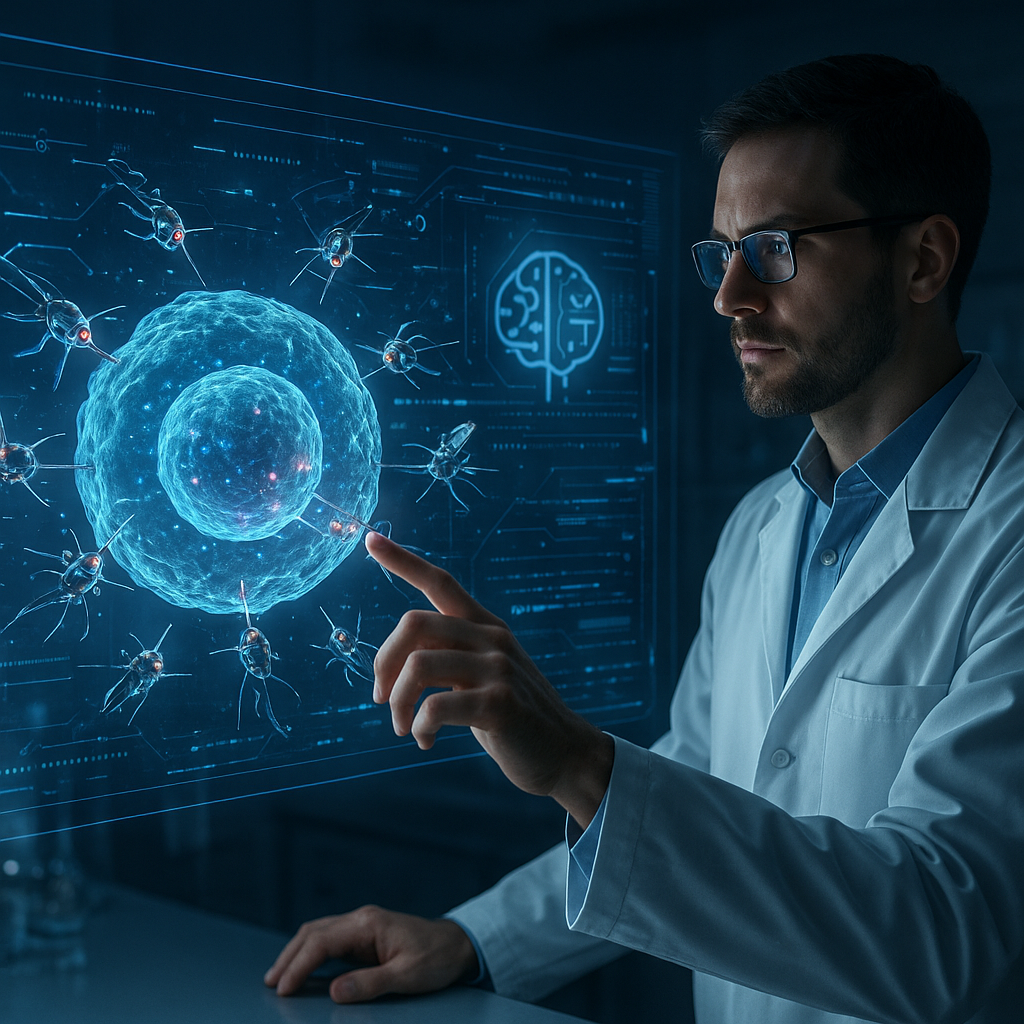
In a bustling laboratory at the Massachusetts Institute of Technology, a robot delicately assembles nanoparticles no wider than a strand of DNA. But it’s not just automation at play; sophisticated machine learning models guide the robot’s every move. This scene, emblematic of the cutting-edge fusion of artificial intelligence and nanomedicine, represents a profound shift in how medicine is designed and delivered. As of 2026, AI algorithms routinely decode complex biological data to engineer nanoparticles that can target diseases with unprecedented precision, promising to redefine healthcare's future.
Nanomedicine, the science of manipulating materials at the atomic and molecular scale to diagnose and treat disease, has long been hailed for its potential to revolutionize medicine. Yet, the challenge has always been the complexity inherent in designing nanostructures that can safely and effectively interact with human biology. Enter artificial intelligence (AI) and machine learning (ML): tools capable of parsing immense datasets, identifying patterns invisible to human researchers, and accelerating discovery processes. This synergy is unlocking new frontiers in targeted drug delivery, diagnostics, and personalized therapies.
“AI’s integration into nanomedicine is not just speeding up research; it’s fundamentally reshaping our approach to treating diseases at the molecular level,” says Dr. Helena Strauss, a leading nanotechnologist at Stanford University.
Tracing the Evolution: How AI and Nanomedicine Converged
The origins of nanomedicine date back to the 1980s when the promise of manipulating matter at the nanoscale began to capture scientific imagination. Early applications, such as liposomal drug delivery systems, emerged in the 1990s and early 2000s, but progress was hampered by the trial-and-error nature of nanoparticle design. Simultaneously, AI was evolving from rule-based expert systems to data-driven machine learning models, culminating in deep learning breakthroughs in the 2010s.
The convergence of these two disciplines became inevitable as the volume and complexity of biomedical data exploded. By the late 2010s, AI began to be applied to molecular simulations, protein folding, and genomic analysis, setting the stage for its application in nanomedicine. The innovation accelerated through the 2020s, buoyed by advances in computational power and the availability of large-scale biological datasets.
One pivotal moment was the 2023 publication of a study where deep reinforcement learning algorithms designed nanocarriers optimized for crossing the blood-brain barrier, a longstanding challenge in treating neurological diseases. This breakthrough demonstrated how AI could navigate the multifactorial constraints of nanomedicine design far more efficiently than traditional approaches.
By 2026, the integration of AI into nanomedicine is no longer experimental but foundational, influencing everything from initial nanoparticle synthesis to clinical trial design.
Data-Driven Nanomedicine: Core Technologies and Impact
The heart of AI’s impact in nanomedicine lies in its ability to learn from complex, multidimensional data and predict outcomes with high accuracy. Several AI methodologies have become indispensable:
- Deep Learning: Neural networks analyze imaging data and molecular structures to identify optimal nanoparticle shapes and compositions.
- Reinforcement Learning: Algorithms iteratively improve nanoparticle design strategies by simulating interactions within biological environments.
- Generative Models: Techniques like GANs (Generative Adversarial Networks) create novel nanostructures tailored for specific therapeutic targets.
- Natural Language Processing (NLP): Mining scientific literature to identify emerging trends and potential molecular candidates.
These technologies underpin a range of applications that have shown measurable benefits:
- Targeted Drug Delivery: AI-designed nanoparticles exhibit up to 40% higher targeting efficiency, reducing off-target toxicity.
- Personalized Nanovaccines: Machine learning models predict patient-specific immune responses, optimizing vaccine formulations.
- Real-Time Diagnostics: AI-powered nanosensors detect biomarkers with enhanced sensitivity, enabling earlier disease detection.
According to recent data from the National Institutes of Health, the number of nanoformulations entering clinical trials increased by 35% between 2023 and 2026, a surge attributed largely to AI-enhanced design pipelines. Companies like NanoGenix and MedAI Solutions are at the forefront, leveraging proprietary machine learning platforms to expedite development cycles.
“AI is the microscope and compass guiding nanomedicine through the labyrinth of biological complexity,” remarks Dr. Samuel Ortega, Chief Scientific Officer at MedAI Solutions.
2026 Breakthroughs: AI-Powered Nanomedicine in Practice
The current year marks a turning point where AI-powered nanomedicine technologies are transitioning from laboratory proof-of-concept to clinical and commercial reality. Several notable advances have defined 2026:
- Smart Nanoparticles for Cancer Immunotherapy: AI algorithms have optimized lipid nanoparticle formulations to deliver mRNA vaccines directly to tumor microenvironments, enhancing T-cell activation while minimizing systemic side effects.
- AI-Guided Nanorobots: Autonomous nanorobots, controlled by reinforcement learning models, perform precision tasks such as targeted drug release and localized tissue repair, with early trials showing promising safety profiles.
- Nanodiagnostics at the Point of Care: Integration of AI with nanobiosensors allows rapid detection of infectious diseases and chronic conditions from a single drop of blood or saliva, facilitating immediate clinical decisions.
Moreover, the regulatory landscape has adapted with the FDA issuing new guidelines in early 2026 to evaluate AI-designed nanotherapeutics, balancing innovation with safety. This regulatory clarity has spurred investment, with venture capital funding in AI-nanomedicine startups surpassing $1.2 billion in the first half of 2026 alone.
Academic-industry collaborations have also flourished. For instance, the partnership between Harvard Medical School and AI startup NanoLogic led to the development of a nanoparticle delivery system that improves chemotherapy efficacy by 25% in lung cancer patients, according to clinical trial results published in April 2026.
These developments underscore how AI is not just an ancillary tool, but a central driver of nanomedicine’s rapid maturation.
Industry Insights and Expert Perspectives
Leading experts emphasize that the fusion of AI and nanomedicine is reshaping industry paradigms. Dr. Li Mei, Director of Nanomedicine Research at Roche, notes, “The traditional siloed approach—where material scientists, biologists, and clinicians worked separately—is giving way to integrated AI platforms that synthesize multidisciplinary data into actionable insights.”
Industry analysts highlight the increasing importance of explainable AI (XAI) in nanomedicine, ensuring that model predictions are transparent and interpretable by researchers and regulators alike. This trend addresses concerns about the 'black box' nature of some AI models, fostering trust and accelerating adoption.
Financially, the global market for AI-driven nanomedicine is projected to reach $15 billion by 2028, up from $4.7 billion in 2023, according to industry estimates. This robust growth is fueled by a combination of technological breakthroughs and increasing demand for precision medicine solutions.
At the same time, ethical considerations loom large. Experts advocate for responsible innovation frameworks to manage risks related to patient privacy, algorithmic bias, and potential environmental impacts of nanomaterials. Institutions like the World Health Organization have initiated task forces to develop guidelines addressing these concerns on a global scale.
“Balancing innovation with ethics is paramount. AI and nanomedicine together hold immense promise, but must proceed with caution and transparency,” advises Dr. Anika Patel, bioethics scholar at Cambridge University.
Future Horizon: What to Watch in AI-Driven Nanomedicine
Looking ahead, several trends and challenges will shape the trajectory of AI in nanomedicine:
- Multimodal Data Integration: Combining genomic, proteomic, imaging, and clinical data through AI will enhance the personalization of nanoparticle therapies.
- Autonomous Research Systems: Fully AI-driven laboratories capable of designing, synthesizing, and testing nanoparticles with minimal human intervention are on the horizon.
- Expanded Disease Targets: Beyond oncology and infectious diseases, AI-nanomedicine approaches are beginning to address neurodegenerative disorders, cardiovascular diseases, and rare genetic conditions.
- Regulatory Evolution: Adaptive regulations incorporating real-world evidence and continuous AI model validation will become standard.
- Public Engagement and Education: Increasing awareness and understanding of AI’s role in nanomedicine will be essential to foster acceptance and inform policy.
These developments promise to deepen the synergy between AI and nanomedicine, driving innovations that were unimaginable just a decade ago. For professionals and stakeholders, staying abreast of these advances is critical. Those interested can explore more about how AI is fundamentally transforming nanomedicine in Transforming Medicine: How AI and Machine Learning Propel Nanomedicine Forward and Why AI Is Unlocking Nanomedicine’s Potential to Revolutionize Healthcare.
In sum, the marriage of AI and nanomedicine is catalyzing a new era where therapies are not only smaller and smarter, but also more adaptive and patient-tailored. This revolution represents a shift from reactive treatment to proactive, precision medicine—ushering in hope for millions worldwide.