Every building has two critical systems that most property owners rarely think about until something goes wrong. The first is the roof — specifically, in the case of flat and low-slope structures, the waterproof membrane that stands between the interior of the building and every drop of rain, snow, and condensation that falls on it year after year. The second is the wall system — the plaster and insulation layer that regulates temperature, manages moisture vapor, and determines how much energy a building consumes maintaining comfortable conditions inside.
Both systems are invisible in normal operation. Both are expensive to repair when they fail. And both are areas where the quality of the materials used determines whether a building owner faces a problem in five years or in fifty.
Kemset Building Materials has built its product line around exactly these two categories of building performance — delivering waterproof flat roof coating solutions that protect commercial and residential structures from above, and insulating plaster wall systems that protect and condition those structures from within. As a Houston-based manufacturer and distributor serving the entire United States, Kemset brings a level of product sophistication and technical depth to both categories that the American building market has been demanding and too rarely finding.
The Flat Roof Problem: Why Standard Coatings Fall Short
Flat roofs are ubiquitous in American commercial construction — warehouses, retail centers, office buildings, multi-family residential complexes, and urban mixed-use developments all depend on flat or low-slope roof systems to keep the rain out. They are also, statistically, among the most maintenance-intensive building components that property owners manage.
The reason is simple physics. Flat roofs do not shed water. They collect it. Ponding water — water that sits on a roof surface for extended periods after rainfall — is the primary enemy of flat roof membrane integrity. It finds every weakness in the membrane, every unsealed seam, every area of micro-cracking caused by thermal cycling, and works its way through. By the time a flat roof leak becomes visible inside the building — as a stain on a ceiling tile, a drip from a light fixture, or visible water on the floor — the membrane has typically been compromised for some time, and the underlying structural deck and insulation have likely absorbed more moisture than the surface appearance suggests.
The conventional response to flat roof membrane failure has historically been tear-off and replacement — a disruptive, expensive process that involves removing the failed membrane, disposing of it, and installing a new system. For many building owners, this cycle repeats every ten to fifteen years, creating an ongoing capital expenditure burden that proper material selection could significantly reduce or eliminate.
Kemset Building Materials offers a better answer through their premium waterproof flat roof coating systems — elastic, high-performance coatings engineered to protect flat roof surfaces against ponding water, UV degradation, thermal cycling, and the full range of environmental stressors that characterize American roofing conditions.
Elasticote 450: Flat Roof Coating Built for Real Conditions
The centerpiece of Kemset's roof coating for flat roofs offering is the Elasticote 450 — a vinyl-modified, anionic, acrylic-based elastic waterproofing topcoat that represents the state of the art in flat roof protection technology.
What makes Elasticote 450 exceptional among flat roof coatings is the combination of physical properties its formulation delivers. Its elasticity rating of 300 to 400 percent means that it can stretch to three to four times its original dimension before failing — an extraordinary flexibility characteristic that allows the coating to accommodate the thermal expansion and contraction that all roofing surfaces experience as temperatures cycle through the day and across the seasons. A rigid coating applied to a flat roof will crack as the substrate moves. Elasticote 450 moves with it, maintaining its waterproof integrity through every cycle.
The product's fiber reinforcement adds dimensional stability and tensile strength to that elasticity — preventing the coating from tearing under the mechanical stresses of foot traffic during maintenance operations, equipment vibration from rooftop HVAC systems, and the tensile loads generated by substrate movement. The result is a coating that is simultaneously flexible enough to accommodate movement and tough enough to withstand the physical demands of an active roof environment.
For property owners and building managers concerned about energy costs — and in the current energy pricing environment, that encompasses virtually everyone — Elasticote 450's cool roof properties represent a significant additional value proposition. The coating achieves a Total Solar Reflectance (TSR) value of 45 to 55 percent, reflecting a substantial portion of incoming solar energy rather than absorbing it as heat. In climates where summer cooling loads represent a major portion of annual energy expenditure — which describes most of the continental United States, including the Sun Belt markets where flat commercial roofing is most prevalent — this reflective performance translates directly into measurable reductions in air conditioning demand and operating cost.
The product's application versatility extends its value across multiple roof types and conditions. Elasticote 450 adheres effectively to concrete, wood, brick, and metal surfaces — the full range of substrates encountered in American flat roof construction. It is rated for use as positive-side waterproofing on inclined roofs, decks, floors, and gutters, as well as in waterproofing underlayment applications where it serves as a sandwiched membrane beneath tiles and stones. Its humidity and salt spray resistance make it particularly well-suited for coastal environments where standard coatings are challenged by the aggressive chemistry of salt-laden air.
Application and storage are straightforward for professional contractors. Elasticote 450 is applied within an ambient temperature range of 41°F to 95°F — covering the working conditions encountered across the full geographic range of American construction activity through most of the year. Unopened packaging has a shelf life of twelve months, allowing contractors to maintain inventory without waste. The product is nonflammable, contributing to job site safety during application.
Beyond Waterproofing: Elasticote 450 as a Long-Term Roof Life Extension Strategy
One of the most compelling applications of Kemset's flat roof coating technology is its use as a proactive life extension strategy for aging but structurally sound roof systems. Rather than waiting for a flat roof membrane to fail and then undertaking the expense and disruption of full replacement, building owners who apply Elasticote 450 to a roof showing early signs of wear — minor surface crazing, small cracks, areas of UV degradation — can dramatically extend the functional life of the existing system.
The economics of this approach are straightforward. A properly applied elastic coating that seals and protects an aging membrane can add years of service life at a fraction of the cost of full replacement. The disruption to building operations is minimized — coating application is far less invasive than membrane tear-off and replacement. And the cool roof benefits of the coating deliver ongoing operational savings that partially offset the application cost over time.
For building owners managing portfolios of flat-roofed commercial properties, this proactive maintenance approach — supported by Kemset's technically superior Elasticote coating system — represents a meaningful opportunity to reduce capital expenditure while improving building performance.
Insulating Plaster Walls in the USA: Where Energy Efficiency Begins at the Surface
The second major pillar of Kemset's American building solutions addresses a challenge that has become increasingly central to both the economics and the regulatory environment of construction: thermal performance of the building envelope.
Buildings account for a substantial portion of total energy consumption in the United States. Most of that consumption goes to heating and cooling — maintaining interior temperatures against the relentless push of the exterior climate. The efficiency with which a building performs that function depends primarily on the thermal resistance of its envelope: the walls, roof, and floor assemblies that separate conditioned interior space from unconditioned exterior environment.
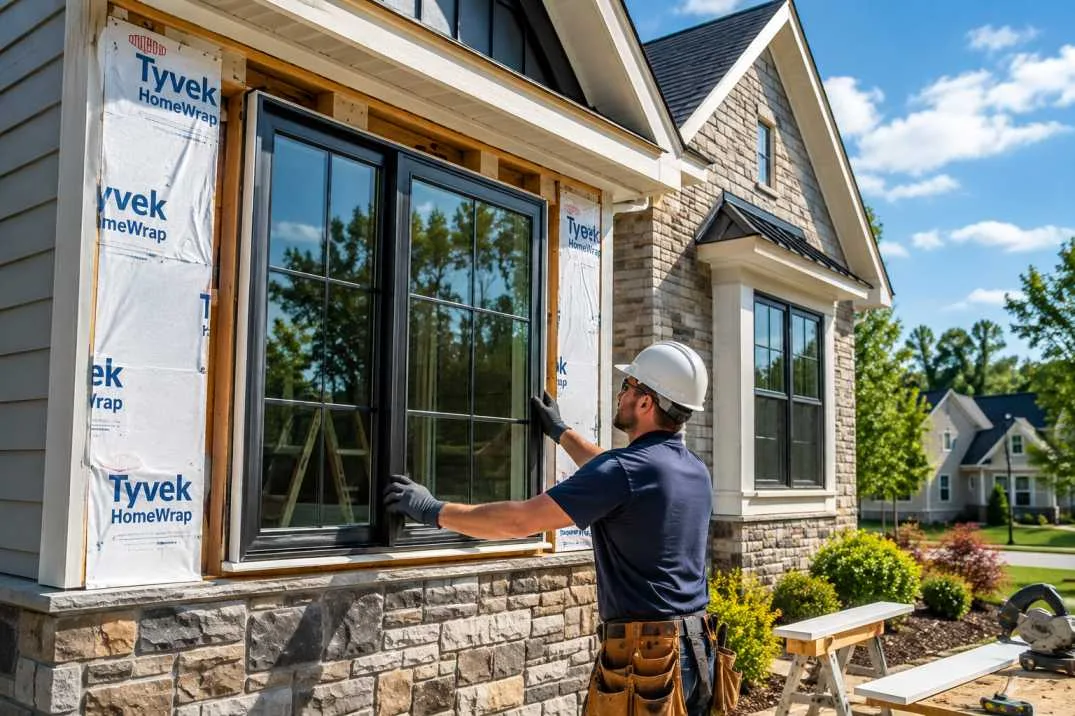
Traditional plaster systems — while durable and aesthetically versatile — provide relatively limited insulating value. They add structural protection and weather resistance to exterior walls, but they do little to impede the flow of heat between interior and exterior. In an era of rising energy costs and tightening building energy codes, this limitation has created growing demand for plaster systems that provide genuine thermal insulation as part of their function — not as a separate insulation layer requiring additional materials and labor but integrated into the plaster itself.
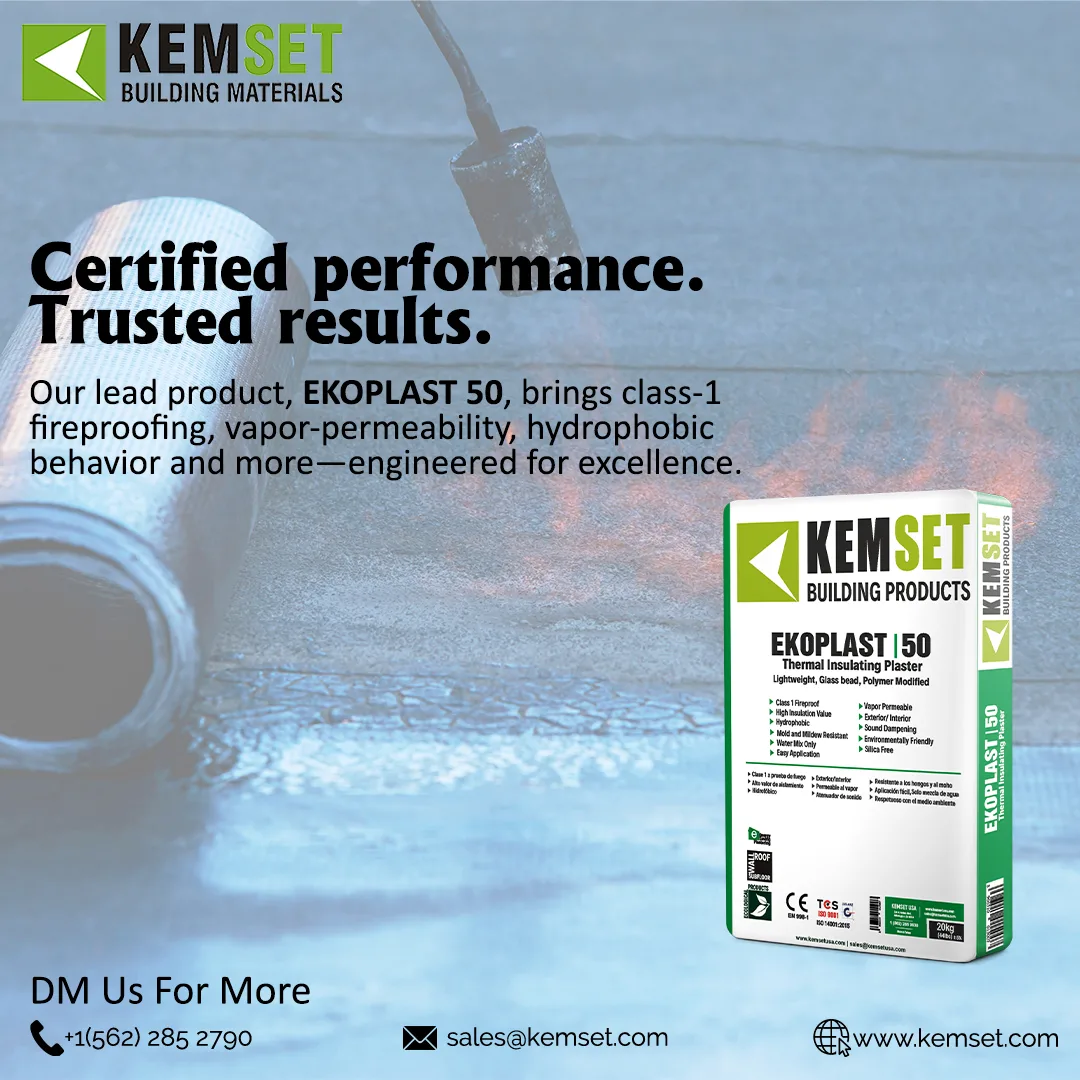
This is exactly what Kemset's Ekoplast 50 delivers: a lightweight, microglass and polymer-modified thermal insulation plaster that provides genuine thermal resistance as part of its plaster function, enabling insulating plaster walls that perform at a level conventional plaster systems simply cannot match.
Ekoplast 50: The Technical Case for Insulating Plaster
The performance credentials of Ekoplast 50 are grounded in a technical specification that explains exactly why it delivers the insulating performance it does.
At the heart of the product's thermal performance is its thermal conductivity value of less than 0.1 W/mK, with a design target of 0.065 W/mK. To put this in context: standard cement-based render has a thermal conductivity of approximately 0.8 to 1.0 W/mK. Ekoplast 50's thermal conductivity is approximately ten to fifteen times lower — meaning that for the same wall thickness, it provides dramatically greater resistance to heat flow. Or, conversely, that a relatively thin application of Ekoplast 50 can provide the thermal resistance that would require a much thicker layer of conventional plaster.
This exceptional thermal performance is achieved through the product's microglass aggregate — microscopic hollow glass spheres that create a cellular structure within the cured plaster matrix, trapping air in a form that conducts heat very poorly. Combined with the polymer modification that binds this lightweight aggregate into a cohesive, durable plaster body, the result is a material that simultaneously functions as a structural plaster coat and a meaningful thermal insulator.
The dry density of 450 kg/m³ — roughly half that of conventional cement render — is both a consequence of this cellular structure and an additional performance advantage. Lighter plaster means lower imposed loads on the structure, reduced transportation costs, and easier handling during application. For renovation projects where load constraints are a concern, or for multi-story construction where cumulative facade weight must be managed, the lightweight characteristic of Ekoplast 50 is a meaningful practical advantage.
Ekoplast 50 achieves a Class 1A fire resistance rating — the highest classification, confirming that it is genuinely fireproof and contributes to rather than undermines the fire safety performance of the wall assembly it forms part of. Its water vapor permeability value of 3.49μ means that it allows moisture vapor to pass through the plaster layer, preventing the interstitial condensation within wall assemblies that can cause moisture damage, mold growth, and insulation degradation in less breathable systems.
Bond strength exceeding 0.3 N/mm² and compressive strength in Class CSII (greater than 1.4 N/mm²) confirm that Ekoplast 50 is not a thermally enhanced material that has compromised its mechanical performance to achieve its insulating properties. It is a full-performance plaster that also insulates — a genuine advancement on what conventional plaster systems can deliver.
The product is certified to ISO 9001:2015 for quality management and ISO 14001:2015 for environmental management, as well as CE-marked under EN 998-1 — the European standard for rendering and plastering mortars. These certifications provide independent verification of both product performance and manufacturing consistency.
The Kemset Integrated Approach: Protecting Buildings Above and Within
What distinguishes Kemset's position in the American building materials market is not simply the individual performance of its products — it is the way those products work together to address the full performance requirements of modern building envelopes.
Ekoplast 50 insulating plaster protects and conditions the walls from within — adding thermal resistance, managing moisture vapor, and providing a durable plaster surface that is compatible with Kemset's primer and finish coat systems. Elasticote 450 protects the roof from above — creating a waterproof, elastomeric, reflective barrier that keeps water out and heat reflected. Watertite Poly addresses the horizontal surfaces and below-grade challenges that bridges the two. And Kemcoat provides the finished exterior face that ties the system together aesthetically and adds the final layer of weather protection.
Together, these products constitute an integrated building protection system that addresses the challenges of moisture intrusion, thermal inefficiency, and surface durability from every angle. They are formulated to work with each other, specified by a single supplier whose technical team understands how they interact, and supported by product documentation and application guidance that enables professional results on every project.
For contractors, building owners, and design professionals seeking building materials that genuinely deliver on their performance claims — that protect effectively, last durably, and support the energy efficiency and sustainability goals that modern building requires — Kemset Building Materials is the partner of choice.
Contact Kemset at +1 (562) 285-2790, email [email protected], or visit kemset.com to explore the complete product range. Kemset serves customers across the United States from their Houston, Texas location at 8411 Villa Dr., Houston, TX 77061.