
Introduction
In India's rapidly growing manufacturing sector, industries are constantly looking for ways to increase productivity while reducing machining costs. From automotive and aerospace to die & mould, oil & gas, and precision engineering, cutting tools play a vital role in achieving consistent machining quality. However, as cutting speeds increase and manufacturers shift toward dry machining, conventional cutting tools often struggle to withstand high temperatures and abrasive wear.
This is where Physical Vapor Deposition (PVD) coating makes a significant difference. By applying an ultra-thin yet extremely hard ceramic coating to the surface of cutting tools, PVD technology enhances wear resistance, reduces friction, and extends tool life without affecting the tool's dimensions. Whether you're using drills, end mills, or taps, selecting the right PVD coating can significantly improve machining efficiency and reduce production costs.
What is PVD Coating?
Physical Vapor Deposition (PVD) coating is an advanced surface engineering process in which coating materials such as titanium, aluminum, chromium, or carbon are vaporized inside a high-vacuum chamber and deposited atom by atom onto the surface of cutting tools. The result is a thin but exceptionally hard coating that protects the tool from wear, heat, oxidation, and corrosion while maintaining its original geometry.
Unlike traditional surface treatments, PVD coating forms a dense and uniform protective layer that enables tools to operate at higher cutting speeds, produce better surface finishes, and maintain sharp cutting edges for much longer. This technology has become a preferred solution for manufacturers seeking higher productivity and lower tooling costs.
Some of the major advantages of PVD coating include:
- Longer tool life
- Superior wear resistance
- Higher heat resistance
- Reduced friction during machining
- Better corrosion protection
- Improved machining performance
- Lower overall production costs
Why Choosing the Right PVD Coating Matters
Not every cutting tool operates under the same conditions. A drill experiences continuous axial cutting forces, an end mill is subjected to heavy radial loads during milling, and a tap faces significant friction while producing internal threads. Because each tool performs a unique function, using the same coating for every application rarely delivers the best results.
Selecting the appropriate PVD coating ensures that the tool can withstand the specific temperatures, cutting forces, and workpiece materials involved in the machining process. The right coating also minimizes downtime caused by premature tool wear and helps manufacturers maintain consistent product quality throughout long production runs.
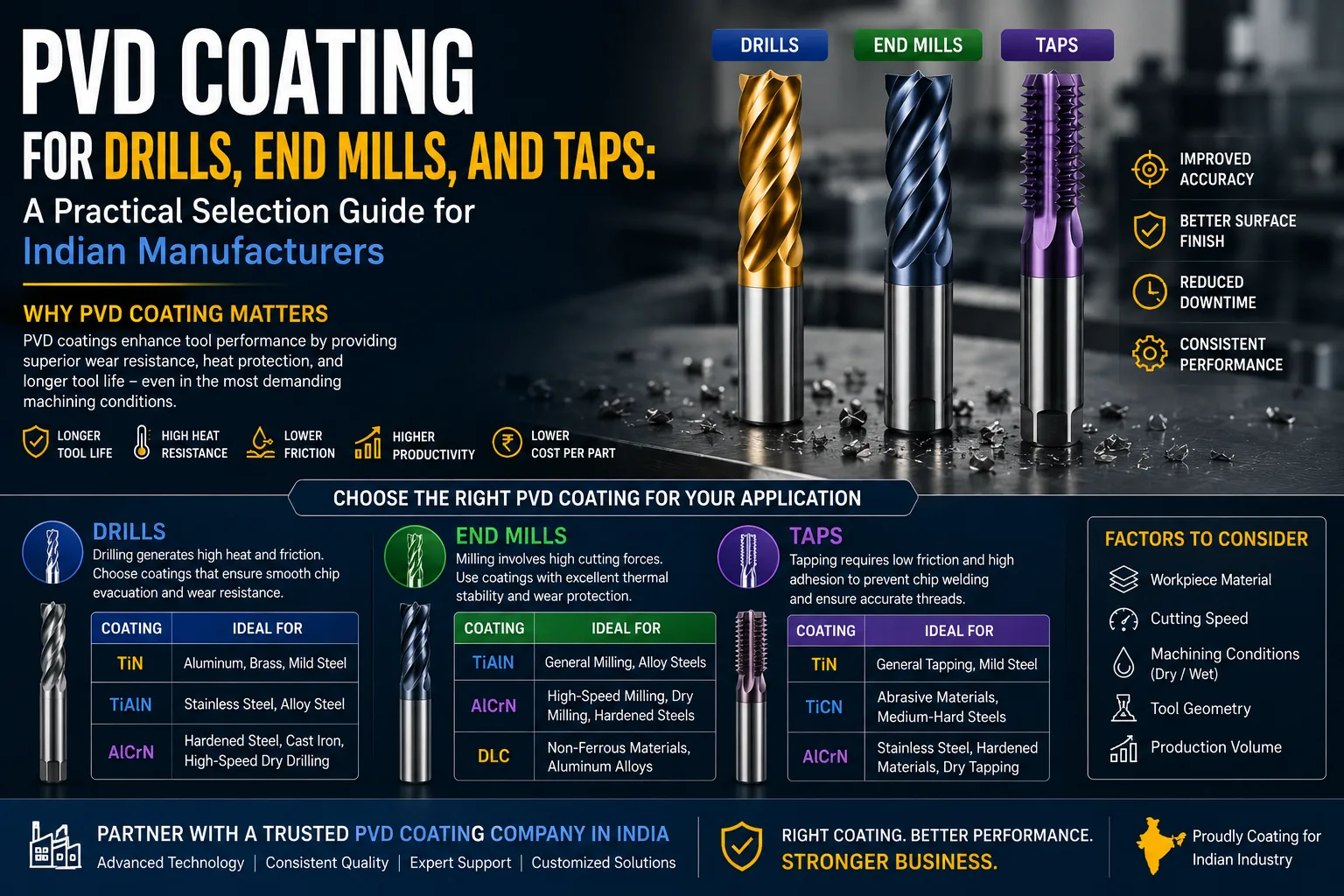
Choosing PVD Coating for Drills
Drills generate significant heat because the cutting edges remain in continuous contact with the workpiece while chips are evacuated through the flutes. Without adequate protection, excessive heat can quickly reduce tool life and compromise hole quality.
For general-purpose drilling in mild steel or aluminum, TiN (Titanium Nitride) remains a popular and economical choice. However, manufacturers machining stainless steel, alloy steel, or operating at higher cutting speeds often benefit from TiAlN (Titanium Aluminum Nitride) because of its superior heat resistance.
For demanding applications involving hardened steels, cast iron, or dry machining, AlCrN (Aluminum Chromium Nitride) offers the best performance. Its excellent oxidation resistance and thermal stability allow drills to maintain sharp cutting edges even under extreme machining conditions.
Selecting PVD Coating for End Mills
End mills are among the most versatile cutting tools used in CNC machining. Since they experience both radial and axial cutting forces, their coatings must withstand continuous friction, elevated temperatures, and interrupted cutting.
For standard milling operations, TiAlN provides an excellent balance between wear resistance and cost. It performs particularly well when machining alloy steels and general engineering materials.
However, when machining hardened steels or operating under high-speed dry machining conditions, AlCrN becomes the preferred choice. Its ability to resist oxidation and thermal fatigue allows end mills to maintain performance throughout extended production cycles, reducing the need for frequent tool changes.
Choosing PVD Coating for Taps
Thread tapping is one of the most demanding machining operations because the tool remains in continuous contact with the workpiece while simultaneously cutting and evacuating chips. High friction can quickly lead to built-up edges, excessive wear, or tap breakage.
For general-purpose threading, TiN provides reliable performance and good wear resistance. When tapping abrasive materials, TiCN offers increased hardness and improved resistance to abrasive wear.
Manufacturers working with stainless steel, hardened alloys, or dry tapping applications often choose AlCrN because its low friction characteristics and exceptional thermal stability help produce cleaner threads while extending tap life.
How to Select the Best Coating
Choosing the right PVD coating depends on several factors rather than simply selecting the hardest coating available. Manufacturers should carefully evaluate:
- Workpiece material
- Cutting speed
- Dry or wet machining conditions
- Production volume
- Tool geometry
- Desired tool life
Considering these factors helps ensure that the selected coating delivers the best balance of performance, durability, and cost-effectiveness.
Why Indian Manufacturers Prefer Professional PVD Coating Services
Investing in a premium coating is only effective when the coating process itself is performed with precision. Reputable PVD coating companies in India use advanced vacuum coating systems, strict quality control procedures, and optimized coating parameters to achieve consistent coating thickness and excellent adhesion.
An experienced coating partner also provides technical guidance, helping manufacturers select the most suitable coating for their applications rather than relying on a one-size-fits-all solution. This results in improved machining performance, lower tooling costs, and greater production efficiency over the long term.
Conclusion
PVD coating has become an indispensable technology for modern machining, enabling drills, end mills, and taps to perform more efficiently under increasingly demanding manufacturing conditions. While coatings such as TiN, TiCN, and TiAlN continue to offer excellent performance for many applications, AlCrN stands out for high-speed dry machining and difficult-to-machine materials due to its superior oxidation resistance and thermal stability.
For Indian manufacturers seeking to improve productivity, extend tool life, and reduce machining costs, selecting the right PVD coating—and partnering with an experienced PVD coating company—is a strategic investment that delivers measurable long-term benefits.