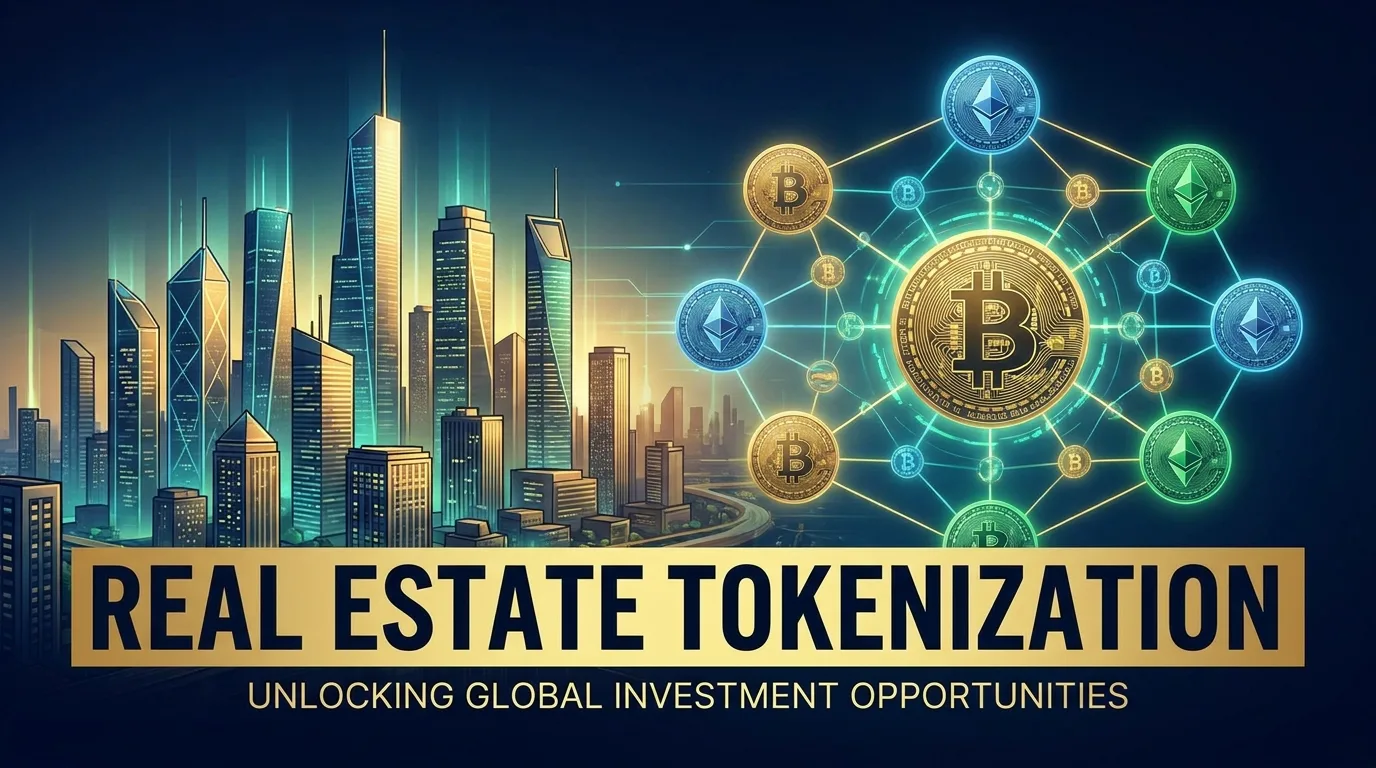
Real estate has traditionally been one of the world’s most desirable asset classes, but it has also remained one of the least accessible and least liquid. Buying property usually requires large capital, lengthy due diligence, complex paperwork, multiple intermediaries, and extended settlement timelines. Even after acquisition, selling a stake in a property or exiting an investment can take months. Real estate tokenization attempts to solve these structural problems by converting ownership rights, income rights, or economic interests in property into blockchain-based digital tokens.
At its core, tokenization does not magically replace legal ownership. Instead, it creates a digital representation of a real-world asset that can be issued, managed, transferred, and recorded using blockchain infrastructure. Deloitte describes tokenization as converting physical or financial assets into fractional digital representations that can be securely owned or traded on digital platforms, and it predicts that tokenized real estate could grow from less than US$0.3 trillion in 2024 to US$4 trillion by 2035. This growth expectation reflects a broader shift in capital markets: investors increasingly want access, transparency, faster settlement, and more flexible investment structures.
Why Real Estate Tokenization Matters Now
The rise of tokenized real estate is not simply a technology trend. It is a response to persistent inefficiencies in property investment. Traditional real estate markets are often fragmented by geography, regulation, valuation standards, and investor eligibility. A prime commercial building in New York, Dubai, Singapore, London, or Mumbai may generate attractive income, but access is typically limited to institutions, family offices, developers, or high-net-worth investors. Tokenization creates a structure in which a property or fund interest can be divided into smaller digital units, allowing qualified investors to participate with lower capital commitments.
This is where a professional Real Estate Tokenization company becomes important. The success of a tokenized property product depends not only on smart contract coding but also on legal structuring, investor onboarding, compliance design, asset documentation, wallet integration, dividend automation, and secondary transfer controls. Similarly, comprehensive Real Estate Tokenization Services should cover the full development lifecycle: asset evaluation, token economics, blockchain selection, security token issuance, KYC/AML workflows, investor dashboards, custody integrations, and post-launch asset administration. Businesses looking for implementation guidance can review more details before choosing a development partner.
The business case is especially strong in markets where high property prices prevent broad participation. Fractional ownership can reduce entry barriers, while blockchain-based records can improve visibility into ownership, transactions, distributions, and compliance events. However, tokenization should not be marketed as a shortcut around regulation. In many jurisdictions, tokenized real estate interests may be treated as securities, especially when investors expect income or profit from the efforts of an issuer, manager, or sponsor. Therefore, compliance-first development is not optional; it is central to long-term viability.
How Real Estate Tokenization Works
A tokenized real estate project usually begins with asset selection. The underlying asset may be a residential property, commercial office, hotel, warehouse, land parcel, real estate fund, debt instrument, or income-producing portfolio. The issuer then decides what the token represents. It may represent equity in a special purpose vehicle, a share of rental income, a debt claim, a fund unit, or a contractual economic right. This legal wrapper is crucial because blockchain tokens alone do not automatically grant enforceable property rights.
Recent research on real-world asset tokenization emphasizes that most deployed RWA systems are hybrid architectures. Blockchain supports representation, transfer control, redemption, pricing, and composability, but core legal guarantees remain dependent on off-chain legal structures, custodians, compliance processes, and verification mechanisms. In simple terms, the token is the digital interface, while the legal entity and contractual framework define the investor’s real-world claim.
Once the legal model is defined, developers create the smart contracts that govern token issuance, supply, transfer restrictions, ownership records, and distribution mechanisms. Security token standards may be used to ensure that only verified investors can receive or trade tokens. A compliant tokenized real estate platform often includes identity verification, jurisdiction-based investor rules, cap table management, document storage, voting modules, reporting tools, and automated payout functionality. For income-generating property, rental proceeds can be distributed proportionally to token holders after expenses, reserves, and management fees are accounted for.
Blockchain selection is another important decision. Public blockchains offer transparency and composability, while permissioned or enterprise-grade networks may provide stronger privacy, controlled access, and regulatory comfort. The right choice depends on the issuer’s target investors, compliance obligations, cost sensitivity, scalability needs, and secondary market strategy.
Key Benefits for Developers, Investors, and Asset Owners
For asset owners and developers, tokenization can unlock new capital formation models. Instead of relying only on banks, private equity, or a narrow group of investors, a developer can structure a compliant digital offering for a broader qualified investor base. This can be useful for income-producing commercial assets, hospitality projects, real estate debt, redevelopment projects, or diversified property funds.
For investors, the appeal is accessibility and portfolio flexibility. Tokenization can allow investors to gain exposure to specific property types, geographies, or income streams without purchasing an entire asset. A person interested in logistics real estate, student housing, rental apartments, or luxury hospitality could potentially invest in a fractionalized product aligned with that thesis. Deloitte also notes that tokenization may allow institutions to create more customized portfolios based on specific investor preferences, such as location, asset type, or sustainability characteristics.
Operational efficiency is another major benefit. Traditional real estate transactions involve brokers, transfer agents, lawyers, escrow agents, fund administrators, and manual reconciliation. Tokenization cannot remove every intermediary, but it can streamline recordkeeping, investor verification, distribution calculations, and ownership transfers. Smart contracts can automate repetitive administrative tasks, while blockchain ledgers create time-stamped audit trails.
Transparency is equally important. Investors often struggle to access timely information about ownership records, asset performance, distributions, and governance. A well-built tokenization platform can provide dashboards showing token holdings, income history, documents, voting notices, valuation updates, and transaction records. This does not eliminate the need for audits or professional reporting, but it improves the investor experience.
Real-World Examples and Market Direction
One of the most cited early examples is the St. Regis Aspen Resort tokenization. In 2018, Elevated Returns completed an US$18 million tokenized real estate offering connected to the luxury hotel in Aspen, Colorado. The deal became a milestone because it showed that tokenization could be applied to a recognized, high-value property rather than only experimental crypto-native assets.
Since then, the market has matured from isolated pilots toward institutional infrastructure. In March 2026, Reuters reported that the New York Stock Exchange partnered with Securitize to support tokenized versions of traditional financial securities, while U.S. exchanges such as NYSE and Nasdaq were increasing efforts to convert assets like stocks, bonds, and funds into blockchain-based tokens. Although this development is broader than real estate alone, it matters because institutional tokenization infrastructure can support greater trust, standardization, and interoperability across asset classes.
The real estate opportunity is also expanding across different product types. Deloitte identifies three major components of the future tokenized real estate ecosystem: tokenized private real estate funds, tokenized ownership of loans and securitizations, and tokenized ownership of undeveloped land or under-construction projects. It projects tokenized real estate loans and securitizations could reach US$2.39 trillion by 2035, while tokenized private real estate funds could reach US$1 trillion. These projections suggest that the largest opportunity may not be individual apartments or homes, but institutional-grade financial products connected to real estate.
Development Challenges and Risk Considerations
Despite its promise, real estate tokenization faces serious challenges. Liquidity is the most misunderstood. Issuing a token does not automatically create a liquid market. A property token may be transferable in theory but difficult to sell in practice if there are few buyers, strict investor restrictions, unclear valuation models, or no regulated secondary market. Recent academic research on real-world asset tokenization warns that tokenization and liquidity should be analyzed as distinct outcomes, because on-chain representation does not guarantee meaningful trading activity.
Regulation is another decisive factor. Depending on structure, tokenized real estate may fall under securities law, real estate law, fund regulation, tax rules, anti-money-laundering requirements, data protection laws, and cross-border investment restrictions. A platform that ignores these obligations may attract early attention but struggle to scale. Properly designed systems include investor accreditation checks, jurisdiction controls, lock-up periods, transfer restrictions, risk disclosures, and audit-ready reporting.
Custody and asset servicing must also be handled carefully. Investors need clarity on who owns the underlying property, who manages it, how income is collected, how expenses are deducted, how distributions are calculated, and what happens in default, sale, redevelopment, insurance loss, or legal dispute. Smart contracts can automate rules, but they cannot repair a roof, resolve a tenant issue, or enforce a mortgage. Strong property management and legal governance remain essential.
Security is another non-negotiable requirement. Smart contract vulnerabilities, private key loss, phishing attacks, poor wallet UX, and weak admin controls can damage investor confidence. Real estate tokenization platforms should undergo smart contract audits, penetration testing, access-control reviews, and compliance testing before launch. Enterprise-grade systems should also include disaster recovery, role-based permissions, transaction monitoring, and secure custody options.
Best Practices for Building a Tokenized Real Estate Platform
A successful platform begins with a clear legal and commercial thesis. Developers should define whether the product is designed for retail investors, accredited investors, institutions, or internal fund administration. This decision shapes the technology, compliance workflow, user interface, jurisdictional scope, and marketing strategy.
The second best practice is to prioritize asset quality. Tokenization cannot make a weak property strong. Investors still care about location, rental demand, tenant quality, leverage, maintenance costs, projected returns, exit strategy, and market risk. The strongest tokenized offerings will combine blockchain efficiency with institutional-grade real estate fundamentals.
Third, the platform should make compliance invisible but effective. Investor onboarding should be smooth, but behind the scenes it must handle identity verification, sanctions screening, accreditation checks, tax documentation, and transfer eligibility. The best platforms do not treat compliance as a barrier; they turn it into a trust layer.
Finally, token economics should be simple. Investors should understand what they own, how returns are generated, when distributions occur, what fees are charged, how tokens can be transferred, and what rights they have. Overly complex token models may impress technologists but confuse investors and regulators.
Conclusion
Real estate tokenization is moving from concept to credible financial infrastructure, but its success depends on much more than blockchain development. It requires sound legal structuring, high-quality assets, investor protection, secure smart contracts, transparent reporting, and practical secondary market design. For businesses that want to launch compliant and scalable property tokenization platforms, Blockchain App Factory provides best services by combining blockchain development expertise with end-to-end tokenization support for real estate businesses, startups, and enterprises.
FAQs
1. What is real estate tokenization?
Real estate tokenization is the process of converting ownership rights, income rights, fund units, or economic interests in property into blockchain-based digital tokens. These tokens can represent fractional exposure to a real estate asset or portfolio.
2. Is tokenized real estate legally valid?
It can be legally valid when structured properly. The token must be connected to enforceable legal agreements, compliant entities, investor disclosures, and jurisdiction-specific regulations. The blockchain record alone is not enough to guarantee property rights.
3. Does tokenization make real estate instantly liquid?
No. Tokenization can improve transferability, but liquidity depends on investor demand, regulatory permissions, secondary market access, valuation transparency, and trading infrastructure.
4. What types of real estate can be tokenized?
Residential properties, commercial buildings, hotels, warehouses, land, real estate funds, debt instruments, mortgages, and securitized property products can all potentially be tokenized, depending on legal and commercial feasibility.
5. What should businesses look for in a tokenization development partner?
Businesses should look for blockchain expertise, smart contract security, compliance workflow experience, investor dashboard development, tokenomics design, custody integration, and post-launch platform support.