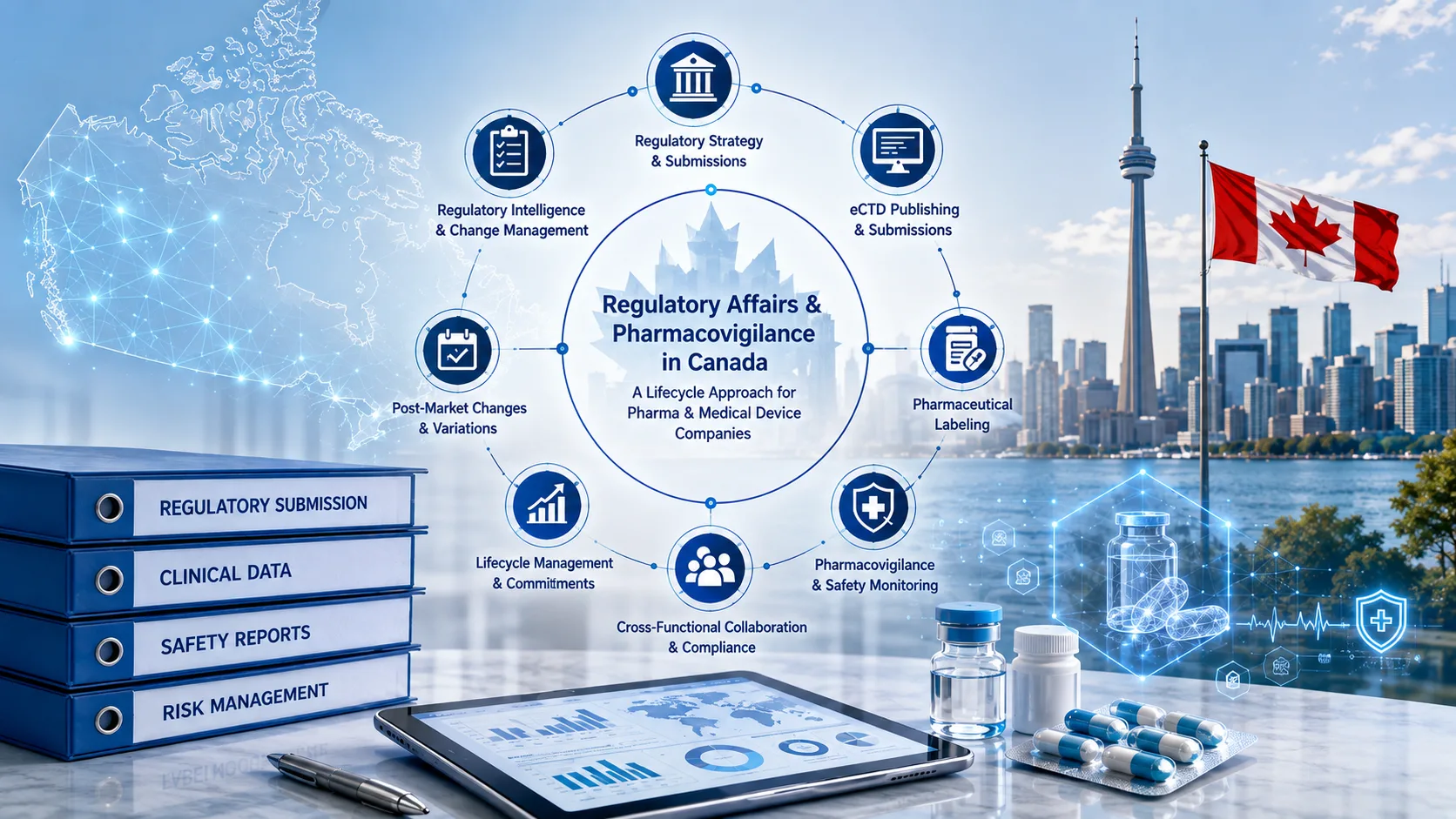
Regulatory Affairs & Pharmacovigilance in Canada
Introduction
For pharmaceutical and medical device companies entering or expanding in Canada, regulatory compliance is not limited to obtaining a marketing authorization or device licence. It is a continuing lifecycle activity that spans regulatory strategy, submission preparation, safety surveillance, labeling, post-authorization changes, and ongoing interaction with Health Canada.
This is where regulatory affairs and pharmacovigilance increasingly intersect.
A regulatory strategy may determine how a product enters the Canadian market, while pharmacovigilance activities generate safety evidence that can influence labeling, risk management, regulatory submissions, and post-market decisions. The quality of information flowing between these functions can therefore have a direct impact on compliance and patient safety.
Health Canada has also continued to refine its regulatory expectations. Its current guidance on drug submissions addresses pre-application planning, filing, screening, review and post-authorization activities, while updated Good Pharmacovigilance Practices guidance issued in May 2026 reinforces the responsibilities of manufacturers and market authorization holders for post-market safety activities.
For organizations managing complex regulatory requirements across markets, Life Science Consulting Services can support broader regulatory strategy, compliance planning, and lifecycle considerations across pharmaceutical and medical device operations.
What Regulatory Affairs and Pharmacovigilance Mean in Canada
Regulatory affairs is the function responsible for helping ensure that a company's products, regulatory strategies, submissions and post-approval activities align with applicable requirements.
Pharmacovigilance, by contrast, focuses on the detection, assessment, understanding and prevention of adverse events and other drug-related problems.
Although these functions have different responsibilities, they are closely connected.
A safety signal may result in:
- A regulatory assessment
- A change to product information
- A risk management activity
- A regulatory submission
- Communication with Health Canada
- Additional post-market monitoring
- Updates to internal benefit-risk assessments
Health Canada's 2026 GVP guidance states that manufacturers or market authorization holders selling drugs are responsible for post-market pharmacovigilance activities and good pharmacovigilance practices.
For organizations developing a Canadian market strategy, this means regulatory planning should consider both pre-market requirements and post-market responsibilities.
Why RA and PV Should Be Managed as Connected Functions
A common organizational challenge is treating regulatory affairs and pharmacovigilance as separate operational silos.
That approach can create information gaps.
For example, a safety issue identified through post-market surveillance may require a regulatory response. If the regulatory team does not receive relevant safety information quickly, the organization may struggle to evaluate the issue, determine appropriate actions or prepare required documentation.
Similarly, a regulatory labeling change can affect safety information used by pharmacovigilance teams.
The RA/PV connection
A connected model allows teams to coordinate:
- Safety signal assessment
- Regulatory reporting
- Risk management plans
- Product labeling
- Regulatory submissions
- Health authority correspondence
- Post-authorization commitments
- Global-to-local regulatory impact assessments
This is particularly important for global companies because Canadian requirements must be integrated with broader international safety and regulatory processes without assuming that one jurisdiction's requirements automatically apply to another.
Key Stages of the Canadian Regulatory Lifecycle
A practical Canadian regulatory strategy can be viewed across several stages.
1. Regulatory planning
Before preparing a submission, organizations need to understand the product classification, applicable regulatory pathway, evidence requirements and Health Canada expectations.
The regulatory plan should consider:
- Product type
- Indication and intended use
- Regulatory pathway
- Clinical and non-clinical evidence
- Quality information
- Canadian-specific requirements
- Labeling requirements
- Post-market obligations
Health Canada's current drug submission guidance provides direction covering pre-application activities, filing, screening, review and other submission-management processes.
For organizations without sufficient local regulatory capabilities, specialized Regulatory Services in Canada can be considered as part of a broader market-entry and compliance strategy.
2. Submission preparation
Submission quality depends on more than scientific content.
Documents must be organized, technically validated and presented in the format required for the applicable regulatory activity.
Health Canada currently requires companies to file submissions electronically, using eCTD or non-eCTD electronic-only formats depending on the regulatory activity.
3. Regulatory review and interaction
After filing, regulatory teams may need to coordinate responses to questions, clarification requests and additional information requirements.
Effective regulatory operations therefore require:
- Submission tracking
- Question management
- Response coordination
- Version control
- Commitment tracking
- Health authority correspondence management
4. Post-authorization lifecycle management
Approval is not the end of regulatory work.
Products may undergo:
- Manufacturing changes
- Site changes
- Labeling updates
- Safety-related changes
- New indications
- New dosage forms
- Regulatory commitments
- Periodic safety activities
This is why lifecycle planning should begin before authorization rather than being added afterward.
eCTD and Regulatory Submission Readiness
Electronic Common Technical Document, or eCTD, has become a central component of modern regulatory submission operations.
For companies filing in Canada, technical submission quality matters alongside scientific and regulatory content.
Health Canada's current electronic filing information identifies eCTD and non-eCTD electronic-only pathways and describes the Regulatory Enrolment Process as a common intake method for applicable transactions.
Health Canada also maintains validation rules intended to reduce errors and follow-up associated with eCTD transactions and encourages sponsors to validate regulatory transactions before filing.
Organizations managing complex dossiers may therefore benefit from dedicated eCTD Publishing Submission capabilities covering document readiness, technical compilation, validation and submission support.
What should teams evaluate?
An effective eCTD process should address:
- Document quality
- Metadata
- Folder structures
- Hyperlinks and bookmarks
- Navigation
- Lifecycle operators
- Technical validation
- Submission sequences
- Regional requirements
- Quality control
A technically compliant submission reduces avoidable administrative issues and helps regulatory teams focus on substantive review.
The Role of Pharmaceutical Labeling
Labeling is another important connection point between regulatory affairs, medical information, safety and pharmacovigilance.
Product information must communicate appropriate information about the product's use, risks and other regulatory considerations. When new safety information becomes available, the regulatory organization may need to assess whether product information requires revision.
Health Canada's current GVP regulatory guidance specifically addresses label updates within its pharmacovigilance framework.
This makes controlled labeling processes particularly important.
Organizations may use Pharmaceutical Labeling Services to support structured labeling activities, provided those services are integrated into the company's broader regulatory governance and product information control processes.
A robust labeling process should include
- Source data review
- Safety information assessment
- Regulatory requirements assessment
- Version control
- Change tracking
- Cross-functional review
- Country-specific implementation
- Approval and archival controls
The objective is not simply to update text. It is to ensure that approved product information remains consistent with the current regulatory and safety position.
Pharmacovigilance and Post-Market Safety in Canada
Pharmacovigilance becomes especially important once a product is commercially available.
Health Canada describes pharmacovigilance as activities designed to detect, assess, understand and prevent adverse events and other drug-related problems. It also conducts post-market GVP inspections of manufacturers and market authorization holders.
The current GVP framework includes requirements relating to areas such as:
- Serious adverse drug reaction reporting
- Annual summary reporting
- Issue-related summary reports
- Record maintenance
- Foreign regulatory actions
- Unusual failure in efficacy
- Label updates
Health Canada's submission-management guidance also distinguishes certain post-market pharmacovigilance documents from the general submission-management framework, including periodic benefit-risk evaluation reports, issue-related reports, risk management plans and risk communications.
For companies that need specialized local capabilities, Pharmacovigilance Services in Canada can form part of an appropriately governed Canadian safety-monitoring model.
Why local regulatory context matters
Global PV systems provide an important foundation, but local regulatory requirements still need to be assessed.
A multinational organization should determine:
- Which Canadian reporting obligations apply.
- Which safety information must be escalated locally.
- How Canadian requirements interact with global safety procedures.
- Who owns regulatory decisions.
- How safety-driven labeling changes are implemented.
- How regulatory commitments are documented and monitored.
Regulatory Intelligence and Change Management
Regulatory requirements do not remain static.
Guidance documents can change, submission processes can be revised, regulatory expectations can evolve and new safety requirements can affect established products.
This makes Regulatory Intelligence Tools valuable for organizations that need a systematic way to monitor regulatory developments rather than relying exclusively on manual searches.
Regulatory intelligence can support:
- Horizon scanning
- Regulatory change monitoring
- Competitor and market analysis
- Guidance tracking
- Impact assessment
- Submission planning
- Compliance planning
The important point is that regulatory intelligence should lead to action.
A regulatory update has limited operational value if nobody determines whether it affects a product, process, submission or safety obligation.
From monitoring to impact assessment
A mature process can follow a simple chain:
Monitor → Assess → Prioritize → Assign → Implement → Document
This turns regulatory intelligence into a practical compliance capability.
Managing the Regulatory Affairs Lifecycle
The regulatory lifecycle extends beyond individual submissions.
Organizations must maintain a controlled view of product status, commitments, variations, labeling, safety developments and regulatory correspondence across time.
A structured Regulatory Affairs Lifecycle approach can help organizations connect activities that are otherwise distributed across departments, systems and geographic markets.
Lifecycle thinking is especially useful when a company manages:
- Multiple products
- Multiple indications
- Multiple countries
- Frequent post-approval changes
- Complex submission histories
- Large regulatory teams
- Extensive safety obligations
The objective is greater visibility and control rather than simply increasing the volume of regulatory activity.
Common Challenges for Global Life Science Companies
Fragmented information
Regulatory, safety, clinical, quality and medical information may reside in different systems.
This can make it difficult to establish a single reliable view of product status.
Inconsistent global-to-local processes
Global procedures may not fully reflect Canadian requirements.
Localization should therefore be deliberate rather than assumed.
Submission errors
Incorrect metadata, document formatting, hyperlinks, lifecycle management or validation issues can create avoidable filing problems.
Poor change visibility
Teams can miss regulatory developments when monitoring is fragmented or entirely manual.
Weak commitment tracking
Post-authorization commitments can involve multiple departments and deadlines. Without appropriate ownership and tracking, obligations can become difficult to manage.
Disconnected safety and labeling processes
When pharmacovigilance and regulatory labeling teams operate independently, safety-driven changes may take longer to assess and implement.
Expert Insights for a More Effective RA/PV Strategy
From a regulatory operations perspective, several principles are particularly important.
1. Build the lifecycle model before approval
Do not design post-market processes after commercialization.
Define responsibilities for safety, labeling, commitments, submissions and regulatory intelligence early.
2. Treat data quality as a regulatory asset
Regulatory decisions depend on reliable information.
Organizations should establish controls around:
- Version management
- Data provenance
- Document ownership
- Audit trails
- Approval status
- Regulatory dates
3. Make RA/PV communication operational
A cross-functional meeting alone is not enough.
Define escalation criteria, ownership, timelines and documented workflows for safety issues that may have regulatory consequences.
4. Separate regulatory monitoring from regulatory decision-making
Technology can help identify changes, but subject-matter experts still need to assess applicability and business impact.
5. Design for inspection readiness
Inspection readiness should be an ongoing state, not a project that begins after an inspection notification.
Health Canada's GVP inspection framework emphasizes compliance verification for manufacturers and market authorization holders.
Teams should be able to demonstrate what they knew, when they knew it, what they assessed and what action they took.
Conclusion
Regulatory affairs and pharmacovigilance in Canada are best understood as interconnected components of the product lifecycle.
Successful organizations do more than prepare technically correct submissions. They create systems that connect regulatory strategy, electronic submissions, labeling, safety surveillance, regulatory intelligence and post-market obligations.
The Canadian regulatory environment continues to evolve, making current guidance monitoring and disciplined change management increasingly important. Health Canada's 2026 updates to pharmacovigilance guidance and its continuing electronic submission framework reinforce the need for organizations to maintain current, documented and inspection-ready processes.
For pharma and medical device organizations, the strategic objective should therefore be clear: build a regulatory operating model that remains reliable from market entry through the full product lifecycle.
FAQs
1. What is the role of regulatory affairs in Canada?
Regulatory affairs coordinates regulatory strategy, submissions, health authority interactions, product information, post-authorization activities and ongoing compliance with applicable Canadian requirements.
2. Why is pharmacovigilance important after product approval?
Post-market safety monitoring helps identify and evaluate emerging safety information and supports appropriate regulatory action. Health Canada requires manufacturers and market authorization holders to maintain applicable pharmacovigilance activities.
3. Does Health Canada accept eCTD submissions?
Yes. Health Canada accepts electronic submissions in eCTD or non-eCTD electronic-only formats depending on the regulatory activity. Applicable submissions are filed through the designated electronic processes, including the Regulatory Enrolment Process.
4. How can regulatory intelligence support pharmaceutical companies?
Regulatory intelligence can help organizations identify changes in legislation, guidance, regulatory processes and expectations, then assess how those changes may affect products, submissions and compliance activities.
5. Why should regulatory affairs and pharmacovigilance teams collaborate?
Safety information can have regulatory consequences, including potential reporting, risk management and labeling activities. Close coordination helps organizations evaluate and respond to safety-related regulatory issues more consistently.