
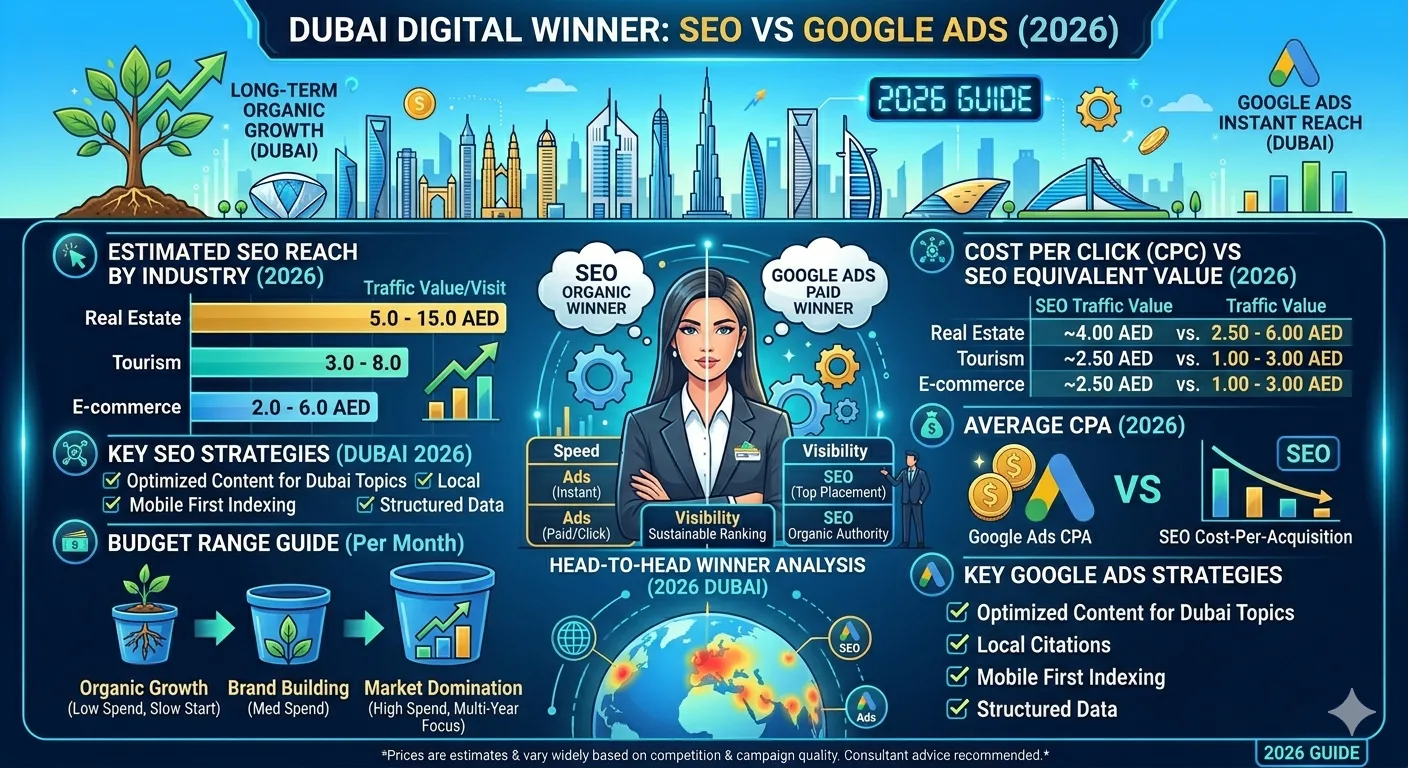
Every business owner in Dubai eventually faces the same budgeting question: should marketing dollars go toward SEO, PPC, or some blend of the two? The honest answer is that it depends heavily on timeline, competition, and cash flow — but understanding the actual mechanics of each channel makes the decision far less of a guessing game.
Pay-per-click advertising offers something SEO fundamentally cannot: immediate visibility. A well-structured Google Ads or Meta Ads campaign can put a business at the top of search results or in front of a highly targeted audience within hours of launch. For businesses with a product launch, a seasonal promotion, or a newly opened location that needs footfall fast, this speed is invaluable. The trade-off is equally clear — visibility disappears the moment the budget stops. PPC is rented attention, not owned equity.
SEO works on an entirely different timeline. Ranking organically for competitive terms in a market like Dubai — where industries from real estate to healthcare to hospitality are aggressively contested — typically takes three to six months of consistent technical optimization, content production, and authority building before meaningful movement appears. But once a page earns a strong position, it tends to hold that position with far less ongoing spend than PPC requires to sustain equivalent traffic. Over a 12-to-24-month horizon, the cost-per-lead from organic search is very often a fraction of what the same lead would cost through paid channels.
The calculation gets more interesting when you look at cost-per-click data in competitive UAE verticals. Legal services, real estate, and healthcare in Dubai routinely see PPC costs-per-click well into double digits in AED, which can make paid acquisition prohibitively expensive for businesses with lower average order values. In these categories especially, a strong SEO foundation isn't just nice to have — it is often the only economically sustainable path to consistent lead flow.
That said, framing SEO and PPC as competitors misses how the best-performing UAE businesses actually use them. PPC data — which keywords convert, which ad copy resonates, which landing pages hold attention — is some of the richest market research available, and it can directly inform SEO content strategy. Conversely, a business with strong organic rankings can run PPC campaigns more efficiently, because a familiar brand appearing in both paid and organic results builds the kind of trust that lowers cost-per-click and improves quality score.
For a business trying to decide where to start, the practical framework looks like this: if the goal is filling a pipeline within the next 30 to 60 days, pay-per-click advertising should lead the strategy while SEO work runs in parallel in the background. If the goal is building a durable, lower-cost acquisition channel over the next year and beyond, SEO deserves the larger share of early investment, with PPC used tactically for specific campaigns rather than as the primary engine.
Margin structure deserves more weight in this decision than most businesses give it. A category with thin margins per transaction — food delivery, budget retail — often can't sustain aggressive PPC spend indefinitely, because the cost-per-acquisition eats too deeply into already-slim profit. High-margin, high-consideration categories like real estate, private healthcare, or luxury goods can typically absorb a higher PPC cost-per-lead for longer, since a single converted lead can be worth many multiples of the acquisition cost. Understanding a business's own unit economics before allocating budget prevents the common trap of copying a competitor's channel mix without knowing whether it's actually sustainable for a different margin profile.
Attribution complexity is another factor that pushes many businesses toward running both channels simultaneously rather than choosing one. A customer might see a PPC ad, not click, later encounter the same brand in organic search results a week later, and convert on that second visit — a pattern that's extremely common and essentially invisible if a business is only tracking last-click attribution on a single channel. This "assisted conversion" effect means the true ROI of SEO and PPC is often understated when each is measured in isolation, and it's part of why businesses running integrated campaigns tend to report stronger overall performance than the sum of each channel's individually reported numbers would suggest.
Timing within the business's own lifecycle matters too. A newly launched business with zero domain authority and no existing search visibility faces a real chicken-and-egg problem with SEO — it takes months to build authority regardless of content quality, simply because search engines weight the age and track record of a domain. PPC fills that gap during the early months, generating revenue and market data while the SEO foundation is being built in parallel. Businesses that try to rely purely on SEO from day one often experience a frustrating, revenue-free ramp-up period that could have been bridged with even modest paid spend.
There is no universally correct split — a Dubai-based ecommerce brand launching for the first time will weight these very differently than an established law firm defending market share. What matters is that the decision is made deliberately, based on realistic timelines and margin structures, rather than defaulting to whichever channel a business happened to try first. Businesses that treat SEO and PPC as two arms of a single acquisition strategy, rather than rival budget lines, consistently see stronger blended ROI than those who pick one and ignore the other entirely.