In today’s highly regulated business environment, organizations must follow a wide range of legal obligations. Companies that fail to comply with statutory requirements often face penalties, legal complications, and reputational damage. This is where statutory compliance audits play a vital role.
A statutory compliance audit is a systematic evaluation of whether a company follows applicable laws, regulations, and government policies. These audits review employee records, payroll compliance, taxation requirements, workplace safety rules, and regulatory filings to ensure that businesses operate legally and ethically.
Businesses across industries—manufacturing, IT, services, logistics, and construction—must comply with labour laws, tax regulations, environmental rules, and corporate governance standards.
A professional statutory compliance audit helps organizations identify compliance gaps, reduce legal risks, and maintain transparency in operations.
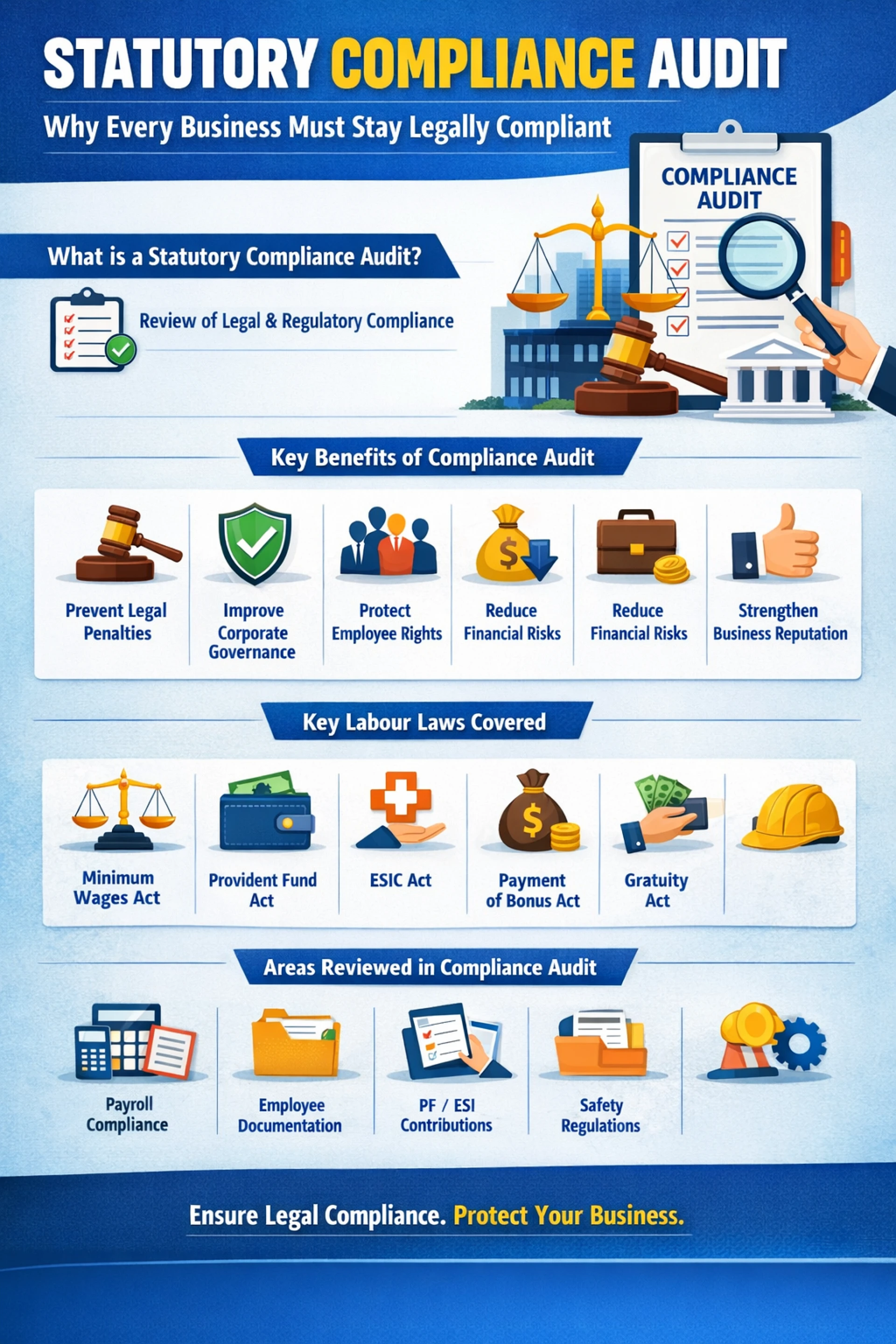
What is a Statutory Compliance Audit?
A statutory compliance audit is a structured process that evaluates whether an organization is following all the legal requirements applicable to its operations.
These laws may include:
- Labour laws
- Tax laws
- Environmental regulations
- Corporate governance rules
- Employee welfare legislation
The audit involves reviewing documentation, policies, payroll records, employment contracts, statutory registers, and regulatory filings.
The primary objective is to confirm that the company fulfills its legal obligations such as:
- Timely statutory payments
- Maintenance of legal registers
- Accurate payroll deductions
- Proper employee documentation
Statutory compliance ensures that businesses operate within the legal framework set by the government and protect both the organization and employees.
Importance of Statutory Compliance Audits
1. Avoid Legal Penalties
Non-compliance with labour or tax laws can result in heavy penalties, legal disputes, or prosecution.
A statutory audit identifies potential violations before government inspections occur.
2. Protect Business Reputation
Organizations that comply with legal regulations gain credibility among employees, investors, and government authorities.
Compliance improves corporate reputation and strengthens trust.
3. Ensure Employee Welfare
Many statutory laws focus on employee protection.
Compliance ensures:
- Fair wages
- Health and safety standards
- Employee benefits
- Workplace rights
4. Improve Operational Efficiency
Statutory audits help organizations streamline HR processes, payroll systems, and compliance procedures.
This improves operational efficiency and transparency.
5. Reduce Financial Risk
Compliance audits detect financial discrepancies related to statutory contributions such as:
- Provident Fund
- ESIC
- Professional tax
- Income tax deductions
Identifying errors early helps prevent financial losses.
Key Laws Covered in Statutory Compliance Audit
Businesses in India must comply with several labour and employment laws.
Some important laws include:
Minimum Wages Act
Ensures employees receive the minimum wage set by the government.
Payment of Wages Act
Ensures timely payment of employee salaries without unauthorized deductions.
Employees Provident Fund Act
Requires employers to contribute to employee retirement savings.
Employees State Insurance Act
Provides medical benefits and insurance to employees.
Payment of Bonus Act
Mandates bonuses for eligible employees.
Payment of Gratuity Act
Provides gratuity benefits to employees after continuous service.
Factories Act
Ensures worker safety, welfare, and working conditions in manufacturing units.
These laws collectively protect employee rights and maintain workplace standards.
Key Areas Reviewed in Compliance Audit
A statutory compliance audit reviews multiple operational areas.
1. Payroll Compliance
Auditors verify:
- Salary calculations
- Minimum wage compliance
- Overtime payments
- Bonus payments
2. Employee Documentation
Auditors review:
- Employment contracts
- Appointment letters
- Attendance records
- Leave records
3. Statutory Contributions
Auditors confirm proper payment of:
- PF contributions
- ESIC contributions
- Professional tax
- TDS deductions
4. Statutory Registers
Organizations must maintain registers such as:
- Employee registers
- Wage registers
- Attendance registers
- Leave registers
5. Health and Safety Compliance
For manufacturing industries, auditors review compliance with safety standards under the Factories Act.
Steps in Statutory Compliance Audit
Step 1: Compliance Assessment
The first step is identifying all applicable laws and regulations.
Step 2: Documentation Review
Auditors examine payroll records, employee documents, and statutory registers.
Step 3: Compliance Gap Identification
Auditors identify gaps where legal requirements are not fully met.
Step 4: Risk Analysis
Compliance risks are analyzed to determine potential legal consequences.
Step 5: Corrective Action Plan
Organizations receive recommendations to resolve compliance gaps.
Step 6: Implementation
Businesses implement corrective actions to ensure compliance.
Challenges in Statutory Compliance
Despite its importance, compliance management can be challenging.
Complex Legal Framework
India has numerous labour laws and regulations, making compliance complex.
Frequent Regulatory Changes
Government policies and regulations are updated frequently.
Multi-State Operations
Companies operating in multiple states must follow different labour laws.
Documentation Requirements
Maintaining numerous registers, filings, and returns can be time-consuming.
Benefits of Professional Compliance Audit Services
Many businesses outsource statutory compliance audits to experts.
Professional consultants provide:
- Compliance risk assessment
- Legal documentation review
- Labour law compliance verification
- Payroll compliance audit
- Statutory filing guidance
Outsourcing compliance management allows businesses to focus on growth while experts handle legal requirements.
Role of Compliance Consultants
Professional compliance consultants help businesses:
- Conduct internal compliance audits
- Maintain statutory records
- File legal returns
- Handle labour inspections
- Implement compliance systems
Their expertise ensures organizations stay legally compliant at all times.
How Compliance Audits Help Business Growth
A strong compliance framework supports business growth.
Benefits include:
- Reduced legal risks
- Improved employee trust
- Better governance
- Operational transparency
- Investor confidence
Companies that prioritize compliance create a sustainable business model.
Future of Compliance Management
Technology is transforming compliance management.
Modern compliance systems now include:
- Automated compliance tracking
- Digital documentation
- Real-time compliance alerts
- Integrated HR compliance systems
These tools help organizations stay compliant more efficiently.