
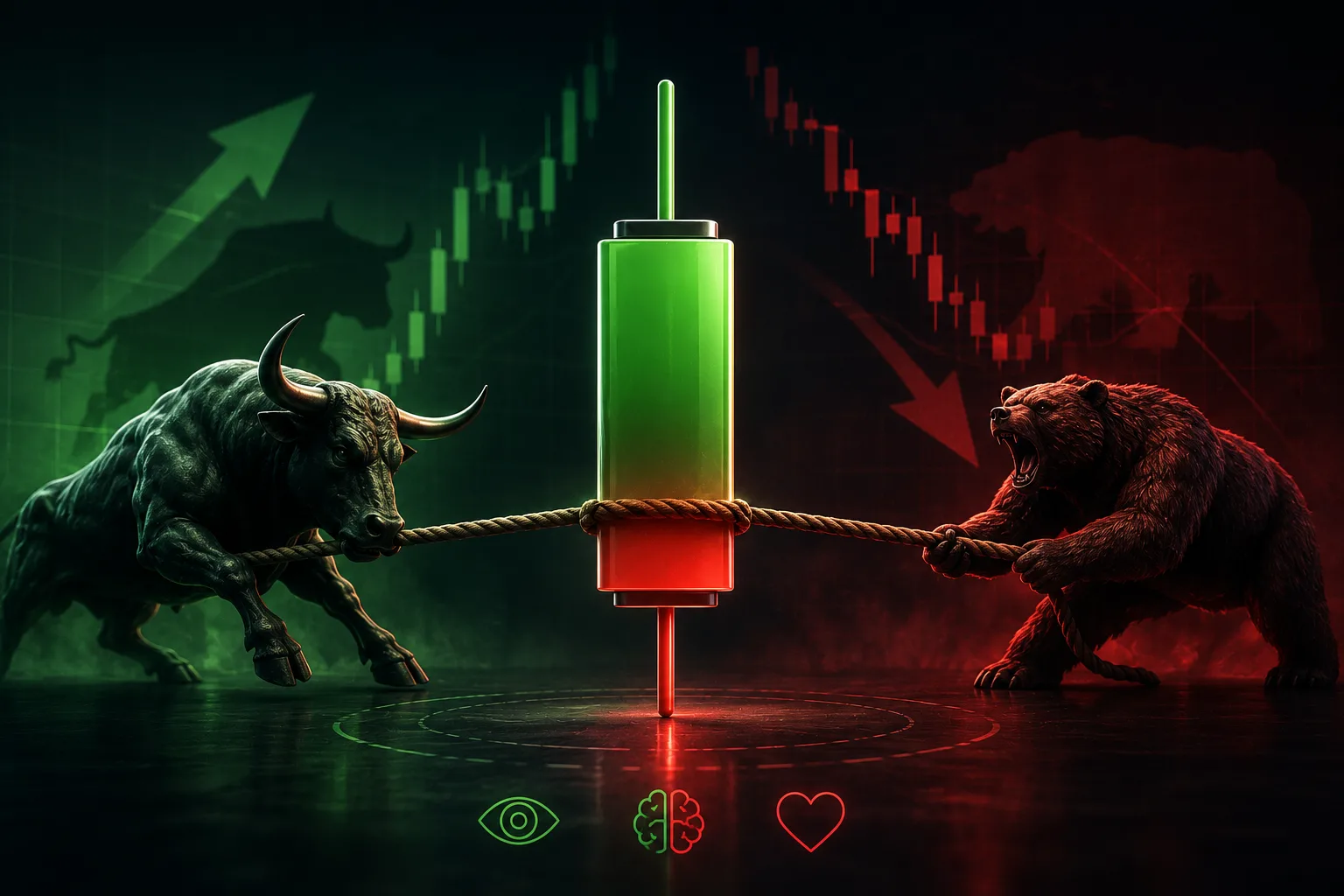
Many developing traders fall into the trap of treating technical analysis like a matching game. They memorise a dozen formations from a textbook, scan a live chart, and expect the market to follow the rules automatically. However, mechanical pattern recognition often overlooks one of the most important elements reflected in price charts: market participant behaviour and psychology.
To transition from a beginner who simply memorises shapes to an intermediate tape reader, you must understand trading price action as a live map of crowd behaviour. Every candlestick reflects the balance of buying and selling activity during a given period and can provide clues about changing market sentiment.
By shifting your focus to candlestick psychology, you stop asking, "What pattern is this?" and start asking, “Who is trapped, who is aggressive, and who is losing control?”
The Tug-of-War: The Real-Time Battle of Bulls and Bears
At its core, a single candlestick is not a static graphic, it is a visual summary of a fierce tug-of-war between buyers (bulls) and sellers (bears) over a specific timeframe.
To perform effective market sentiment analysis, a trader must visualise the journey the price took from the opening bell to the final second before the candle closed.
- The Boundaries of the Battlefield: The relationship between the open and close provides insight into whether buyers or sellers held greater control by the end of the session.
- The Aggression Shift: If a candle opens, drops significantly, and then surges to close near its highs, it reveals that while the bears had early control, buyers regained control and pushed prices back toward the session highs.
Understanding these internal mechanics prevents you from trading blind. You are no longer just looking at a red or green box, you are evaluating which side is exerting real effort and which side is exhausted.
Decoding Shadows & Wicks: How to Read Market Fear and Greed
If the real body of a candle represents the final consensus of value, the wicks (or shadows) represent the extremes of emotion. The wicks are where we learn how to read market fear and greed in their purest forms.
A long wick indicates that prices moved significantly away from the opening range before reversing, suggesting that one side was unable to maintain control.
[High Price] <-- The peak of buyer Greed
|
| <-- Upper Wick: Trapped buyers / Heavy selling pressure
|
+---------+
| Open |
| | <-- Real Body: The final consensus of value
| Close |
+---------+
| <-- Lower Wick: Heavy buying pressure / Short-covering
[Low Price] <-- The peak of seller Fear
Long Upper Wicks at Key Resistance
When a long upper wick forms at a well-defined resistance level, it represents a structural failure of buyer momentum.
- The Greed Phase: As the price breaks above resistance, retail buyers experience FOMO (Fear Of Missing Out). Driven by greed, they market-buy at the absolute top, expecting an explosive breakout.
- The Institutional Wall: At the same time, large market participants or profit-taking sellers or patient swing traders use this sudden influx of buying liquidity to execute massive sell orders or take profits.
- The Trap: The aggressive buying pressure is completely absorbed by the limit sell orders. The price plummets back down before the session ends.
The resulting long upper wick leaves the breakout buyers "trapped" in losing positions. This visual rejection tells you that the market is rejecting higher prices, often serving as a precursor to a downward reversal.
Long Lower Wicks at Key Support
Conversely, a long lower wick at a structural support floor represents a failure of seller momentum.
- The Fear Phase: Price breaks below support, triggering stop-loss orders and causing retail panic. Traders sell out of fear, believing the asset is crashing.
- The Value Absorption: Value-orientated buyers view these lower prices as a discount and aggressively buy up the panic-selling volume.
- The Snap-Back: The massive influx of buy orders forces the price back up above the support line before the candle closes. The fear evaporates, leaving behind a long lower wick that signals strong underlying demand.
Real Body vs. Market Noise: Why the Closing Price Matters
Intraday price action is filled with emotional spikes, high-frequency trading activity, order-flow imbalances, short-term volatility, and temporary chaos. This intra-session volatility is often referred to as "market noise". If you watch a candle form tick-by-tick, greed and fear will easily warp your judgement.
This is why experienced price action traders place the highest value on the closing price.
The Golden Rule of Tape Reading: Many price action traders consider the closing price especially important because it represents where buyers and sellers ultimately agreed on value for that session. While the open, high, and low provide valuable information about intraday price movement, the closing price is often given greater weight when assessing trend strength and market sentiment.
- The Real Body (the space between the open and close) represents the ultimate compromise of the session. It filters out the intraday failures and shows where the market settled after all arguments between bulls and bears were resolved.
- A Large Real Body signals dominant, sustained conviction. If a candle closes near its absolute high with virtually no upper wick, it means buyers remained aggressive up to the final second.
- A Tiny Real Body with Large Wicks (such as a Doji or Spinning Top) indicates a complete breakdown of trend conviction. Despite massive volatility throughout the session, neither side could hold their ground, resulting in total market indecision.
Why Volume Matters
A candlestick becomes more meaningful when supported by trading volume. For example, a bullish candle accompanied by significantly higher-than-average volume suggests stronger buying participation than a similar candle formed on low volume. Likewise, long upper or lower wicks are generally considered more reliable when they occur alongside elevated trading activity, as higher volume indicates broader market participation.
Conclusion: Shifting from Rules to Reality
Mastering technical analysis requires moving past rigid templates. While standard textbooks show you what a perfect pattern looks like, live markets show you how human beings react under financial pressure. By training your eyes to decode the length of the wicks and the position of the closing price, you can accurately gauge the underlying velocity of market participants.
Understanding the emotional dynamics of a single candlestick is just the beginning. The next phase involves recognising how these small conflicts contribute to larger market trends. By examining these psychological shifts, you can gain insights into the foundational elements that shape market behaviour. Consider studying various candlestick patterns to enhance your understanding of price action and improve your charting skills.