
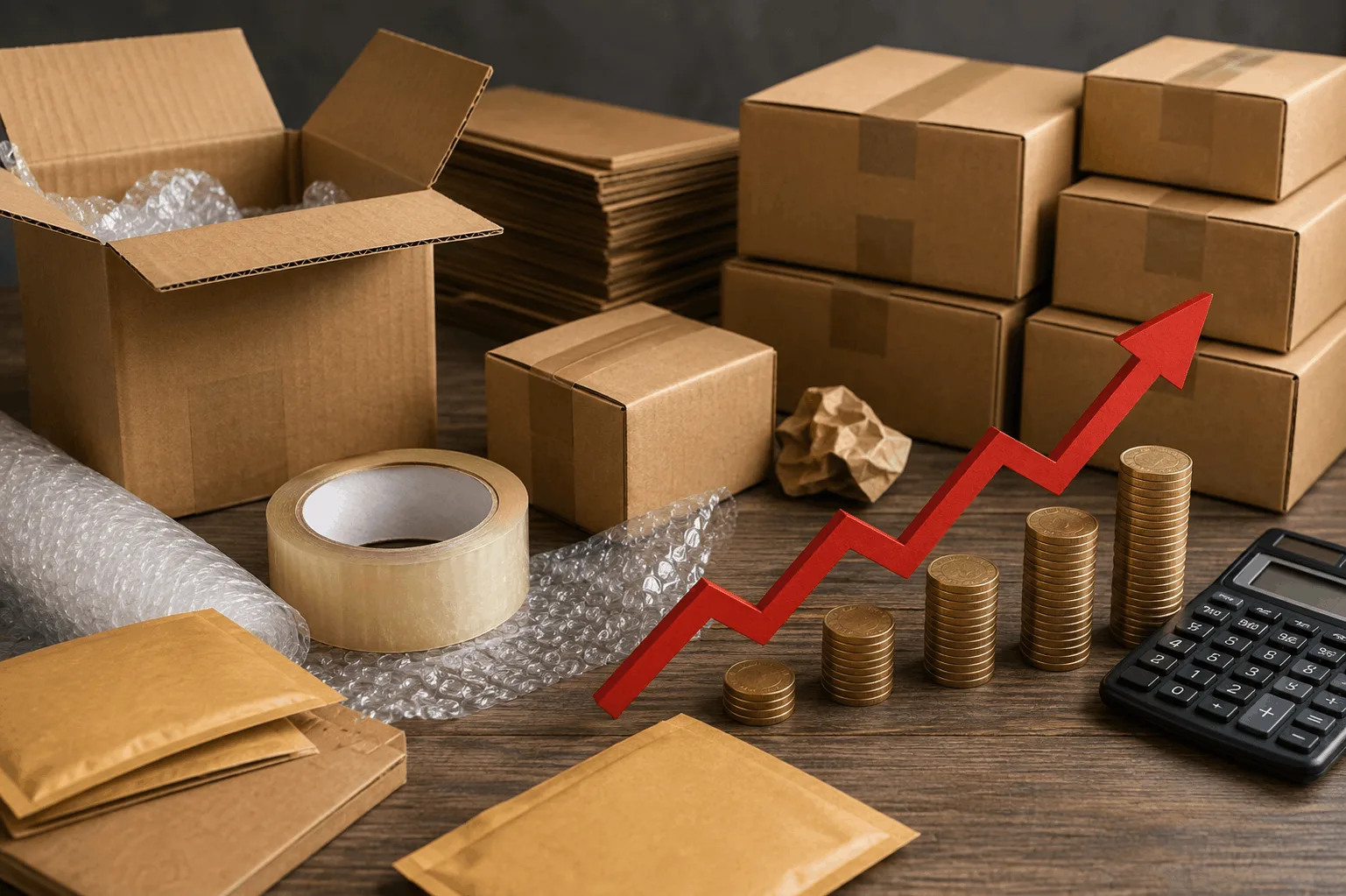
There’s a particular kind of false economy that plays out in warehouses and stockrooms across the UK every week: a business runs low on boxes or bags, places a smaller order until things settle down, and ends up paying more per unit than if they’d just ordered properly in the first place. It feels responsible in the moment not to tie up cash in stock you might not need. In practice, it’s usually the opposite of responsible. It’s one of the quieter ways growing businesses bleed margin without ever noticing where it went.
Why Small Orders Feel Safe but Rarely Are
Ordering little and often feels like a cautious choice. It avoids tying up cash, avoids committing to storage space you might not have, and avoids the discomfort of a large invoice. The problem is that packaging, unlike most other business costs, is something almost every operation needs on a completely predictable, repeating basis. Packaging is not a discretionary purchase made to hedge against uncertain demand; rather, it is a near-certainty that significantly alters the financial calculation.
The Per-Unit Cost That Often Goes Untracked
Most businesses track the total they spend on packaging over a month or a quarter, but far fewer break that figure down to cost per unit, which is the actual price of a single postage bag, a single carrier bag, or a single box. That is the number that gradually increases for small orders. Suppliers price in volume for a reason: it costs roughly the same to pick, pack, and dispatch an order of 500 units as it does 5,000, but the revenue on the smaller order is a fraction of the larger one. The per-unit price directly reflects that gap, regardless of whether a business notices it. The per-unit price directly reflects this gap, regardless of whether a business is aware of it.
Where the Extra Cost Actually Comes From
It’s worth being specific about this, because “buying in bulk is cheaper” is a fairly generic claim on its own. The real cost of under-ordering breaks down into a few distinct places.
Delivery Charges Add Up Faster Than People Expect
Every reorder generally comes with its delivery cost, whether that’s charged directly or baked into a slightly higher unit price on smaller orders. A business placing four small orders across a month is often paying for four separate deliveries, when one larger order could have covered the same period for a single delivery charge instead. Many suppliers also offer free next-working-day delivery once an order crosses a certain value threshold, which small, frequent orders simply never reach.
The Time Cost of Constantly Reordering
There’s also a cost that rarely shows up on an invoice at all: the time spent actually managing frequent reorders. Someone must notice when stock is low, check the current pricing, place the order, and follow up if there are delays; this time directly reduces the hours available for other business activities. For a small operation, the time spent managing frequent reorders is often the more expensive cost of the two, even though it’s the one nobody puts a number on.
The Real Risk of Running Out Entirely
Perhaps the sharpest cost of all is what happens when the timing goes wrong and stock runs out before the next small order arrives. A business that runs out of postage bags or carrier bags on a busy day faces more than just a minor inconvenience; it experiences significant challenges, including delayed dispatch, unhappy customers, and, in some cases, the need to source an emergency top-up at a higher price from any available stock. That emergency purchase is almost always the most expensive packaging a business buys all year, and it’s entirely avoidable with better ordering habits.
Where This Shows Up Most Clearly: Everyday Packaging
The businesses most exposed to this pattern are usually the ones going through high volumes of relatively low-cost, everyday materials, which are precisely the kind of items that feel too “ordinary” to plan around carefully but add up fastest.
Postage Bags: High Volume, Easy to Underestimate
A postage bag is a small, inexpensive item on its own, which is precisely why businesses tend to underestimate how much they’ll actually use over a month. E-commerce sellers shipping clothing, soft goods, or documents typically go through postage bags at a volume that makes small, reactive ordering genuinely inefficient. But buying properly in bulk, in the right size and colour for the business, tends to bring the per-bag cost down meaningfully once the volume increases past a certain point.
Plastic Carrier Bags: Still a High-Frequency Cost for Many Retailers
The same logic applies to plastic carrier bags for retail and market-stall businesses. These are used constantly, in genuinely predictable volumes tied directly to footfall or sales, which makes them one of the easier categories to plan a proper bulk order around rather than restocking reactively whenever a box runs low behind the counter.
How to Actually Fix the Pattern
Recognising the problem is the easy part. Changing the ordering habit itself takes a bit more discipline, but it’s a genuinely manageable shift.
1. Work Out Real Usage, Not Guessed Usage
The starting point is simply looking at actual consumption over the last few months, rather than guessing. Most businesses are surprised by how predictable their packaging usage actually is once they look at it properly, which makes it far easier to size a bulk order against real need rather than ordering defensively in small, frequent batches.
2. Choose a Packaging Supplier Built for Volume, Not Just Availability
Not every supplier is genuinely set up to support wholesale packaging materials at scale. It’s important to seek out packaging suppliers who provide a comprehensive range of products, competitive trade pricing for bulk orders, and reliable, rapid delivery, especially for larger orders, rather than relying on suppliers who are suitable for occasional small purchases but struggle with larger orders.
3. Treat free delivery thresholds as a planning tool, not a coincidence.
Many suppliers offer free next-working-day delivery once an order exceeds a certain value. Rather than treating that threshold as incidental, it’s worth actively planning orders around it, as a slightly larger order that clears the free delivery threshold often works out cheaper overall than two smaller orders that each incur a separate delivery charge.
Summing Up
To sum up, it is always best to ensure that you invest in bulk packaging materials rather than opting for packaging materials in bits and pieces. Ordering in small batches will lead to greater losses in the future and, therefore, to an accumulated loss in the business. So, always buy the best packaging materials in bulk for peace of mind and savings.