Discrete manufacturing sectors such as aerospace, medical devices, and automotive engineering operate under a relentless mandate to accelerate product lifecycles. Moving from a conceptual sketch to a functional prototype, and ultimately to production-ready hard tooling, represents the most volatile phase of this cycle. Errors introduced during early-stage modeling compounds downstream, resulting in failed prototype runs and blown budgets. Successfully auditing third-party CAD design services requires a sophisticated framework that balances technical fluency, manufacturing domain expertise, and robust data management.
The Prototyping Bottleneck: Why Model Integrity Directs Manufacturing Success
What is the primary cause of prototyping failures during the transition from digital design to physical manufacturing?
Prototyping failures usually stem from a lack of Design for Manufacturability (DFM) awareness in the digital model, where geometries look flawless on screen but violate physical material limits or tool path constraints on the factory floor.
When engineering teams rush through early design phases, they often overlook downstream manufacturing processes. For instance, a part intended for rapid prototyping via stereolithography (SLA) requires entirely different wall thicknesses and support strategies than a part destined for injection molding. Engaging qualified CAD design services early mitigates this friction by ensuring the underlying models account for physical production limitations from day one, avoiding massive re-tooling costs. A model lacking appropriate draft angles or parting lines will inevitably lock up in a mold, adding massive re-tooling costs and weeks of delay to the launch schedule.
Strategic Criteria for Evaluating Enterprise CAD Design Services
What specific capabilities should engineering leaders demand when vetting external CAD partners?
Organizations must prioritize partners that demonstrate strict parametric modeling discipline, comprehensive knowledge of Geometric Dimensioning and Tolerancing (GD&T), and deep structural familiarity with downstream tooling processes.
Selecting elite CAD design services is about securing a predictable path to production. Decision-makers must evaluate potential providers across several critical operational pillars:
- Parametric Intent and DFM: When evaluating prospective CAD design services, inspect their parametric modeling methodologies. If parameters are incorrectly constrained, modifying a single dimension breaks the entire design tree. True experts design files with clear parametric intent, allowing your team to execute rapid iterations seamlessly.
- Multi-CAD and PLM Integration: Whether your internal engineering ecosystem relies on PTC Creo or SolidWorks, your external partner must handle multi-CAD native files seamlessly. Sharing flat neutral files (like STEP) strips out the parametric feature history. Working with a specialized provider like 3HTi ensures your outsourced CAD design services embed perfectly into your internal Product Lifecycle Management (PLM) workflows, maintaining a clean digital thread from design to tool.
Accelerating Tooling Success Through Advanced 3D CAD Modeling Services
How does advanced 3D modeling reduce production risks for complex industrial tooling?
Advanced 3D modeling eliminates tooling risks by enabling comprehensive digital assembly testing, kinematic motion analysis, and mold-flow simulations before any metal is cut.
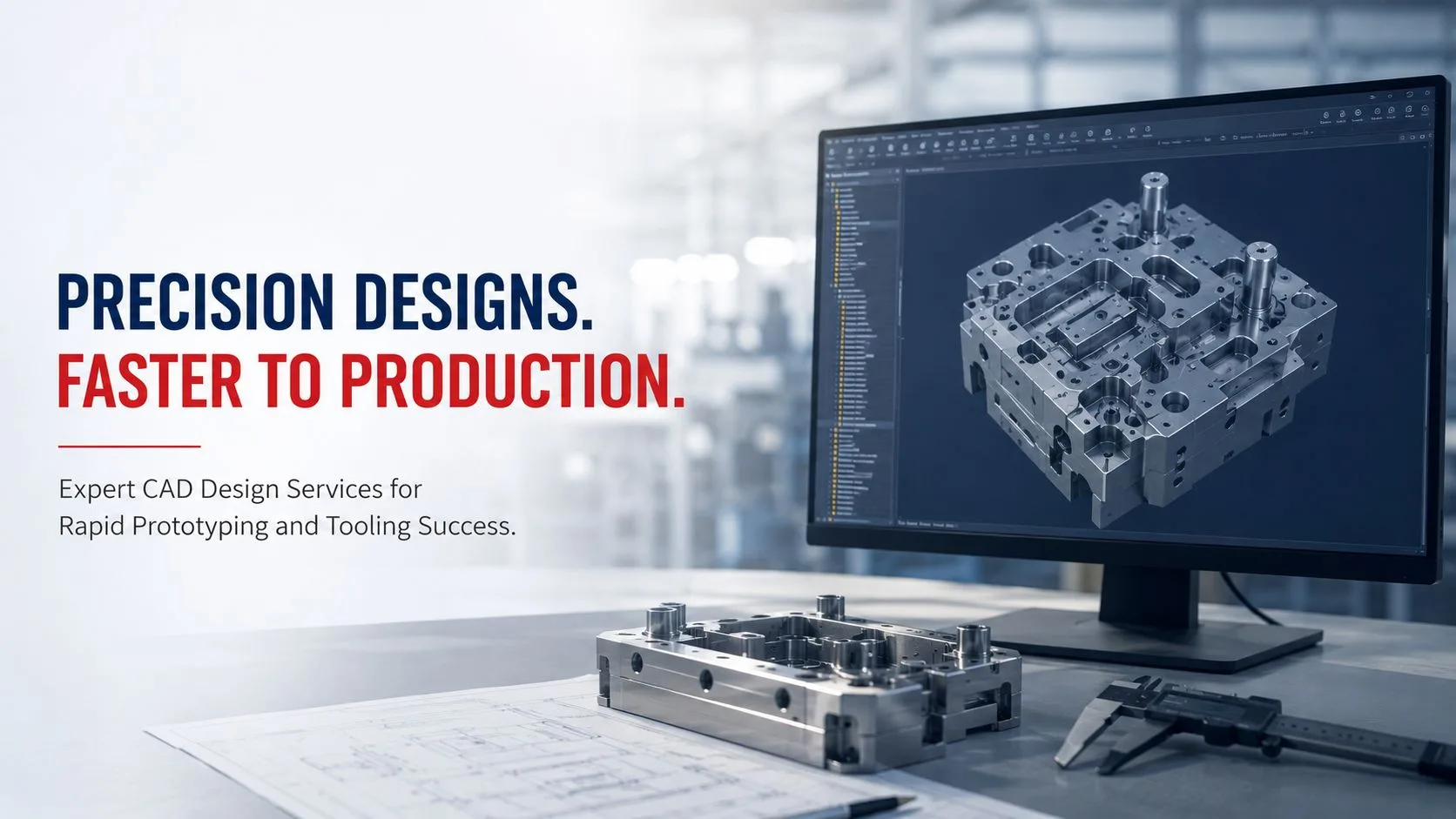
Transitioning from a prototype to production tooling represents a massive capital expenditure. Utilizing specialized 3D CAD modeling services allows manufacturing firms to simulate real-world mechanical behaviors digitally. For example, in progressive die stamping or multi-cavity injection molding, designers can execute kinematic analysis to verify slide clearance and cooling line distribution. This preventative validation ensures that hard tooling functions perfectly on the first setup, eliminating expensive manual modifications on the toolroom floor.
Common Pitfalls and Risks to Avoid in Engineering Outsourcing
Outsourcing to professional CAD design services offers massive scalability, but avoiding a few critical traps is vital to protecting your timeline:
- Accepting Non-Parametric Geometry: Component models lacking feature history prevent your internal team from making future updates easily. Always demand native feature trees.
- Overlooking Data Security Protocols: Ensure your service provider operates within secure IT infrastructures that align with compliance mandates such as ITAR, NIST, or ISO standards.
- Treating CAD as Simple Drafting: Your partner must act as a collaborative engineering resource capable of optimizing manufacturing throughput, not a basic tracing tool.
Streamlining the Journey with Modern Product Development Solutions
Why should design optimization be tied to broader enterprise engineering systems?
Tying design optimization to broader enterprise systems ensures that design revisions instantly update across downstream engineering, procurement, and manufacturing departments, preventing costly discrepancies.
Ultimately, design optimization cannot happen in a silo. True engineering velocity is achieved when design changes trigger instant updates across your entire supply chain. Integrating design activities with end-to-end product development solutions guarantees that prototype performance feedback loops directly back into your core engineering database. This holistic approach bridges the physical gap between advanced prototype testing and hard tooling validation, safeguarding product quality and keeping long-term scaling predictable.
Conclusion
Partnering with external design resources is an exceptionally effective mechanism for scaling engineering throughput and compressing development cycles. However, the value of that partnership rests entirely on the technical discipline of the provider. By focusing your evaluation on parametric model integrity, DFM expertise, and smooth enterprise software alignment, you can insulate your operations from downstream tooling errors. Investing in high-fidelity CAD design services up-front is the definitive strategy for unlocking hidden factory capacity and bringing complex products to market flawlessly.
Frequently Asked Questions (FAQs)
Q1: How do professional CAD design services ensure that digital models are optimized for injection molding tooling?
Expert service providers systematically build essential manufacturing details directly into the model, including exact draft angles, uniform wall thicknesses, and correct parting lines, preventing tool locking and reducing downstream cycle times.
Q2: What is the risk of using neutral file formats like STEP or IGES for rapid prototyping?
Neutral files flatten the parametric feature tree into a static solid. This prevents engineering teams from executing fast design changes, as any geometric alteration requires manually rebuilding the model from scratch.
Q3: Why is Geometric Dimensioning and Tolerancing (GD&T) critical for advanced tooling development?
GD&T establishes clear, standardized geometric control over part features. This guarantees that components manufactured across independent global facilities fit together perfectly, eliminating unexpected tolerance stack-up issues during final assembly.
Q4: How do 3D CAD modeling services shorten the development lifecycles of complex medical devices?
These services create highly precise digital twins that allow engineers to perform kinematic simulations and stress analyses early, identifying structural vulnerabilities before investing capital in physical prototypes or regulatory compliance testing.
Q5: Can external CAD design services adapt directly to our internal PLM data structures?
Yes. Experienced engineering integrators map their outputs to match your custom lifecycle states, naming conventions, and revision controls, ensuring all outsourced files blend seamlessly back into your enterprise PLM environment.
Q6: What distinction should be made between rapid prototyping design and production tooling design?
Prototyping design prioritizes fast form, fit, and functional validation using flexible parameters. Tooling design enforces rigid structural, thermal, and mechanical constraints required to endure millions of manufacturing compression cycles without material failure.
Q7: How do holistic product development solutions lower overall product launch costs?
These frameworks bridge the gaps between design, simulation, and manufacturing. Catching errors in the digital workspace instead of during hard tooling production prevents expensive scrap material runs and avoids launch delays.