Most people who give money online never think about what happens before the donate button appears on their screen. They land on a fundraising page, read something that moves them, enter their card details, and walk away feeling good about it. The entire experience is designed to feel simple and direct. What nobody advertises is the verification work that had to happen first — the document checks, the government database searches, the financial reviews, and the back-and-forth with compliance teams that determines whether a charity earns the right to appear on a platform at all.
That verification work is unglamorous, time-consuming, and genuinely complicated. It also happens to be one of the most important things a donation platform does.
The environment platforms are operating in now looks nothing like it did fifteen years ago. Early fundraising websites were modest in scope. The charities on them were often locally or regionally known, the donor bases were manageable in size, and a small team could realistically stay on top of the review workload without too much difficulty. That picture has changed completely. Today's platforms deal with organizations from dozens of countries, each registered under different national laws, each subject to different rules around financial reporting, governance, and accountability. Managing all of that simultaneously is a serious operational undertaking that most donors never see and rarely think about.
The Foundation of Donor Trust
Every online donation rests on an assumption that the donor almost never states out loud. When someone gives through a fundraising platform, they are not just trusting the charity — they are trusting that the platform has already done the hard work of confirming that the charity is real and legitimate. Nobody reads terms and conditions before donating to earthquake relief. People give on instinct, and they do so on the unstated belief that somebody responsible has already run the necessary checks.
"Donor trust is not built in the moment someone clicks donate. It is built through every verification decision a platform makes before that button ever appears."
That belief holds most of the time. When it does not — when a donor later finds out that the organization they supported had no genuine charitable purpose, or that their money went somewhere entirely different from what was described — the damage runs beyond that individual transaction. It becomes a news story. It makes people more cautious about giving online in general. One well-publicized failure can follow a platform for years and make donors more hesitant across the board, regardless of whether the platform has since tightened its standards.
This is the real weight behind verification. In the United States, confirming 501(c)(3) status through the IRS is the standard starting point, establishing that an organization is federally recognized and operating for legitimate charitable purposes. In the United Kingdom, registration with the Charity Commission serves a comparable function. Every other country has its own equivalent system with its own documentation requirements and its own processes for confirming that an organization remains in good standing. A platform operating internationally has to navigate all of these frameworks at once, and the places where they do not align are exactly where problems tend to surface.
What the Verification Process Actually Involves
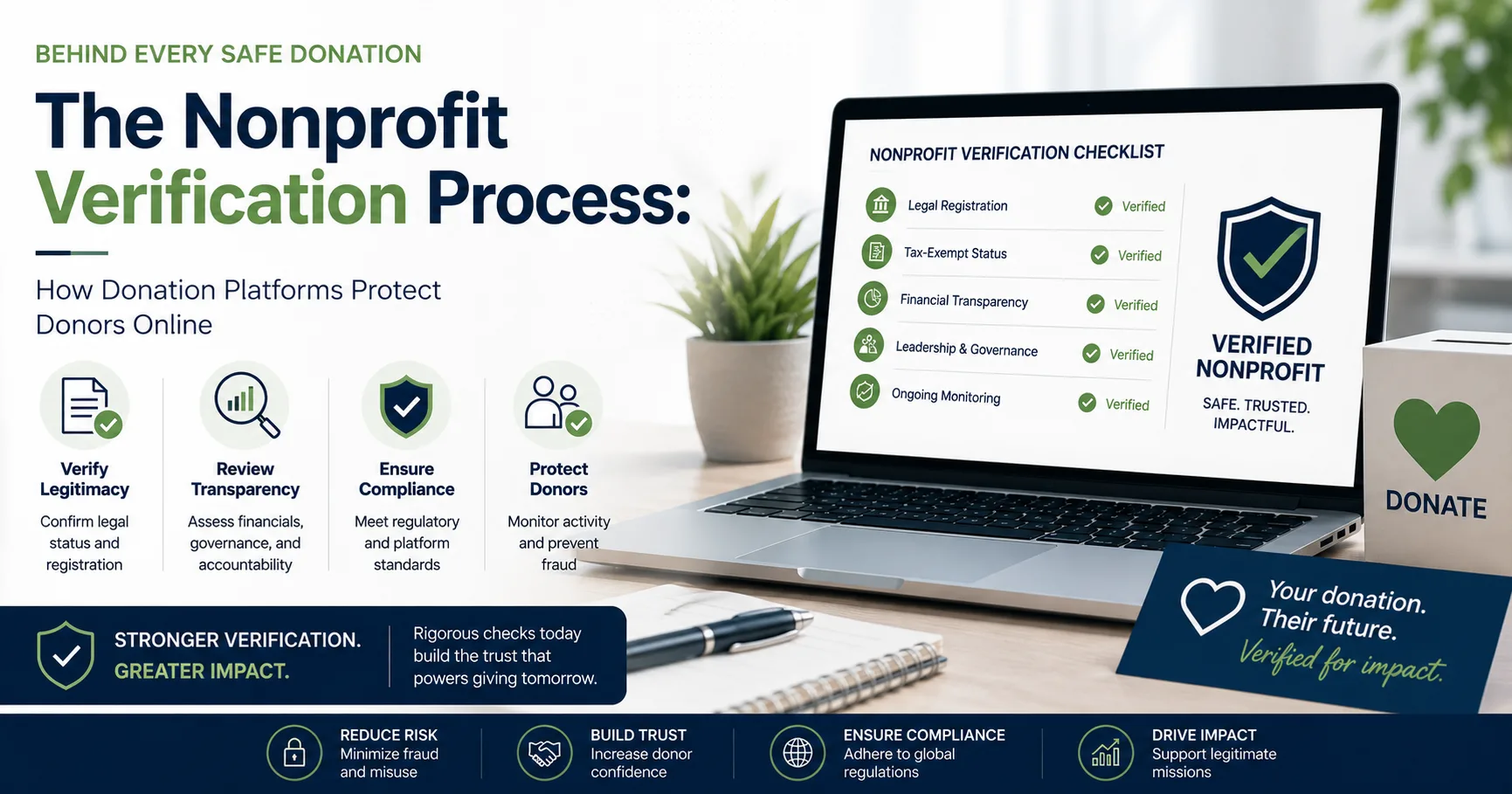
Verification is not a single check that either passes or fails. It is a sequence of distinct inquiries, each looking at a different dimension of an organization's legitimacy. Below is a breakdown of the core layers most reputable platforms work through:
Verification LayerWhat It ExaminesCommon ComplicationsLegal RegistrationWhether the organization is a recognized legal entity under its home country's lawsOutdated records, name changes, structural reorganizationsFinancial AccountabilityHow donated income is used, leadership compensation, spending patternsHigh overhead ratios, inconsistent filings, missing audit trailsIdentity VerificationWhether the applicant is genuinely authorized to represent the organizationPublic registration details being misused by unauthorized partiesOngoing MonitoringWhether an organization's good standing has changed since it first joinedRevoked statuses, regulatory investigations, leadership changesLegal registration is the starting point. The basic question is whether the organization actually exists in the way it claims to. For established charities in countries with well-maintained public registries, this can often be confirmed without too much difficulty. But records go out of date. Organizations restructure or change their names. Sometimes what an organization calls itself publicly does not match exactly what appears in official documentation. A check that looks routine at the outset can become more involved when the details do not line up.
Financial accountability tends to be where the most revealing information comes out. Tax filings like the Form 990 in the United States, annual reports, and independently audited accounts give a real picture of how an organization handles money. What share of its income actually reaches the programs it advertises? How is its leadership paid? Do the spending patterns make sense given the stated mission? A charity consistently reporting high administrative costs relative to program delivery may have a reasonable explanation for that — but the explanation should be confirmed rather than assumed.
Identity verification addresses a risk that is easy to overlook. The fact that a nonprofit is legally registered says nothing about whether the person filing an application on its behalf actually has the authority to do so. Registration details are publicly accessible in many jurisdictions, which means someone could theoretically use a legitimate charity's information to open a fundraising account without any genuine connection to that organization. Preventing this requires confirming authorization actively, not just accepting that the applicant knows the right details.
Ongoing monitoring is the layer that tends to get underweighted relative to its importance. An organization that was fully compliant when it joined a platform two years ago may look quite different today. Tax-exempt statuses get revoked. Regulatory concerns arise. Leadership changes can shift how an organization is governed in ways that matter. Treating verification as a one-time entry requirement and then leaving organizations to run indefinitely without further review means making current assumptions based on past information.
Where the Process Gets Difficult
The challenges in nonprofit verification are practical and persistent. Anyone who has spent time in compliance work knows that the straightforward cases are rarely the ones that define the job.
“The hardest part of verification is not finding the fraudulent applications — it is finding them quickly enough, during exactly the moments when there is the least time to look carefully.”
Data fragmentation sits at the core of the problem. There is no single global database of verified charities. Every country maintains its own registry on its own schedule using its own definitions of good standing. Building an accurate picture of an international organization's status means working across multiple independent systems that were built for entirely different purposes and that do not communicate with each other.
Language adds another layer of difficulty for organizations based in countries where official documents are produced in different languages or writing systems. This is not simply a translation issue. Legal terminology carries precise meaning in specific regulatory contexts, and that meaning does not always carry over cleanly. Authenticating foreign documents and drawing confident conclusions about compliance requires both linguistic and regulatory familiarity that not every compliance team has on hand.
Fraud is a consistent pressure rather than an occasional problem. It intensifies at predictable times — major natural disasters, humanitarian crises, and large-scale emergencies all generate sharp increases in public generosity, and those increases attract organizations with no genuine charitable purpose. Some are entirely fabricated. Others hold technical registrations but have no meaningful program activity. Identifying them during a period when platforms are simultaneously handling increased legitimate traffic requires real operational discipline.
The table below illustrates how fraud risk tends to shift across different scenarios:
SituationFraud Risk LevelPrimary Risk TypeMajor natural disasterHighNewly created fictitious organizationsOngoing humanitarian crisisHighRegistered entities with no program activityStandard application periodModerateIdentity impersonation of legitimate charitiesPost-crisis periodModerateOrganizations that collected and then went dormantRoutine operationsLowerDocumentation irregularities, outdated filingsManual review creates a structural tension that grows alongside platform size. A compliance team can do careful, thorough work on a volume of applications proportionate to its capacity. Once that volume exceeds what the team can handle, something gives — either the process slows down and legitimate charities wait far too long, or the depth of review on each case gets compressed. Neither outcome is good, and platforms that have not grown their compliance operations in proportion to their overall size tend to feel this tension at the worst possible times.
Technology Helps, But Only Up to a Point
The tools available for verification have improved meaningfully over recent years. Live API connections to government charity registries allow platforms to check current registration status rather than working from a snapshot of data that may be months out of date. Automated screening can be configured to flag specific inconsistencies — a registration number that does not return a match in official records, or document characteristics that do not match what genuine filings typically look like.
Document processing tools have made it faster to work through financial filings and governance disclosures when application volumes are high. Work is ongoing in applying pattern recognition to identify applications that share characteristics with previously flagged fraudulent submissions, though these systems are still maturing and their accuracy depends heavily on the quality of the data underlying them.
"Automation handles the volume. It does not handle the judgment. Those are two different problems, and only one of them has a technological solution."
What technology does not do is replace the judgment of someone who knows what they are looking at. Experienced compliance staff understand not just what a suspicious filing looks like, but why it looks that way and what it means. They recognize when something feels wrong even when it is technically in order. Platforms that have leaned heavily into automation while cutting back on human compliance capacity have sometimes discovered, at difficult moments, that the two approaches work best as complements rather than as alternatives to each other.
What Donors Actually Expect
Donor expectations around verification are not sophisticated, and that is not a criticism — it is just the reality of how most people approach giving. They want to donate through a platform they trust to an organization they believe in. They want to feel that confidence is warranted. Most donors are not asking for documentation of the review process and would not read it if it were offered. The actual expectation, stated plainly, is that somebody responsible has already done the checking.
That is a simple expectation to describe and a demanding one to consistently meet. Donors extend trust freely and quickly, often without much deliberation. Platforms receive that trust without always taking stock of what it actually represents. Those that handle it seriously are not the ones doing the minimum — they are the ones that invest in verification because they understand what it means when that trust turns out to have been misplaced. Real people who gave money in good faith are the ones who pay the cost when it fails, and that matters beyond any reputational consideration.
Transparency carries value here even when most donors never actively engage with it. A platform that clearly documents how it reviews organizations, what criteria it applies, and how it handles concerns when they arise creates an accountability record that serves regulators, journalists, researchers, and the segment of donors who do investigate before giving. It also functions as internal discipline — organizations that have publicly stated their standards are more likely to maintain them consistently than those that operate without declared expectations.
Why This Work Matters More Than It Gets Credit For
Verification does not attract much recognition. There are no headlines when a platform quietly rejects a fraudulent application. There is no enthusiasm generated by a thorough compliance process. This work sits in the background of an industry that talks frequently about impact, generosity, and community. But it underpins all of those things.
The confidence a person feels donating online to an organization they have only just discovered, through a platform they chose somewhat casually, is grounded in the assumption that someone has already verified who is on the receiving end of that money. When that assumption holds, giving online works. When it does not, the consequences reach beyond the immediate incident and chip away at the general willingness to trust digital fundraising as a practice.
Progress has been real and meaningful. Better tools, improved data access, and clearer understanding of where the most serious risks concentrate have all moved the field forward compared to where it was a decade ago. But the problem has grown alongside the solutions, and the two have not kept the same pace. Platforms that stay honest about the difficulty of this work, keep investing in doing it properly, and treat compliance as a core function rather than a cost to be minimized are the ones that build something worth sustaining. In an industry that runs entirely on the willingness of people to trust, that kind of investment is not optional — it is the whole point.