
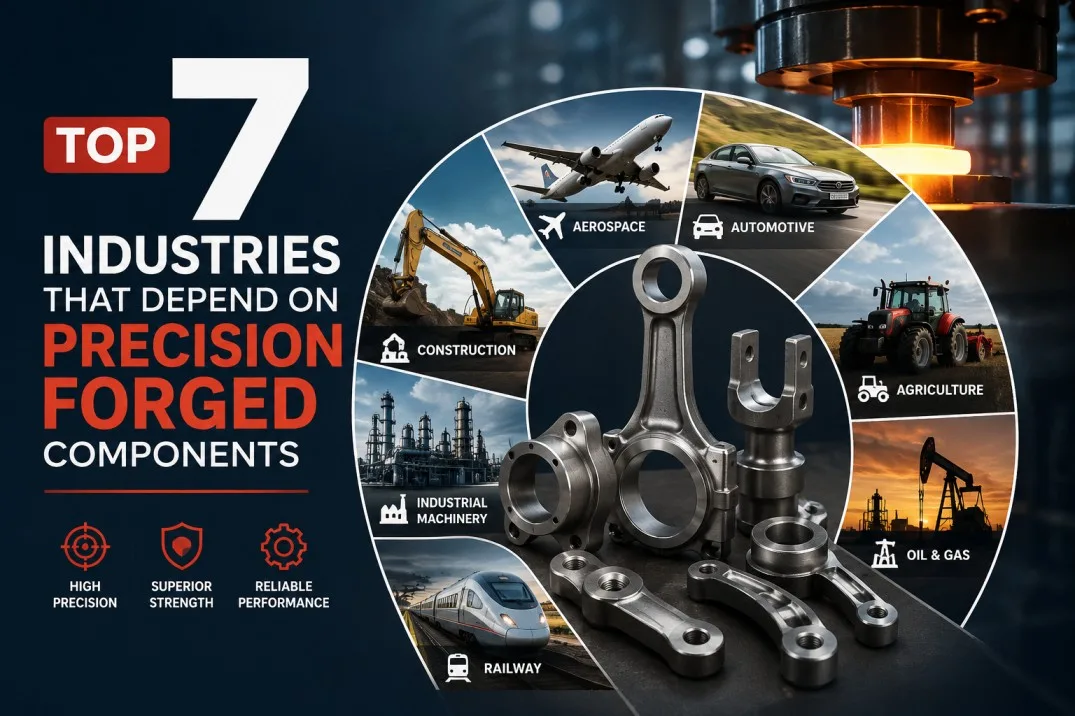
Why Precision Forging Is the Backbone of Modern Manufacturing
Every day, millions of machines, vehicles, and industrial systems operate under extreme pressure, temperature, and stress. From aircraft engines to construction equipment, these industries share one common requirement: components that are exceptionally strong, reliable, and durable.
This is where precision forged components play a critical role.
Unlike cast or machined parts, precision-forged components are manufactured by shaping heated metal under high pressure. This process aligns the grain structure of the metal, resulting in superior strength, improved fatigue resistance, and longer service life.
As industries continue to demand lighter, stronger, and more reliable products, precision forging has become one of the most trusted manufacturing processes worldwide.
In this article, we explore the seven major industries that rely heavily on precision forged components and why forging remains the preferred manufacturing solution.
1. Automotive Industry
The automotive sector is one of the largest consumers of forged components.
Modern vehicles require thousands of parts capable of handling continuous loads, vibrations, and changing road conditions.
Common forged automotive components include:
- Crankshafts
- Connecting rods
- Steering knuckles
- Transmission gears
- Axle shafts
- Wheel hubs
Why forging is preferred
- High fatigue strength
- Better wear resistance
- Improved safety
- Longer service life
- Reduced material waste
As electric vehicles continue to grow, manufacturers increasingly depend on lightweight yet durable forged components for enhanced efficiency.
2. Agriculture Equipment Manufacturing
Agricultural machinery operates in some of the harshest working environments.
Tractors, harvesters, tillers, and cultivators face constant impact loads, mud, dust, and heavy mechanical stress.
Typical forged agricultural components include:
- Gear blanks
- Shafts
- Flanges
- Hydraulic fittings
- Couplings
Hitch components
Precision forging improves equipment durability while reducing maintenance costs for farmers.
3. Construction & Earthmoving Equipment
Construction machinery operates continuously under heavy loads.
Equipment such as excavators, loaders, cranes, and bulldozers require components capable of enduring years of demanding use.
Common forged components include:
- Pins
- Bushings
- Hydraulic parts
- Track components
- Lifting hooks
- Gear parts
Forged components provide:
- Superior impact resistance
- High tensile strength
- Better dimensional stability
- Longer operational life
4. Railway Industry
Rail transportation demands uncompromising reliability.
Even a minor component failure can lead to significant operational and safety issues.
Precision forging is widely used for manufacturing:
- Couplers
- Brake system parts
- Suspension components
- Wheel hubs
- Connecting assemblies
- Axle components
These parts must withstand continuous vibration, dynamic loading, and varying environmental conditions.
5. Oil & Gas Industry
Few industries place greater stress on mechanical components than oil and gas.
Drilling operations, offshore platforms, and refining equipment require parts that can tolerate:
- High pressure
- Corrosion
- Elevated temperatures
- Continuous operation
Typical forged products include:
- Flanges
- Valves
- Connectors
- Pressure fittings
- Shafts
- Rings
Forged components significantly improve operational safety and equipment reliability.
6. Industrial Machinery & Manufacturing
Factories rely on precision machinery that operates around the clock.
Forged components are essential for:
- CNC machines
- Press machines
- Material handling equipment
- Industrial gearboxes
- Compressors
- Pumps
The accuracy and strength of forged parts help minimize downtime while improving manufacturing efficiency.
7. Defense & Aerospace
Among the most demanding sectors, defense and aerospace require components that meet the highest standards of quality and reliability.
Applications include:
- Landing gear components
- Aircraft structural parts
- Engine components
- Defense equipment
- Missile system components
- Heavy-duty fasteners
Precision forging offers:
- Exceptional strength-to-weight ratio
- Excellent fatigue resistance
- Reliable performance under extreme conditions
- Strict dimensional accuracy
Every forged component undergoes rigorous quality inspection to meet industry standards.
Why Precision Forging Is Better Than Casting or Machining
When manufacturing critical industrial components, choosing the right production process directly impacts performance, durability, and safety. Precision forging offers several advantages over conventional casting and machining methods, making it the preferred choice for demanding applications.
Superior Strength
The forging process aligns the metal's internal grain structure, resulting in components that are significantly stronger than cast parts. This enhanced grain flow improves the part's ability to withstand heavy loads and repeated stress.
Improved Fatigue Resistance
Forged components are designed to endure continuous cycles of stress without cracking or failing. This makes them ideal for industries such as automotive, aerospace, and construction, where reliability is essential.
Better Material Efficiency
Precision forging minimizes material waste by producing near-net-shape components. This reduces the amount of machining required, helping manufacturers save both time and raw material.
Enhanced Dimensional Accuracy
Modern precision forging techniques produce components with consistent dimensions and tighter tolerances, reducing the need for extensive secondary operations.
Greater Reliability
Forged parts have fewer internal defects such as porosity or shrinkage cavities, which are more common in cast components. This results in higher-quality products with a longer operational lifespan.
Cost-Effective Over the Product Lifecycle
Although the initial tooling investment may be higher, forged components often provide lower maintenance costs, fewer failures, and a longer service life, making them a more economical choice in the long run.
What Makes a Reliable Forging Partner?
When selecting a forging manufacturer, businesses should evaluate:
- Manufacturing capabilities
- Material expertise
- Quality certifications
- Precision machining support
- Heat treatment facilities
- On-time delivery
- Custom engineering support
- Industry experience
A reliable supplier doesn't simply manufacture components—it contributes to the long-term performance and success of the final product.
Final Thoughts
Precision forged components are the hidden foundation of countless industries. Whether powering automobiles, supporting infrastructure projects, or enabling advanced aerospace systems, forged parts deliver the strength, durability, and reliability modern engineering demands.
As manufacturing standards continue to evolve, precision forging will remain essential for producing high-performance components that meet increasingly stringent quality and safety requirements.
For businesses seeking dependable, high-quality forged solutions, partnering with an experienced manufacturer can make a significant difference in product performance and operational efficiency.