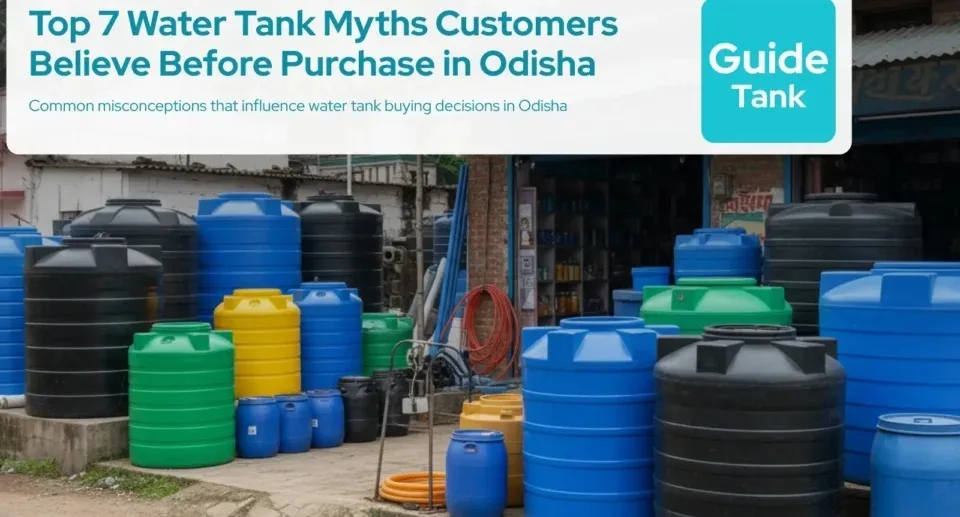
The blog “Top 7 Water Tank Myths Customers Believe Before Purchase in Odisha” highlights the common misconceptions that often mislead homeowners, builders, and retailers when choosing a water storage tank. In Odisha, buying a water tank is not a frequent purchase, which is why many people depend on recommendations from neighbours, plumbers, relatives, or local shopkeepers rather than researching the product themselves. As a result, several myths have become widely accepted, even though they may not be suitable for Odisha’s climate and water storage requirements.
The article begins by explaining why water tank myths are so common in Odisha. Water storage is usually viewed as a basic necessity rather than a technical investment. Most buyers focus on price and availability while overlooking important factors such as material quality, UV protection, layer construction, durability, and installation standards. The combination of limited product awareness and price-sensitive purchasing decisions allows misinformation to spread easily in both urban and rural markets.
The blog then discusses seven of the most common water tank myths. The first myth is that all water tanks are the same. In reality, water tanks differ significantly in terms of raw material quality, manufacturing standards, UV resistance, wall thickness, and overall durability. High-quality branded tanks are typically made from food-grade virgin plastic and are designed to withstand harsh weather conditions, while low-cost alternatives may deteriorate much faster.
The second myth is that bigger water tanks are always better. Although larger tanks may seem like a practical solution, oversized tanks can lead to stagnant water, increased maintenance costs, algae growth, and unnecessary structural load on rooftops. Choosing the right capacity based on actual household water usage is a smarter approach.
Another common misconception is that single-layer tanks are sufficient. The blog explains that multi-layer tanks provide better protection against sunlight, heat, contamination, and physical damage. Each layer serves a specific purpose, helping to improve hygiene, insulation, and overall tank lifespan.
The article also addresses the myth that price is more important than quality. While cheaper tanks may reduce initial expenses, they often result in higher long-term costs due to repairs, leakage, and replacement. Investing in a quality water tank generally provides better value over time.
Many buyers also believe that tank colour does not matter. However, colour plays a role in controlling heat absorption and preventing algae growth. Proper colour combinations can help maintain water quality, especially in Odisha’s hot and humid climate.
The blog further clarifies that warranty coverage does not mean lifetime protection. Warranties usually apply only when the tank is installed and used according to the manufacturer’s guidelines. Misunderstanding warranty terms often leads to customer disappointment during claim situations.
The final myth discussed is that installation quality does not affect tank performance. Even a premium-quality tank can fail prematurely if installed on an uneven base or fitted incorrectly. Proper installation is essential for ensuring durability and preventing structural damage.
The blog concludes by emphasizing that understanding these myths can help buyers avoid common mistakes, protect water quality, reduce maintenance expenses, and make better long-term investment decisions. It also encourages retailers to educate customers and provide accurate product information. By replacing assumptions with facts, homeowners and builders in Odisha can confidently select the right water tank for their specific needs and enjoy reliable water storage for many years.