
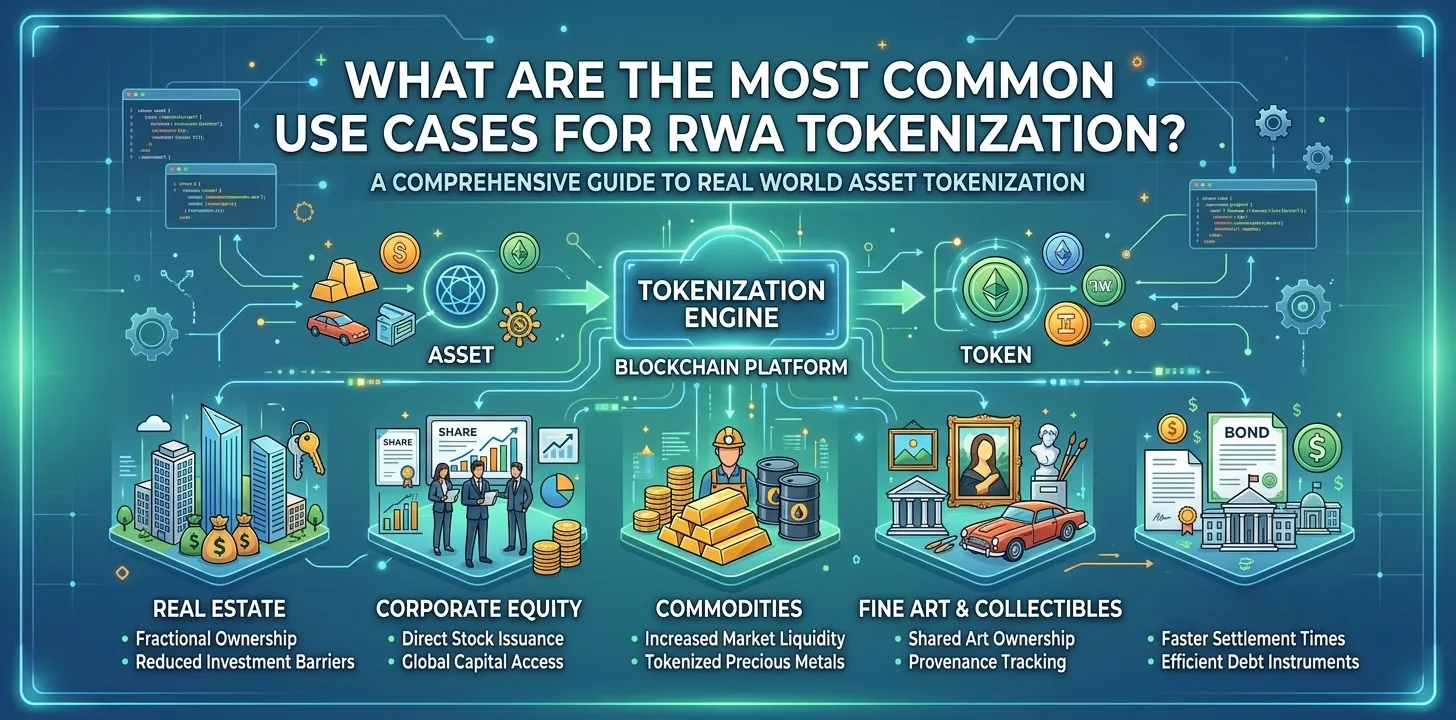
Real-world asset (RWA) tokenization is emerging as one of the most important applications of blockchain technology beyond cryptocurrencies. Instead of using blockchain primarily for native digital assets, tokenization allows ownership rights or claims associated with physical and traditional financial assets to be represented digitally on a blockchain or other programmable ledger.
This can apply to real estate, government bonds, private credit, investment funds, commodities, infrastructure, artwork and other assets. The fundamental attraction is not simply that an asset receives a “crypto token.” The bigger opportunity is to connect ownership, compliance, transfer rules, settlement and financial logic within a programmable system.
The Bank for International Settlements (BIS) describes tokenization as recording claims on real or financial assets on a programmable platform. It highlights the ability to combine messaging, reconciliation and settlement into a more seamless process, including programmable delivery-versus-payment transactions.
Interest is also reflected in market forecasts. McKinsey estimates that tokenized financial assets could reach approximately $2 trillion in market capitalization by 2030 in its base case, excluding cryptocurrencies and stablecoins. Its analysis identifies funds, bonds, loans and securitization among the asset classes with strong potential for adoption.
But where is RWA tokenization actually useful? The answer extends well beyond real estate. Below are some of the most significant and practical use cases.
1. Real Estate Tokenization
Real estate is arguably the most recognizable RWA tokenization use case because property is valuable, relatively illiquid and often requires substantial capital to purchase.
Traditionally, buying a property involves large upfront capital, extensive documentation, legal intermediaries and lengthy settlement processes. Tokenization can restructure the ownership model by representing shares or economic interests in a property or property-holding entity as digital tokens.
For example, suppose a commercial property is valued at $10 million. Instead of requiring one investor to purchase the entire asset, an appropriately structured offering could divide the economic interest into a large number of digital units. Investors could potentially purchase smaller portions, subject to applicable securities, property and investor-eligibility regulations.
The important distinction is that tokenization does not automatically change the underlying legal ownership. The token must be legally connected to an enforceable ownership right, security, fund interest, debt claim or other contractual arrangement.
Tokenization can also improve administration. Rental income, distributions, ownership records, transfer restrictions and corporate actions can potentially be incorporated into a digital infrastructure. This makes real estate particularly attractive for fractional ownership and automated asset servicing.
The BIS has specifically identified real estate as an asset class that could benefit from fractionalization and broader access, although it also emphasizes that tokenization introduces regulatory and operational considerations.
2. Tokenized Government Bonds and Treasury Securities
Government bonds are another major RWA tokenization application because they have standardized structures, established markets and significant settlement infrastructure.
Tokenized bonds can represent claims on government debt through blockchain-based instruments. Investors can potentially benefit from faster settlement, programmable transfers and more streamlined recordkeeping.
The opportunity is not purely theoretical. According to BIS research published in 2025, more than 20 tokenized sovereign and supranational bonds had been issued, exceeding $4 billion across nine currencies by mid-2025. The BIS also reported that early tokenized bond markets showed bid-ask spreads that could be narrower than conventional bonds, although the market remains at an early stage.
One particularly interesting application is collateral management. Tokenized government securities can potentially move between financial institutions more quickly and be incorporated into programmable collateral arrangements.
For example, a smart contract could automatically verify collateral requirements and transfer eligible tokenized securities when predetermined conditions are met. This could reduce manual intervention while shortening settlement processes.
3. Tokenized Investment Funds
Investment funds are another strong candidate for tokenization. Mutual funds, private equity funds, money-market funds and alternative investment vehicles traditionally depend on multiple layers of administration involving fund managers, transfer agents, custodians and other intermediaries.
Tokenization can create a digital representation of fund units while connecting ownership records with automated compliance and administrative processes.
Investors could potentially receive tokenized fund interests that support more efficient subscription, transfer, redemption and distribution processes. Depending on the regulatory framework, smart contracts can also help enforce investor eligibility, holding restrictions and transfer rules.
This is one reason McKinsey identifies mutual funds and exchange-traded funds among the asset classes likely to be relatively early adopters of tokenization.
The value proposition is particularly compelling for funds with large numbers of investors and complex administrative requirements. Instead of maintaining disconnected records across several systems, organizations can move toward a shared and programmable infrastructure.
4. Private Credit and Tokenized Loans
Private credit has traditionally been difficult to access because loans are negotiated privately, have limited liquidity and require extensive documentation and servicing.
Tokenization can represent loan claims, debt instruments or interests in private-credit portfolios as digital assets. This could make loan administration more transparent while potentially creating new mechanisms for transferring eligible interests.
Consider a business loan backed by equipment or other collateral. A tokenized structure could represent the lender's economic interest while smart contracts manage certain processes such as payment schedules, interest calculations or distribution rules.
The opportunity is particularly relevant as private credit has expanded significantly. Reuters reported in 2026 that private-credit assets in the UK alternative investment fund sector had more than doubled since 2021, reaching £335 billion by 2025.
However, tokenizing private credit does not eliminate credit risk. The underlying borrower can still default, collateral can still lose value and legal enforcement remains essential. Tokenization primarily changes how claims are represented, administered and potentially transferred.
5. Commodities and Precious Metals
Gold, silver, agricultural commodities, energy products and other physical commodities can also be represented through tokens.
A tokenized commodity typically needs a credible mechanism connecting the digital token with the underlying physical asset. For example, a gold-backed token may represent a claim to a specified quantity of gold held by a custodian.
This model can provide investors with a digital way to gain exposure to physical commodities without personally storing the underlying asset.
The critical issue is verification. Investors need confidence that the physical commodity exists, is properly segregated or allocated where required, and can be redeemed according to the terms of the token. Consequently, custody arrangements, audits and legal enforceability are just as important as blockchain technology.
6. Tokenized Corporate Bonds and Debt Securities
Corporate debt is another natural application because bonds already represent standardized financial claims.
A company can potentially issue debt securities through a tokenized platform, with the blockchain representing ownership and transaction history. Smart contracts can automate elements such as coupon payments, maturity events and investor restrictions.
This is particularly relevant to the broader concept of delivery-versus-payment (DvP). Rather than securities changing hands separately from payment, programmable systems can coordinate both sides of the transaction.
BIS identifies DvP as a canonical tokenization use case because the asset transfer and payment can be linked so that one occurs only when the required condition on the other side is satisfied.
Such functionality could reduce settlement risk and minimize some of the reconciliation work associated with traditional financial infrastructure.
7. Private Equity and Alternative Assets
Private equity interests are generally illiquid and difficult to transfer. Investors may need to remain invested for years before receiving an exit.
Tokenization could represent ownership interests in private companies, private equity funds or alternative investment vehicles. In a properly regulated environment, this could create more flexible mechanisms for managing ownership and secondary transfers.
The major benefit is not necessarily turning private equity into a highly liquid asset overnight. Instead, tokenization can establish infrastructure that makes ownership records easier to manage and potentially makes compliant secondary markets more practical.
This distinction is important. Tokenization does not automatically create liquidity. There must also be sufficient buyers, appropriate regulations, reliable valuation mechanisms and suitable trading infrastructure.
8. Infrastructure and Renewable Energy Assets
Large infrastructure projects often require substantial capital and have long investment horizons. Examples include solar farms, wind projects, data centers, transportation infrastructure and energy facilities.
Tokenization can potentially divide the economic interests in these projects into smaller digital units, allowing different categories of investors to participate where regulations permit.
For renewable-energy projects, tokenized interests could potentially be connected to revenue generated by an operational asset. Smart contracts may also be used to automate certain distribution mechanisms.
This creates an interesting intersection between RWA tokenization and sustainable finance. Instead of merely recording ownership, tokenized infrastructure can potentially connect investment rights with measurable project cash flows.
9. Art, Collectibles and Other High-Value Physical Assets
Fine art, luxury collectibles, rare items and other valuable physical assets can also be tokenized.
A token could represent fractional economic ownership or a contractual claim associated with a particular asset. This potentially allows investors to participate in markets that traditionally required specialized knowledge and significant capital.
However, valuation and authenticity are major challenges. Unlike standardized government bonds, an artwork does not have a universally accepted market price. Provenance, insurance, custody and authenticity therefore become central components of any credible tokenization model.
Blockchain can provide a transparent record of transactions, but it cannot independently prove that a physical object is genuine. Reliable off-chain verification remains essential.
10. Tokenized Collateral and Financial Settlement
One of the more important institutional applications of RWA tokenization is collateral management.
Banks and financial institutions constantly move collateral to support lending, derivatives and other transactions. Traditional processes can involve multiple systems, intermediaries and reconciliation steps.
Tokenized securities can potentially be transferred and monitored through programmable infrastructure. Smart contracts could automatically determine whether collateral requirements are satisfied and initiate predefined actions.
The BIS notes that tokenized government securities could support faster collateral transfers and tokenized repo transactions, potentially improving liquidity management and reducing settlement risks.
This demonstrates why institutional tokenization may ultimately focus less on retail speculation and more on improving financial-market infrastructure.
Why These Use Cases Matter
Although the assets differ, many RWA tokenization use cases address the same underlying problems: fragmented records, slow settlement, limited accessibility, high administrative costs and inefficient asset transfers.
Tokenization can potentially combine several functions within a single programmable environment:
- Digital ownership or claim representation
- Automated compliance rules
- Transparent transaction records
- Fractional ownership
- Programmable payments
- Automated distributions
- Faster settlement
- Potentially improved transferability
- More efficient collateral management
The BIS argues that tokenization can integrate messaging, reconciliation and settlement into a more seamless operation. This is arguably more significant than simply putting existing assets “on-chain.”
Challenges That RWA Tokenization Must Overcome
Despite its potential, RWA tokenization is not a technology-only project. The connection between an on-chain token and an off-chain asset is fundamental.
Legal ownership must be clearly defined. Regulatory requirements must be satisfied. Investors need appropriate disclosures and protections. Custodians must reliably hold physical assets when applicable. Oracles and external data providers may be needed to deliver information such as valuations or asset performance.
There is also the question of liquidity. A tokenized property is not necessarily liquid simply because it exists on a blockchain. A functioning secondary market requires buyers, sellers, regulatory permission and appropriate market infrastructure.
The Financial Stability Institute at BIS has similarly noted that tokenization remains relatively small in scale and that expected benefits must be balanced against operational complexity, liquidity pressures and regulatory uncertainty.
Therefore, successful RWA projects need to combine blockchain infrastructure with legal structuring, compliance, custody, asset verification and market access.
What Is the Future of RWA Tokenization?
The future of RWA tokenization is likely to be driven by practical financial applications rather than tokenization for its own sake.
Government securities, investment funds, loans, bonds and other financial instruments have characteristics that make them particularly suitable for programmable infrastructure. McKinsey expects these asset classes to be among the major drivers of tokenized-market growth through 2030.
Meanwhile, physical assets such as real estate, commodities and infrastructure can benefit from fractionalization and more efficient ownership administration, but they face greater legal, custody and valuation challenges.
The most important evolution may therefore be the development of financial ecosystems in which tokenized assets and tokenized money interact on programmable infrastructure. In such an environment, issuing an asset, transferring ownership, receiving payment, managing collateral and distributing income could become interconnected processes rather than separate administrative tasks.
Conclusion
RWA tokenization is moving beyond the idea of simply converting physical assets into blockchain tokens. Its strongest use cases involve solving real financial problems such as illiquidity, fragmented ownership records, settlement delays, restricted access and inefficient asset servicing. Real estate, government bonds, investment funds, private credit, commodities, corporate debt, private equity and infrastructure are among the most promising applications. As regulations and institutional infrastructure mature, businesses need reliable RWA tokenization services and a technically robust RWA tokenization solution that connects blockchain capabilities with legal, compliance, custody and asset-management requirements. Blockchain App Factory provides best services for businesses exploring RWA tokenization, helping organizations build secure, scalable and customized tokenization platforms designed around their specific asset and business requirements.
FAQs
1. What is RWA tokenization?
RWA tokenization is the process of representing ownership rights, economic interests or claims associated with real-world assets as digital tokens on a blockchain or programmable ledger.
2. What is the most common RWA tokenization use case?
Real estate is one of the most visible use cases because tokenization can potentially support fractional ownership and more efficient management of property-related interests.
3. Can government bonds be tokenized?
Yes. Tokenized government bonds are already being issued in several markets, although regulatory and infrastructure requirements vary by jurisdiction.
4. Does tokenization automatically make an asset liquid?
No. Tokenization can improve transferability and create infrastructure for secondary markets, but actual liquidity depends on market demand, regulation, trading infrastructure and other factors.
5. Why are smart contracts important for RWA tokenization?
Smart contracts can automate rules associated with token transfers, payments, distributions, compliance conditions and settlement, making tokenized assets more programmable and operationally efficient.