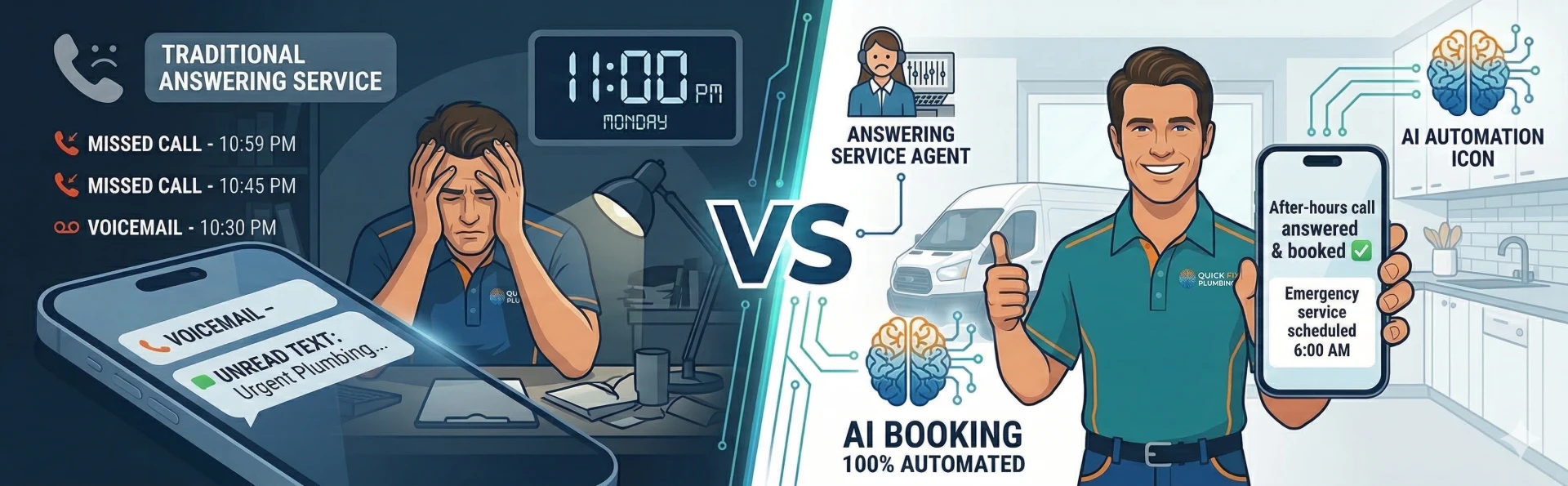
It's 11:30 PM on a Friday night. A homeowner's furnace stops working and the temperature inside is dropping fast. They grab their phone, search for emergency HVAC repair, and start calling every company they can find. Most calls go straight to voicemail. One or two ring endlessly with no answer. Then they reach a business where someone actually picks up, confirms availability, and books them for an emergency service call within the hour.
That business gets a $600 emergency service call. The businesses with voicemail get nothing.
This scenario plays out thousands of times every week across the home services industry. Emergencies do not respect business hours. Pipes burst at 2 AM. Air conditioners fail on Sunday afternoons. Water heaters break down on holidays. Roofs start leaking during overnight storms. The contractor who can answer the phone when these emergencies happen wins the job. The contractor who cannot loses it, often permanently.
This is why 24/7 answering coverage is not a luxury feature for contractors. It is a competitive necessity. The question is not whether you need after-hours coverage. The question is which type of 24/7 answering service actually delivers results worth paying for.
The options fall into three categories: traditional human answering services, virtual receptionist companies, and AI-powered answering systems. Each one has different capabilities, different costs, and different impacts on your ability to actually convert after-hours calls into revenue. Understanding which one fits your business requires looking past the marketing claims and evaluating what each option actually does when a customer calls.
What Contractors Actually Need From 24/7 Answering Coverage
Before comparing specific services, it is worth establishing what contractors actually need from after-hours phone coverage. The requirements are specific and not every answering service meets them.
First, the service needs to answer every call immediately with no hold time. A customer calling with an emergency at midnight is not patient. If they get a busy signal, hold music, or more than three or four rings, they hang up and call the next contractor.
Second, the service needs to understand contractor terminology and scenarios. A generic answering service agent who handles calls for law firms, medical offices, and plumbing companies in the same shift cannot distinguish between a routine service request and a genuine emergency in the trades. They do not know that a sewage backup requires immediate dispatch while a dripping faucet can wait until morning.
Third, the service needs to book appointments directly into your schedule, not just take messages. A message that says "customer called about water heater issue, please call back" creates follow-up work and delay. By the time you call back in the morning, the customer has already booked with someone else. The service needs to check your availability and confirm an appointment time during the initial call.
Fourth, the service needs to integrate with your field service software. If bookings made by the answering service do not appear automatically in ServiceTitan, Jobber, or Housecall Pro, someone on your team has to manually enter them, which defeats the purpose of having an answering service in the first place.
Fifth, the cost needs to scale predictably. Services that charge per minute or per call can become expensive quickly when volume spikes during peak season or after storms.
Most traditional answering services meet the first requirement. Few meet all five. This is why many contractors try an answering service, find it underwhelming, and cancel within a few months.
Traditional Human Answering Services: What They Do Well and Where They Fall Short
Traditional human answering services have been around for decades. They employ live agents who answer calls on behalf of multiple businesses following scripts and protocols set by each client.
The primary advantage of human answering services is that a real person answers the phone, which some customers prefer, especially older demographics who are uncomfortable with automation. Human agents can handle highly unusual situations that fall outside any script and can provide empathy in emotionally charged conversations.
However, traditional answering services have significant limitations for contractors specifically. The most critical limitation is that they typically cannot book appointments directly into your scheduling system. They take a message with the customer's information and the reason for the call, then relay that message to you via text, email, or phone. You still have to call the customer back to confirm availability and book the appointment, which creates the same delay problem that leads to lost conversions.
The agents at traditional answering services are generalists, not specialists. They work from a script you provide but do not have deep knowledge of contracting, plumbing, HVAC, or electrical work. They cannot assess whether a call is truly urgent or prioritize emergency calls appropriately without explicit instructions for every possible scenario.
Cost is another significant limitation. Most traditional answering services charge per minute of agent time, with rates typically ranging from $1.00 to $2.50 per minute in 2026. For a contractor receiving 50 after-hours calls per month with an average call duration of 4 minutes, that translates to 200 minutes monthly at $1.50 per minute, which is $300 per month. During busy periods when call volume doubles, the cost doubles as well.
Some traditional services offer flat monthly rates for a set number of minutes, but these plans typically cap coverage at 100 to 200 minutes per month with overage charges applying beyond that threshold. For contractors in high-demand markets or during peak season, these limits are easy to exceed.
Virtual Receptionist Services: The Mid-Tier Option
Virtual receptionist services sit between traditional answering services and AI systems in terms of capability and cost. Companies like Ruby Receptionist and similar providers offer more sophisticated call handling than basic message-taking services.
Virtual receptionists are trained to handle calls more naturally than traditional answering service agents. They answer using your business name, follow more detailed call scripts, and attempt to provide a more personalized experience. Some virtual receptionist companies specialize in specific industries and train their agents on industry terminology.
The cost model for virtual receptionist services typically involves monthly plans ranging from $200 to $800+ depending on call volume allowances. This is more expensive than basic answering services but includes more sophisticated handling.
However, virtual receptionist services still face the same core limitation as traditional answering services when it comes to contractor needs: they cannot book appointments directly into your dispatch software in most cases. The receptionist can check availability if you provide them with access to a calendar, but that calendar is usually separate from your actual dispatch board, which means bookings still require manual coordination.
Another limitation is availability during true emergencies. While virtual receptionist services advertise 24/7 coverage, during extreme volume events like major storms when hundreds of contractors are receiving emergency calls simultaneously, the service can become overwhelmed and hold times increase or calls go unanswered.
Virtual receptionists work well for businesses that primarily need professional call answering and message relay. They work less well for contractors who need instant booking capability and real-time dispatch integration.
AI-Powered Answering Systems: The Technology That Changed Contractor Coverage
AI answering technology has advanced dramatically in the past few years, and purpose-built systems for contractors now offer capabilities that traditional services cannot match.
An AI answering service for contractors operates fundamentally differently than human-staffed services. Rather than agents reading from scripts, the system uses conversational AI trained specifically on contractor scenarios to handle calls naturally, understand industry terminology, assess urgency, and take action.
The most significant advantage is booking capability. AI systems integrate directly with ServiceTitan, Jobber, Housecall Pro, FieldRoutes, and Service Fusion via API. When a customer calls after-hours, the AI answers, gathers information about their issue, assesses urgency, checks the real-time dispatch schedule, books the customer into an available slot, and sends confirmation via text and email. The job appears on the dispatch board immediately with no manual entry required.
This instant booking capability is what converts after-hours calls into actual revenue. The customer hangs up with a confirmed appointment rather than a promise of a callback, which dramatically reduces the drop-off rate.
The second major advantage is unlimited capacity. An AI system handles one call or one hundred calls simultaneously with identical response time and quality. During storm seasons or peak periods when call volume spikes, there is no degradation in service and no additional cost.
The third advantage is consistency. The AI applies the same process on every call. It asks for the same qualifying information, explains pricing the same way, and books appointments using the same criteria. There is no variation based on agent experience, fatigue, or mood.
Cost predictability is the fourth advantage. AI systems typically use subscription pricing rather than per-minute billing. A contractor pays a flat monthly fee regardless of call volume, which makes budgeting predictable and removes the concern that busy months will generate large bills.
Feature-by-Feature Comparison: What Each Service Type Actually Delivers
To make an informed decision about which 24/7 answering service is best for your contracting business, it helps to compare them feature by feature.
Immediate answer rate: Traditional answering services answer quickly when agents are available but may have hold times during busy periods. Virtual receptionists typically answer within a few rings. AI systems answer on the first or second ring with no hold time regardless of simultaneous call volume.
After-hours availability: All three options offer 24/7 coverage. The difference is in consistency. Human services can have staffing gaps during overnight hours or holidays. AI operates identically at 3 AM as it does at 3 PM.
Industry knowledge: Traditional services have minimal contractor-specific knowledge unless you provide extensive training. Virtual receptionists may have some industry training depending on the service. AI systems built for contractors are trained on thousands of contractor-specific calls and understand industry terminology natively.
Appointment booking capability: Traditional services typically cannot book directly into your schedule. Virtual receptionists may be able to check a calendar but rarely integrate with dispatch software. AI systems book directly into ServiceTitan, Jobber, Housecall Pro, and similar platforms in real time.
Emergency call prioritization: Traditional services follow your script but may not accurately assess urgency. Virtual receptionists do slightly better with training. AI systems trained on contractor scenarios reliably distinguish emergency calls from routine requests based on the language customers use.
Cost structure: Traditional services charge $1 to $2.50 per minute. Virtual receptionists charge $200 to $800+ monthly for tiered call volume. AI systems typically charge $400 to $800 monthly flat rate with unlimited or high-volume coverage.
Scalability: Traditional services scale linearly with cost. Virtual receptionists have capacity limits. AI scales instantly without additional cost.
Integration with business systems: Traditional services have no integration. Virtual receptionists rarely integrate. AI systems integrate via API with major field service platforms.
The ROI Calculation: Which Service Actually Pays for Itself?
The best 24/7 answering service for contractors is ultimately the one that generates the highest return on investment, not necessarily the one with the lowest monthly cost.
To calculate ROI, start with the value of after-hours calls. For most contractors, after-hours calls represent 20 to 30 percent of total call volume and tend to be higher-value jobs because they are often emergencies where customers are willing to pay premium rates.
A plumbing company receiving 20 after-hours calls per month with an average emergency service value of $500 has $10,000 in potential monthly revenue from those calls. If their current system (voicemail) converts 10 percent of those calls because they call back the next morning and most customers have already booked elsewhere, they are capturing $1,000 and losing $9,000.
Now run the same calculation with different answering services. A traditional answering service that takes messages and relays them might improve conversion to 20 percent because the customer at least knows their call was received. That is $2,000 captured and $8,000 lost. The service costs $300 per month, so net impact is $1,000 minus the previous $1,000 baseline, which is break-even before accounting for the $300 cost. Not a good ROI.
A virtual receptionist service that can check availability and give customers rough time estimates might convert at 35 percent. That is $3,500 captured. The service costs $500 per month. Net impact is $2,500 in additional revenue minus $500 cost, which is $2,000 per month net gain. Better ROI.
An AI system that books appointments in real time during the initial call converts at 70 percent based on data from contractors using these systems. That is $7,000 captured. The service costs $600 per month. Net impact is $6,000 in additional revenue minus $600 cost, which is $5,400 per month net gain. Significantly better ROI.
This calculation does not include the value of time saved by not having to manually return calls or enter bookings into your system, which adds further value to the AI option.
Understanding what different AI answering systems actually cost helps frame the investment properly relative to the revenue being captured.
What Happens When Customers Want to Speak to a Human?
A common concern contractors raise about AI answering systems is what happens when a customer insists on speaking to a human rather than an AI.
Well-designed AI systems handle this scenario gracefully. When a customer says "I want to talk to a person" or expresses frustration with the automated interaction, the AI transfers the call to a designated human on your team if someone is available, or takes detailed information and promises a callback during business hours if no one is available.
The practical reality is that most customers calling after-hours care more about getting their problem solved than about who they are speaking with. A homeowner whose basement is flooding at midnight is relieved when the AI answers, understands the situation, and books an emergency plumber for first thing in the morning. They are not upset that they spoke to AI. They are grateful that someone answered and helped them.
For customers who genuinely need human judgment for complex situations, the transfer capability ensures they get it. For the majority of after-hours calls that are straightforward emergency or service requests, the AI handles them completely and customers are satisfied with the outcome.
This is one area where designing intelligent interactions specific to contractor scenarios makes a significant difference in customer acceptance and satisfaction.
Industry-Specific Requirements for Different Contractor Types
Different types of contractors have different after-hours coverage needs, and the best answering service for one type may not be ideal for another.
HVAC contractors have highly seasonal demand with extreme volume spikes during summer heat waves and winter cold snaps. The ideal answering service for HVAC needs to handle volume surges without degrading quality or increasing cost. AI systems excel here because they scale instantly. Traditional services struggle because agent availability is fixed.
Plumbing contractors receive a high percentage of genuine emergencies after-hours. Burst pipes, sewage backups, and water heater failures cannot wait. The ideal service for plumbers needs to book emergency appointments immediately and communicate urgency appropriately. AI systems that integrate with dispatch software and understand emergency prioritization work best.
Roofing contractors often receive call surges after storms when dozens or hundreds of homeowners discover roof damage simultaneously. The ideal service needs to handle this concentrated volume and qualify leads quickly to separate serious repair requests from exploratory calls. AI systems that can handle unlimited simultaneous calls and ask qualifying questions consistently are most effective.
Electrical contractors need services that can assess whether a call is truly an emergency requiring immediate dispatch or a routine request that can wait. An AI system trained on electrical scenarios can distinguish between a power outage requiring emergency service and a light fixture replacement that can be scheduled normally.
Real Results: What Contractors Report After Switching to AI
The most useful data on which 24/7 answering service works best comes from contractors who have tried multiple options and compared results.
Contractors who switched from voicemail to traditional answering services report modest improvements. They capture some additional after-hours calls that they were previously missing entirely, but conversion rates stay relatively low because customers do not get immediate booking confirmation.
Contractors who switched from traditional answering services to virtual receptionists report better call handling quality and slightly better conversion, but the improvement is incremental rather than transformative because the core limitation of delayed booking still exists.
Contractors who switched from either traditional or virtual services to AI answering systems report the most dramatic improvements. After-hours conversion rates double or triple. Monthly revenue from after-hours calls increases by 50 to 100 percent. Administrative time spent on call follow-up and manual booking entry drops significantly.
One HVAC company in Nevada reported that after switching from a traditional answering service to an AI system, their after-hours booking rate went from 22 percent to 68 percent. They were receiving approximately 30 after-hours calls per month. At 22 percent conversion, they booked 6 to 7 jobs. At 68 percent conversion, they booked 20 jobs. At an average after-hours service value of $450, that is an additional $5,850 in monthly revenue from the same call volume.
A plumbing company in Georgia reported similar results. Their traditional answering service was costing $400 per month and converting roughly 18 percent of after-hours calls. After switching to AI at $550 per month, conversion jumped to 63 percent. The additional $150 in monthly cost generated an additional $4,200 in monthly revenue.
How Sameday Delivers 24/7 Contractor Coverage
Sameday is an AI answering platform built specifically for contractors. Unlike generic AI assistants, Sameday is trained on HVAC, plumbing, electrical, roofing, and pest control scenarios and understands the terminology and urgency signals specific to each trade.
Sameday operates 24 hours a day, 7 days a week, 365 days a year. When a customer calls after-hours, the AI answers immediately, asks what is happening, assesses whether it is an emergency or routine request, gathers the service address, checks the dispatch schedule for availability, books the appointment into the next available slot, and sends confirmation via text and email.
The system integrates with ServiceTitan, Jobber, Housecall Pro, FieldRoutes, and Service Fusion. Bookings flow directly to the dispatch board in real time. Dispatchers see after-hours jobs appear in their system automatically when they arrive in the morning, with all customer details and scheduling information already populated.
Sameday handles unlimited simultaneous calls. During storm seasons or peak demand periods when call volume spikes, the system absorbs the volume without degradation in quality or response time. There are no hold times and no missed calls regardless of volume.
The platform uses subscription pricing rather than per-minute billing. Contractors pay a predictable monthly rate regardless of how many calls come in, which eliminates cost uncertainty during busy periods.
Contractors using Sameday report that after-hours revenue becomes a meaningful percentage of total monthly revenue, typically 20 to 30 percent of jobs, compared to near-zero when after-hours calls went to voicemail.
Implementation: What to Expect When Setting Up 24/7 Coverage
Getting started with a 24/7 answering service is simpler than most contractors expect, though the process varies depending on which type of service you choose.
Traditional answering services typically require you to provide detailed scripts covering every possible call scenario. Setup can take several days to a week while the service trains agents on your scripts and tests the process.
Virtual receptionist services have a similar onboarding process but usually provide more guidance on script development. Setup typically takes a few days to a week.
AI systems like Sameday have the fastest setup. The onboarding process involves configuring the AI with your business name, service area, types of services you offer, pricing structure, availability rules, and emergency protocols. For most contractors, this takes 15 to 30 minutes. Integration with field service software is typically guided by the support team and completes within a day.
Once configured, the service goes live immediately. You can test it by calling your own number outside business hours to experience how calls are handled.
For any service type, it is important to monitor call quality during the first few weeks and make adjustments as needed. Listen to call recordings, review transcripts, and refine the process based on real customer interactions.
Measuring Performance: How to Know if Your Answering Service is Working
The effectiveness of a 24/7 answering service should be measured by specific metrics, not just by whether it answers the phone.
Track the percentage of after-hours calls that result in booked appointments. If this number is below 50 percent, the service is not converting effectively and may be just taking messages rather than actually booking jobs.
Track revenue from after-hours bookings as a percentage of total monthly revenue. If after-hours represents less than 10 percent of your total jobs despite being 20 to 30 percent of call volume, conversion is weak.
Track customer satisfaction by asking customers who book after-hours how their experience was. If multiple customers report frustration with the process or mention that they had to call back multiple times to confirm their appointment, the service is not working well.
Track your cost per after-hours booking. Divide your monthly answering service cost by the number of after-hours jobs booked. If this number is more than 10 to 15 percent of your average job value, the ROI may not justify the expense.
These metrics reveal whether your answering service is actually helping you acquire customers or just creating busy work.
Conclusion
The best 24/7 answering service for contractors is the one that answers every call immediately, understands contractor terminology and scenarios, books appointments directly into your dispatch software during the initial call, integrates with your field service management platform, and operates with predictable cost regardless of call volume.
Traditional human answering services answer calls but rarely book jobs. Virtual receptionists provide better call handling but still create follow-up work and delayed booking. AI-powered systems like Sameday answer calls, book jobs in real time, integrate with your business systems, and convert after-hours calls into actual revenue at rates that traditional services cannot match.
For contractors, after-hours calls are not an inconvenience to manage. They are high-value revenue opportunities that go to whoever answers and books fastest. The answering service that captures those opportunities most effectively is the one worth investing in.
Is your contracting business ready to stop losing after-hours calls to voicemail? Book a Free Demo with Sameday Today and see how AI handles contractor calls 24/7.