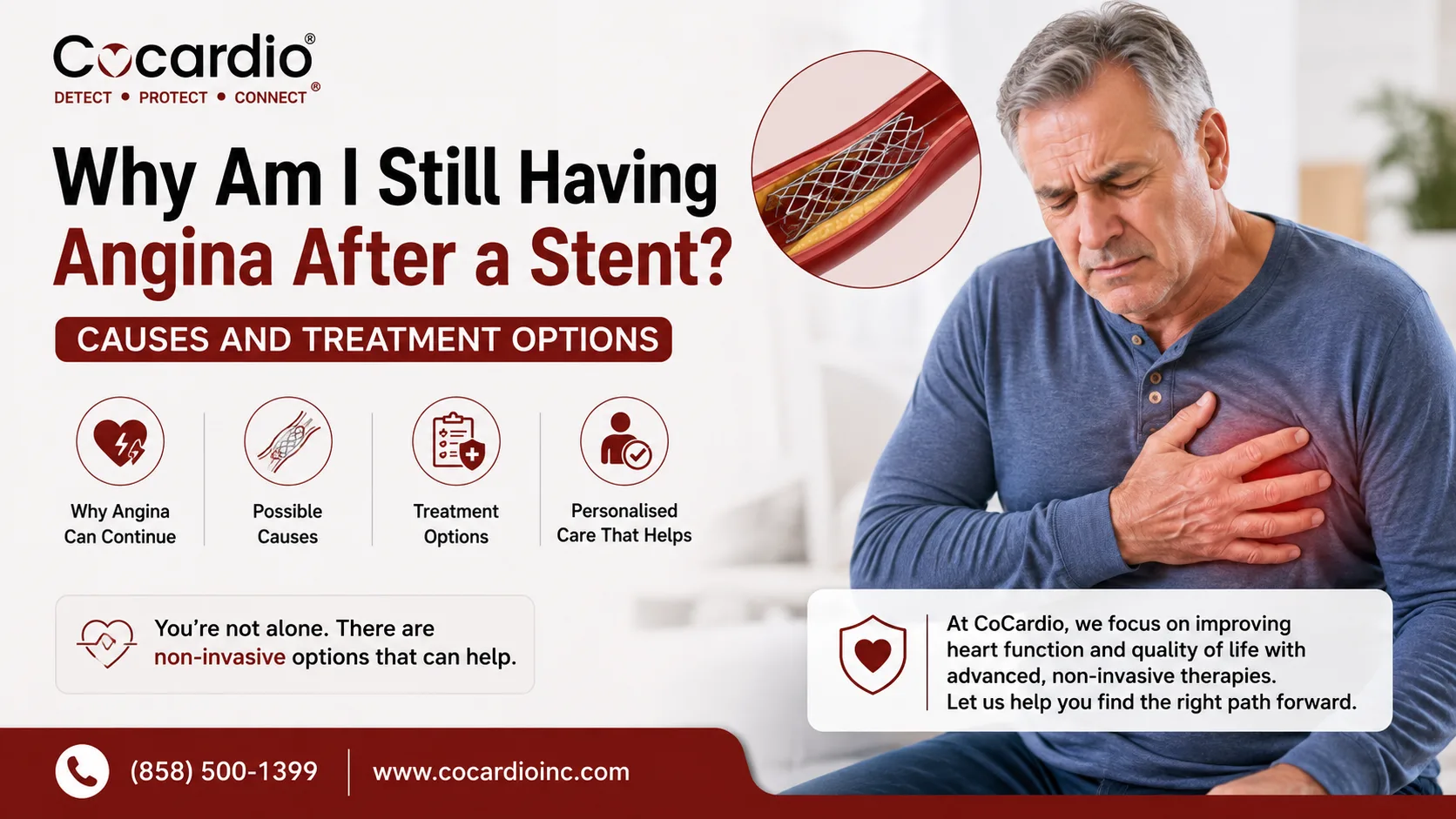
A coronary stent can restore blood flow through a significantly narrowed artery, but it does not guarantee that every episode of chest discomfort will disappear. Some patients continue experiencing angina after a successful procedure because coronary artery disease can involve multiple vessels, smaller blood vessels, coronary spasm, or other mechanisms that a single stent does not address.
Symptoms may also return months or years later if coronary disease progresses or a new narrowing develops. For selected patients with chronic stable or refractory symptoms, EECP therapy for angina may be considered after appropriate cardiovascular evaluation. Persistent or recurrent chest pain after a stent should always be discussed with a healthcare professional rather than assumed to be a normal part of recovery.
Is It Normal to Still Have Angina After a Stent?
Some patients continue to experience chest discomfort after percutaneous coronary intervention, and there can be several explanations for these symptoms. A stent treats a specific narrowed segment of a coronary artery, but it does not eliminate atherosclerosis throughout the rest of the coronary circulation. Your cardiologist may need to determine whether symptoms represent continuing ischemia, another cardiovascular problem, or a noncardiac cause of chest discomfort.
When symptoms are chronic and stable despite appropriate treatment, additional management strategies may be considered based on the underlying cause. Patients exploring noninvasive options may also want to ask about EECP therapy cost, including treatment-course expenses and potential insurance coverage.
Why Doesn't a Stent Always Stop Angina Completely?
Stents are highly useful when an appropriate coronary narrowing needs to be opened, but angina is not always caused by one discrete obstruction. A person may have diffuse coronary artery disease affecting longer sections of the coronary circulation or disease in vessels that are not suitable for stenting. Symptoms can also arise from coronary microvascular dysfunction or vasospasm, which involve mechanisms that conventional stenting may not resolve. In other cases, the original coronary intervention may have been successful but new disease develops elsewhere over time. Determining why symptoms persist is therefore more useful than assuming that the stent itself has failed.
What Causes Chest Pain After a Coronary Stent?
Chest discomfort after stenting can have cardiac and noncardiac causes, and the timing and pattern of symptoms can provide important clues. Potential cardiovascular explanations include residual coronary disease, restenosis, stent thrombosis, progression of atherosclerosis, coronary spasm, and microvascular dysfunction.
Musculoskeletal pain, gastrointestinal problems, anxiety-related symptoms, and other conditions can also produce discomfort that feels similar to angina. Because some post-stent complications can be serious, new or worsening symptoms should not be diagnosed at home. Appropriate medical assessment can help distinguish recurring myocardial ischemia from other possible causes.
Can a Stent Become Narrowed Again?
Yes, restenosis can occur when tissue growth develops within a previously treated segment and narrows the artery again. Modern drug-eluting stents have substantially reduced the frequency of restenosis compared with earlier stent technologies, but the possibility has not been completely eliminated. Symptoms may resemble the exertional angina a patient experienced before the original procedure, although symptoms alone cannot confirm restenosis.
Depending on the clinical situation, a cardiologist may recommend noninvasive testing or coronary angiography to assess blood flow and the treated artery. Treatment depends on the findings rather than automatically placing another stent.
Can a Blood Clot Form Inside a Stent?
Stent thrombosis is a serious complication in which a blood clot forms within or around a coronary stent. Although uncommon with contemporary treatment, it can suddenly restrict coronary blood flow and potentially cause a heart attack. Taking prescribed antiplatelet medication exactly as directed is particularly important after stent placement because prematurely stopping treatment can increase the risk of thrombosis in some patients.
Patients should never independently stop aspirin, another antiplatelet drug, or any cardiovascular medication because they feel better after the procedure. Sudden severe chest pain after stenting requires emergency medical attention rather than waiting for a routine appointment.
When Is Chest Pain After a Stent an Emergency?
New, severe, persistent, or rapidly worsening chest pressure after a coronary procedure should be treated seriously. Warning symptoms can include shortness of breath, sweating, nausea, dizziness, fainting, or pain spreading to the arm, shoulder, jaw, neck, or back.
Chest discomfort occurring at rest or feeling substantially different from a person's established stable angina pattern also requires prompt assessment. Do not wait for an outpatient EECP appointment if symptoms could represent a heart attack, unstable angina, or stent-related complication. Emergency cardiovascular evaluation should always come before consideration of noninvasive chronic-angina treatment.
Can Coronary Artery Disease Progress After Stenting?
Yes, because a stent treats a localized narrowing rather than curing the underlying atherosclerotic disease affecting the coronary arteries. Plaque can continue developing elsewhere, particularly when cardiovascular risk factors are not adequately controlled. Cholesterol, blood pressure, diabetes, smoking, physical inactivity, and other factors can influence long-term cardiovascular risk.
This is why medication and lifestyle management remain important after a technically successful coronary intervention. Feeling better after stenting should not be interpreted as a reason to stop the treatments prescribed to reduce future cardiovascular risk.
Why Risk-Factor Management Still Matters
Long-term management after stenting often involves cholesterol-lowering treatment, blood-pressure control, diabetes management when applicable, avoiding tobacco, appropriate physical activity, and heart-healthy nutrition.
Antiplatelet therapy may also be prescribed according to the patient's procedure and cardiovascular circumstances. These measures address risks that the physical stent itself cannot eliminate. Regular follow-up allows clinicians to monitor symptoms, medications, and changes in cardiovascular health over time. Controlling underlying disease is therefore just as important as treating the artery that originally required intervention.
Could Microvascular Angina Explain Persistent Symptoms?
Some patients have angina because the smaller vessels within the coronary circulation do not regulate blood flow normally. This condition, often discussed as coronary microvascular dysfunction or microvascular angina, may produce ischemic symptoms even when the major coronary arteries do not contain another obstruction suitable for stenting.
Standard coronary angiography is designed primarily to visualize larger epicardial coronary arteries, so additional evaluation may sometimes be needed. Microvascular disease can be particularly frustrating for patients who expected stenting to eliminate all of their symptoms. Treatment should be individualized according to the suspected mechanism and the patient's broader cardiovascular condition.
Can Coronary Spasm Cause Angina After a Stent?
Coronary artery spasm can temporarily reduce blood flow by causing a coronary artery to constrict. Because this is a functional change rather than simply a fixed plaque obstruction, placing a stent does not necessarily prevent vasospastic symptoms elsewhere in the coronary circulation.
Episodes can occur at rest and may follow a different pattern from typical exertional stable angina. Specific medications may be used to manage vasospastic angina depending on the patient's clinical circumstances. Accurate diagnosis matters because different mechanisms of angina may require different treatment strategies.
What Tests Might Be Needed for Angina After a Stent?
The appropriate evaluation depends on the timing, severity, frequency, and characteristics of the symptoms. A healthcare professional may review the patient's electrocardiogram, medications, previous angiograms, cardiovascular risk factors, and details of the original stent procedure.
Depending on the situation, testing may include blood tests, echocardiography, stress testing, coronary CT angiography, or repeat invasive coronary angiography. Additional assessment may be considered when microvascular dysfunction or coronary spasm is suspected. The purpose is to identify why angina persists before another treatment is selected.
Does Persistent Angina Mean You Need Another Stent?
Not necessarily, because another stent is useful only when there is an appropriate coronary lesion that is likely to benefit from another intervention. If testing identifies a significant new obstruction or restenosis, further revascularization may be considered depending on the clinical circumstances.
However, diffuse disease, microvascular dysfunction, coronary spasm, or other mechanisms may not be improved simply by placing another stent. Some patients may also have coronary anatomy that makes further percutaneous intervention or bypass surgery less appropriate. This is where careful cardiovascular evaluation becomes essential before deciding what treatment should come next.
What Happens When Angina Persists Despite Medication and Stenting?
Some people continue experiencing chronic stable or refractory angina despite receiving guideline-directed medical therapy and previous coronary revascularization. Symptoms can limit walking, climbing stairs, exercise, work, travel, and other normal activities, which can significantly affect quality of life.
Cardiologists may review medication doses, investigate additional causes of ischemia, and determine whether further revascularization is technically possible and clinically appropriate. When symptoms remain despite these measures, EECP therapy for angina may be considered for appropriately selected patients. The objective is to reduce the burden of chronic symptoms and improve functional capacity rather than replace necessary cardiovascular care.
How Can EECP Help With Persistent Angina?
EECP uses inflatable cuffs positioned around the lower body and synchronized with the patient's cardiac cycle. The cuffs inflate sequentially during diastole and rapidly deflate immediately before the heart contracts, producing a process called counterpulsation.
This is designed to increase diastolic blood flow and reduce the resistance against which the heart pumps during systole. In selected patients, EECP therapy for angina may reduce angina frequency and improve exercise tolerance or quality of life, although responses vary. EECP does not physically remove coronary plaque or mechanically reopen a blocked stent.
Is EECP Another Type of Heart Procedure?
External counterpulsation therapy is noninvasive and does not involve inserting a catheter into the coronary arteries. No surgical incision, coronary stent, or implanted medical device is required during treatment. Patients typically lie on a treatment table while cuffs around the calves, thighs, and lower body inflate and deflate in synchronization with the heartbeat.
A conventional treatment course commonly consists of approximately 35 one-hour sessions delivered over about seven weeks. Although the treatment is noninvasive, appropriate screening remains necessary because EECP is not suitable for every cardiovascular condition.
Does EECP Replace a Stent or Bypass Surgery?
No, EECP should not be described as a replacement for urgent or clinically indicated coronary revascularization. A severely narrowed artery causing an acute coronary syndrome may require treatments that directly restore blood flow, including percutaneous coronary intervention or bypass surgery depending on the circumstances.
EECP has a different role and is generally considered for selected patients with chronic stable or refractory angina. It is particularly relevant when symptoms persist despite appropriate medical management and additional revascularization is not considered suitable or beneficial. Treatment selection should therefore be based on the patient's cardiovascular evaluation rather than a preference for invasive or noninvasive care alone.
What Is a Typical EECP Treatment Course?
A conventional EECP course usually includes approximately 35 hours of treatment. Patients commonly receive one-hour sessions five days per week for about seven weeks, although individual scheduling can vary. The repeated treatment sessions are intended to produce cumulative effects rather than treating EECP as a one-time solution for an episode of chest pain.
Some patients may begin noticing changes during the treatment course, while others may experience improvement later or have a more limited response. Patients considering treatment can review the Complete EECP patient guide for a broader overview of treatment expectations, angina, coronary artery disease, safety, and cost considerations.
How Is Progress During EECP Measured?
Progress is often evaluated through changes that matter in daily life rather than relying on one measurement alone. Patients may notice that they can walk farther, climb stairs more comfortably, or perform routine activities before chest discomfort develops.
Clinicians can also monitor angina frequency, exercise tolerance, symptom severity, and the patient's use of prescribed short-acting antianginal medication. Improvements should be interpreted within the context of the patient's overall cardiovascular treatment plan. Patients should not stop or reduce prescribed medication simply because they feel better during an EECP course.
Who Might Be Considered for EECP After a Stent?
EECP may be considered for selected patients who continue to experience chronic stable or refractory angina despite appropriate medication and previous revascularization. Before treatment, clinicians need to confirm that symptoms are stable and that an acute coronary problem requiring urgent intervention has not been overlooked.
Medical history, blood pressure, heart rhythm, vascular health, and other conditions may influence treatment suitability. EECP therapy for angina is therefore not automatically recommended simply because someone has experienced chest discomfort after stenting. A proper cardiovascular evaluation helps determine whether EECP has an appropriate role in the patient's treatment plan.
Finding EECP Treatment Near Encinitas
Patients searching for ECP therapy near me should look beyond location when comparing treatment providers. Ask how patients are screened, how the treatment course is structured, what monitoring is performed, and how the provider coordinates with existing cardiovascular care. It is also important to understand realistic treatment goals rather than expecting EECP to physically remove plaque or repair a coronary stent.
Convenience matters because a typical course requires frequent appointments over several weeks, but clinical appropriateness should remain the first consideration. Patients should also confirm insurance benefits and potential out-of-pocket expenses before beginning treatment.
Can Angina Return Years After a Successful Stent?
Yes, chest discomfort can return months or years after a person initially experienced good symptom relief from coronary stenting. This can occur because atherosclerosis progresses elsewhere, restenosis develops, microvascular dysfunction becomes symptomatic, or another cardiovascular or noncardiac condition develops. The fact that a stent worked successfully in the past does not reveal the cause of new symptoms today.
Recurring symptoms should therefore prompt appropriate clinical reassessment rather than an assumption that the original stent has simply stopped working. Early evaluation can help determine whether changes in medication, testing, revascularization, or another management strategy are appropriate.
Can Lifestyle Changes Reduce the Risk of Further Problems?
Lifestyle measures remain important after coronary stenting because the underlying cardiovascular disease requires ongoing management. Avoiding tobacco, controlling blood pressure and diabetes, maintaining appropriate physical activity, following a heart-healthy eating pattern, and managing cholesterol can all form part of a long-term risk-reduction strategy.
Patients should take prescribed cardiovascular medications consistently and discuss side effects rather than stopping treatment independently. Cardiac rehabilitation may also provide structured support for exercise and recovery when clinically appropriate. These measures cannot guarantee that angina will never return, but they can form an important part of comprehensive cardiovascular care.
What Should You Ask Before Starting EECP?
Patients should ask why EECP is being recommended, whether their symptoms meet an appropriate clinical indication, and what realistic improvement might look like. It is also useful to understand the number and duration of sessions, how progress will be monitored, and whether any medical conditions could affect treatment eligibility. Insurance coverage and expected patient responsibility should be clarified before beginning the full course whenever possible.
Patients should also ask how EECP will fit alongside medications, cardiology follow-up, and any previous coronary procedures. A well-informed decision considers the complete cardiovascular treatment plan rather than viewing EECP as an isolated therapy.
What If Cost Is a Concern?
The financial responsibility for EECP can differ depending on insurance coverage, medical necessity requirements, provider arrangements, deductibles, and other plan-specific factors. Patients should verify benefits before starting treatment rather than assuming every insurance policy covers the same indications or number of sessions. Self-pay patients should ask whether quoted prices represent individual appointments or the complete recommended course.
Cost should also be considered alongside provider experience, screening, monitoring, and treatment suitability. Clear information before the first session can help patients make a more informed decision about whether treatment is financially practical.
Why Am I Still Having Angina After a Stent?
Persistent angina after a stent does not necessarily mean that the procedure failed, because chest discomfort can arise from residual disease, restenosis, disease progression, microvascular dysfunction, coronary spasm, or noncardiac causes. The first step is determining why the symptoms are occurring and whether another coronary intervention or adjustment in medical treatment is needed. For appropriately selected patients whose chronic stable symptoms remain limiting despite suitable treatment, EECP therapy for angina may offer a noninvasive option for improving symptom burden and functional capacity.
CoCardio in Encinitas can help medically stable patients learn more about EECP and understand the typical 35-session treatment process after appropriate cardiovascular evaluation. New, worsening, severe, or resting chest pain should always be treated as a reason for urgent medical assessment rather than waiting for an outpatient EECP consultation.
Medical Disclaimer
This article is intended for general educational purposes only and does not provide medical advice, diagnosis, or individualized treatment recommendations. Persistent or recurrent chest pain after coronary stenting requires appropriate medical evaluation, and EECP is not suitable for every patient. Do not stop antiplatelet medication, heart medication, or any other prescribed treatment without consulting your healthcare professional. New, severe, prolonged, or worsening chest pain, particularly when accompanied by shortness of breath, sweating, nausea, fainting, or pain spreading to the arm, jaw, back, or neck, requires immediate emergency medical attention.