
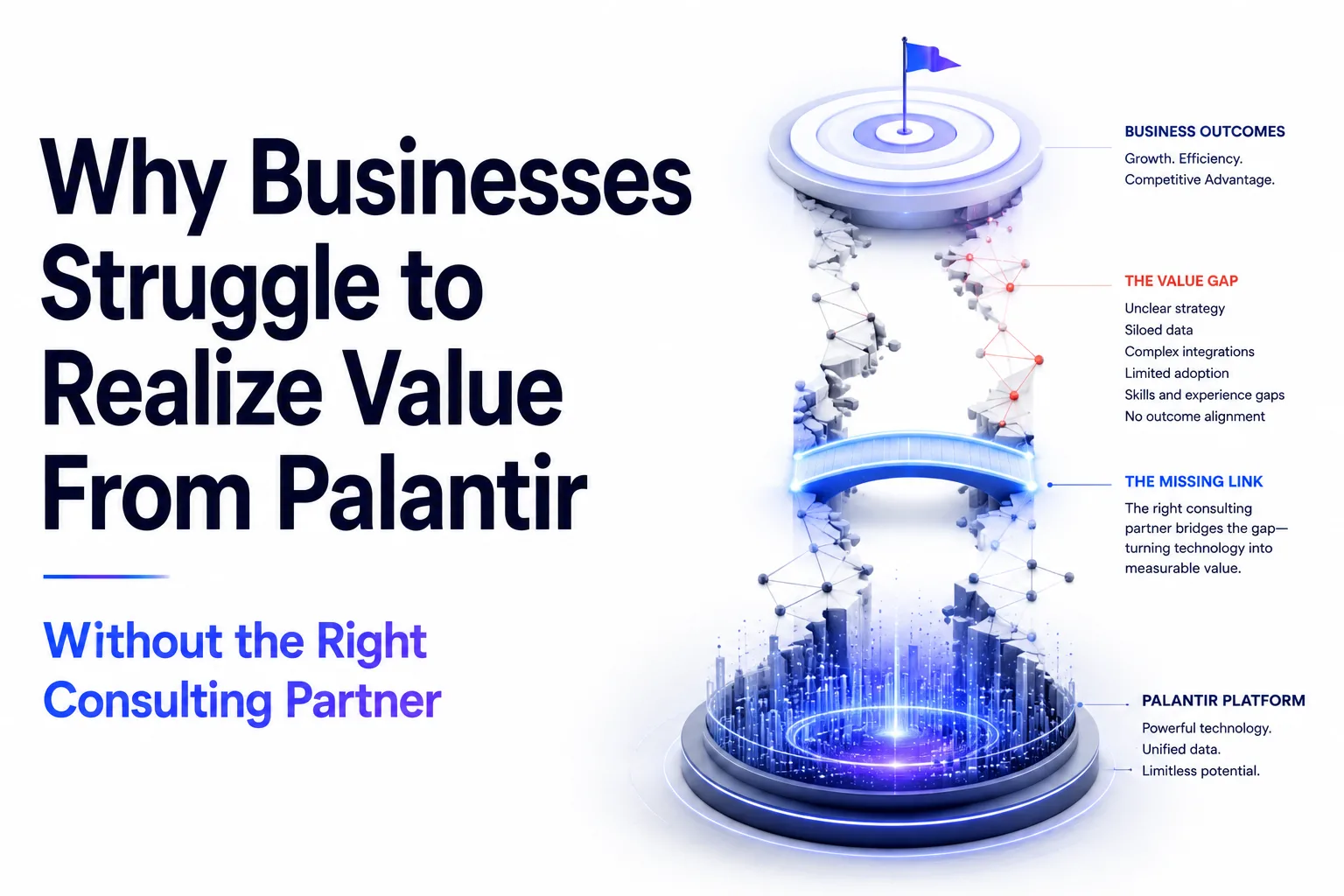
Many organizations invest in Palantir because they want better visibility, stronger decision-making, and a more connected operating environment. Leadership teams often see the platform as a way to break down data silos, improve workflows, and create a foundation for AI-driven initiatives. These goals are realistic, but achieving them requires much more than purchasing software and connecting a few systems.
This is where many enterprises encounter problems.
The platform itself may be powerful, but value does not appear automatically after deployment. Organizations still need to define business objectives, redesign workflows, establish governance structures, train users, and align multiple stakeholders around a shared vision. Without these elements, even the most advanced technology can struggle to produce measurable outcomes.
That is why consulting partners play such an important role in many Palantir initiatives. The right partner helps organizations move beyond implementation and focus on adoption, operational improvements, and long-term value creation. Without that guidance, companies often spend significant resources building capabilities that fail to gain traction across the business.
Technology Deployment Does Not Equal Business Value
One of the most common misconceptions in enterprise technology is the belief that deployment automatically creates results. A project team may complete integrations, launch applications, and migrate data successfully. From a technical standpoint, the implementation appears complete and the project may even be considered a success.
The business often sees things differently.
Executives do not invest in platforms because they want more integrations. Operations teams do not adopt new systems because they enjoy changing workflows. Organizations invest because they expect measurable improvements in efficiency, visibility, collaboration, or decision-making. If those outcomes fail to appear, the project will eventually be viewed as disappointing regardless of technical achievements.
This gap between deployment and value is where many organizations struggle. The technology works exactly as intended, but the business does not operate differently. Employees continue relying on old processes, stakeholders use the platform inconsistently, and the expected transformation never fully materializes.
Consulting partners help bridge this gap by focusing on operational outcomes rather than technical milestones alone.
Enterprise Transformation Is More Complex Than Most Teams Expect
Large-scale transformation projects rarely involve a single department or a single objective. Multiple teams participate, each with its own priorities, responsibilities, and expectations. Operations leaders may focus on efficiency. Technology teams may prioritize architecture. Executives may concentrate on strategic outcomes and long-term growth.
Managing these competing perspectives is often more difficult than implementing the technology itself.
Without strong coordination, projects can become fragmented. Different departments pursue different goals, workflows evolve inconsistently, and stakeholders lose alignment over time. The organization may end up with a technically sophisticated platform that lacks a unified purpose.
Experienced consulting partners understand how to navigate this complexity. They help organizations establish priorities, align stakeholders, and create implementation plans that support broader business objectives. This structure becomes increasingly important as projects expand and involve additional teams.
The larger the initiative becomes, the more valuable this coordination typically is.
Adoption Is Often the Real Challenge
Many organizations underestimate how difficult it is to change behavior.
Employees become comfortable with familiar systems, even when those systems are inefficient. Teams develop workarounds, manual processes, and communication patterns that feel predictable. Introducing a new platform does not automatically eliminate these habits.
This is why adoption deserves as much attention as technology implementation.
A platform creates value only when people use it consistently and incorporate it into daily operations. If employees view the system as optional or unnecessary, adoption slows and business outcomes suffer. Even well-designed solutions can struggle when users do not understand how the platform helps them perform their jobs more effectively.
Consulting partners often spend significant time addressing this challenge. They help organizations design adoption strategies, create training programs, engage stakeholders, and establish processes that encourage long-term usage. Their objective is to ensure that the platform becomes part of everyday work rather than another underutilized technology investment.
Governance Problems Can Slow Progress
Governance is another area where organizations frequently underestimate the complexity involved.
As platforms grow, questions emerge regarding ownership, permissions, accountability, compliance, and operational control. Different departments require different levels of access. Sensitive information must be protected. Business processes need clear approval structures and defined responsibilities.
If governance is not addressed early, problems tend to appear later.
Teams become uncertain about who owns data, who can make changes, and how information should be managed. This uncertainty reduces trust and makes expansion more difficult. What begins as a small issue can become a significant obstacle as adoption increases across the organization.
Experienced consulting firms help establish governance frameworks before these challenges become difficult to manage. By defining responsibilities and creating clear operating models, they help organizations scale more confidently and avoid unnecessary friction.
Strong governance is rarely the most visible part of a transformation initiative, but it is often one of the most important.
AI Initiatives Increase the Need for Expert Guidance
The rise of enterprise AI has added another layer of complexity to Palantir programs.
Many organizations now view the platform as a foundation for AI assistants, workflow automation, predictive analytics, and decision-support systems. While these opportunities are exciting, they also require careful planning and execution. AI initiatives depend heavily on data quality, governance, operational context, and workflow design.
Without these foundations, AI projects often struggle to move beyond demonstrations.
Organizations sometimes focus on models and tools while overlooking the underlying environment required for success. As a result, intelligent systems may generate interesting outputs without creating meaningful business impact. The technology works, but the organization lacks the structure needed to apply it effectively.
Consulting partners help address this challenge by focusing on readiness rather than technology alone. They help organizations create the operational foundations that allow AI initiatives to scale and generate sustainable value.
This perspective is becoming increasingly important as AI adoption accelerates across industries.
Internal Teams Cannot Do Everything Alone
Many enterprises have talented internal teams with deep knowledge of business operations and technology systems. These employees play a critical role in any transformation effort because they understand the organization better than any external partner ever could.
However, expertise and capacity are not the same thing.
Internal teams are often responsible for maintaining existing systems, supporting users, managing infrastructure, and delivering ongoing projects. Adding a large-scale transformation initiative on top of these responsibilities can create significant pressure. Even highly capable teams may struggle to dedicate sufficient time and attention to the project.
Consulting firms provide additional capacity while also bringing experience from previous implementations. They can help accelerate execution, reduce risk, and support internal teams during periods of intense activity. This partnership allows organizations to move more quickly without overwhelming existing resources.
For many enterprises, the combination of internal knowledge and external expertise produces the strongest results.
Why the Right Partner Matters More Than Ever
Not all consulting firms provide the same value.
Some focus primarily on technical implementation. Others specialize in governance, adoption, AI strategy, or operational transformation. Choosing the right partner therefore requires a clear understanding of the organization's priorities and challenges.
The best consulting relationships are built around shared objectives. The partner understands what success looks like, how the business operates, and what obstacles may emerge during implementation. Their recommendations are shaped by long-term outcomes rather than short-term project milestones.
Organizations exploring Palantir consulting companies often discover that the quality of the partnership influences project success as much as the technology itself. A strong partner helps the organization avoid common mistakes and maintain focus on the outcomes that matter most.
That guidance can make a significant difference in the overall return on investment.
Conclusion
Many organizations struggle to realize value from Palantir because they focus heavily on deployment while giving less attention to adoption, governance, operational alignment, and long-term execution. The technology may be capable of delivering significant benefits, but those benefits depend on how effectively the platform is integrated into the business.
This is where consulting partners become essential. They help organizations connect technology with operational outcomes, align stakeholders, establish governance structures, and create strategies that encourage adoption. Their role extends beyond implementation and into the broader transformation effort.
As enterprise initiatives become more complex and AI continues to reshape business operations, the importance of experienced consulting support will only increase. Organizations that choose the right partner are more likely to move beyond deployment and achieve the measurable outcomes that justified the investment in the first place.
FAQs
Why do companies struggle to realize value after implementation?
Many focus on deployment while underestimating adoption, governance, and operational transformation requirements.
How do consulting partners help?
They provide expertise in implementation, stakeholder alignment, governance, workflow design, and long-term adoption strategies.
Why is adoption so important?
Technology creates value only when employees use it consistently as part of their daily workflows.
How does governance affect platform success?
Governance supports trust, accountability, compliance, and scalability as the platform expands across the organization.
Why are AI initiatives increasing demand for consulting firms?
AI requires strong operational foundations, making experienced implementation guidance more valuable than ever.
Can internal teams manage these projects alone?
Some can, but many organizations benefit from additional expertise, implementation experience, and execution capacity provided by consulting partners.