If you have worked on a data team for any decent amount of time, you already know the feeling. Someone pushed a change late in the evening, nothing was documented, and by the next morning a dashboard that executives rely on is completely broken. The whole team spends the day trying to remember what the pipeline looked like before, piecing things together from memory and old screenshots.
That is not a horror story. For a lot of data teams, that is just Tuesday.
The gap between how software engineers work and how data engineers work has been obvious for years. Developers have been using Git, pull requests, and automated pipelines as standard practice for over a decade. Data teams, for the most part, have been making live edits in shared workspaces and hoping for the best. It has worked well enough at small scale, but once teams grow or the stakes get higher, that approach starts to show its cracks.
The Real Cost Nobody Talks About
The broken dashboard scenario gets talked about in retrospectives, but the deeper cost rarely does.
When there is no version control, there is no accountability built into the process. You cannot easily answer who changed what, when they changed it, or why. That is uncomfortable enough on a regular project. In industries like banking, insurance, or healthcare, it can become a compliance issue with actual financial consequences attached to it.
There is also the trust problem. Stakeholders who have been burned by unreliable data enough times start to question everything. They build their own spreadsheets on the side. They stop relying on the reports your team produces. Rebuilding that trust takes far longer than the original incident.
The honest reason most data teams end up in this situation is not carelessness. It is that the platforms were not originally built with structured development in mind. They were built to be powerful and accessible, which they are. But accessible and structured are two different things, and at some point growing teams have to choose which one matters more.
What DevOps Actually Looks Like in Practice
DevOps gets treated like a buzzword sometimes, but the underlying practices are pretty simple when you strip away the jargon.
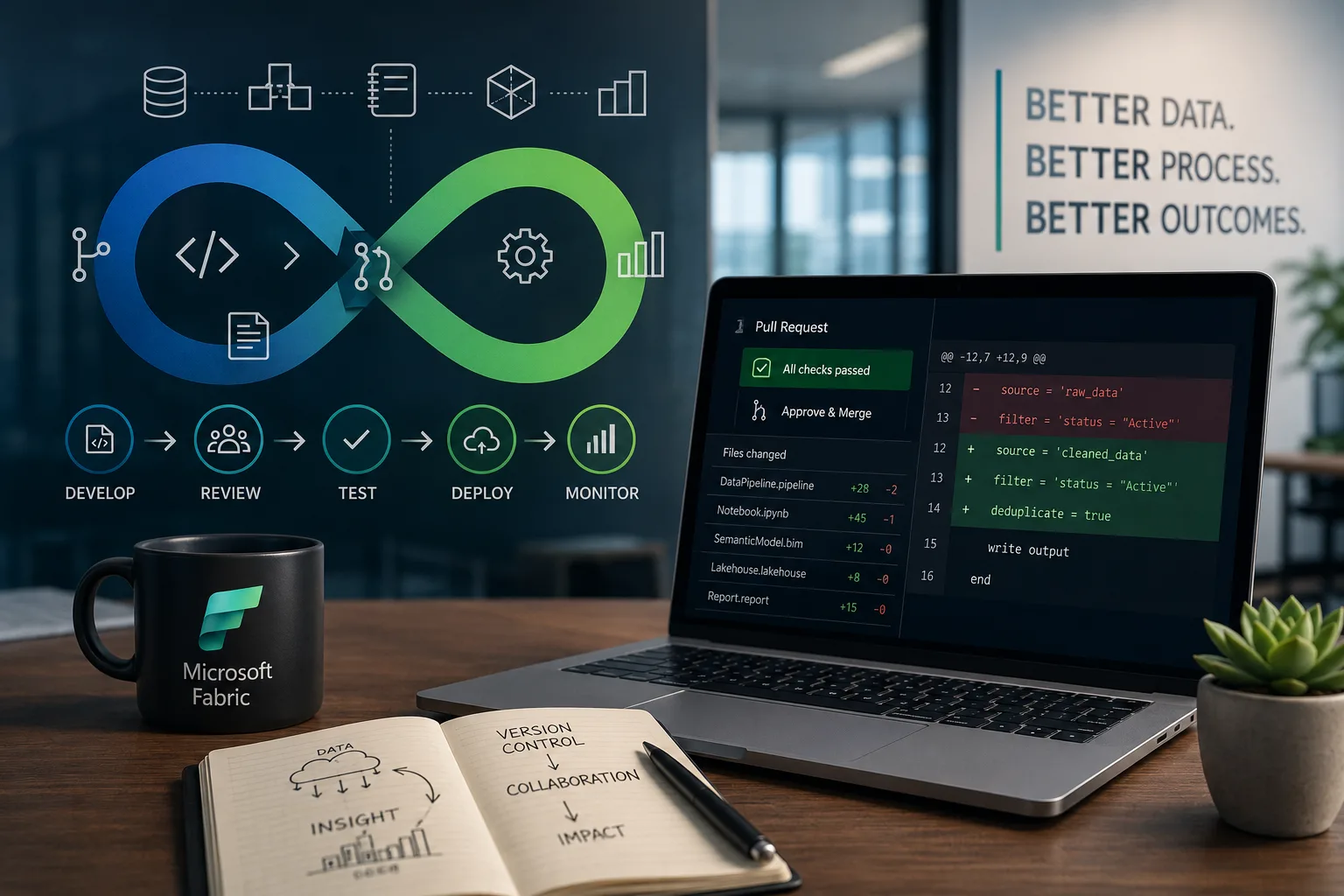
Version control just means that every change gets recorded. Who made it, when they made it, and what exactly they changed. You can go back to any point in history and see what the pipeline or report looked like. That alone solves a huge category of problems that data teams deal with regularly.
Working in branches means each engineer gets their own isolated copy of the work. You make your changes there, test them, and only merge them into the main codebase after someone else has reviewed them. Nobody can accidentally overwrite what someone else is building.
Code review before anything goes to production means a second set of eyes catches mistakes before users ever see them. It also means the team gradually develops shared standards for how things get built, which makes the whole codebase easier to maintain over time.
Automated deployment pipelines mean the same steps run the same way every single time. No missed checklist items, no "I thought you handled that part," no surprise differences between the test environment and production.
None of this is complicated in theory. The challenge has always been that the tooling for data platforms did not support it the same way application development tooling did. That is genuinely changing now.
What the Microsoft Fabric Update Actually Changes
Microsoft pushed a significant update to Fabric in April 2026 that is worth paying attention to if you work in this space.
Git integration now covers the full range of Fabric asset types. That includes data pipelines, notebooks, semantic models, lakehouses, and reports. Not just some of them. All of them. Engineers can work locally in VS Code with the same extensions and shortcuts they already use and push changes through a proper review process before anything touches production. CI/CD pipelines can be set up to handle deployments automatically once changes are approved.
For teams that have been waiting for the platform to catch up to how they actually want to work, this is a meaningful step forward. You can read the full details of what shipped directly in the Microsoft Fabric release notes.
The practical effect is that a data team can now operate with the same kind of discipline that software teams have had for years. That is not a small thing.
What Actually Changes When Teams Make the Shift
The first thing that changes is accountability, and it happens almost automatically. When every change is committed with an author name and a message explaining what was done, the question of "who changed this and why" has a clear answer. You do not need to ask around. You just look at the history.
For teams in regulated industries, this is significant. Compliance reviews that used to involve interviewing engineers and reconstructing timelines from memory become a straightforward exercise of pulling commit records. That is a real reduction in both effort and risk.
The second thing that changes is how well distributed teams can work together. When everyone is working in the same shared workspace, the person who saves last wins. There is no coordination mechanism beyond hoping people communicate well. Branches fix this. Engineers in different time zones can work on different things at the same time without stepping on each other, and the merge process creates a natural checkpoint where conflicts get resolved deliberately instead of accidentally.
The third change is in release cycles. When deployments are manual, they tend to be infrequent because every release carries risk and takes effort. When the pipeline is automated and the review process is consistent, releases become smaller and more frequent. Small changes are easier to test, easier to review, and much easier to roll back if something goes wrong. The overall quality of what reaches production tends to improve as a result.
Where Most Teams Actually Are Right Now
Most data teams are still working the way software teams worked ten or fifteen years ago. That is not a criticism, it is just where the tooling has been. But the tooling has caught up, and the teams that build these practices now are going to have a real head start.
If your organization already uses Azure DevOps or GitHub for application development, the path to applying the same practices to your data engineering work is shorter than you might think. The concepts transfer directly. The challenge is mostly in establishing the right conventions and making sure the team is comfortable with Git-based workflows.
It is not an overnight change, but it is also not as large a lift as it can seem from the outside. The teams doing this well started somewhere simple, usually just getting pipelines into source control and establishing a basic branch strategy, and built from there.
The platform is ready. The question is whether the process and culture around it will follow.
Resources :
Fabric April 2026 Feature Summary - Microsoft Fabric Community
https://www.dreamitcs.com/blogs/microsoft-fabric-devops-what-changed-and-why-your-data-team-should-care