
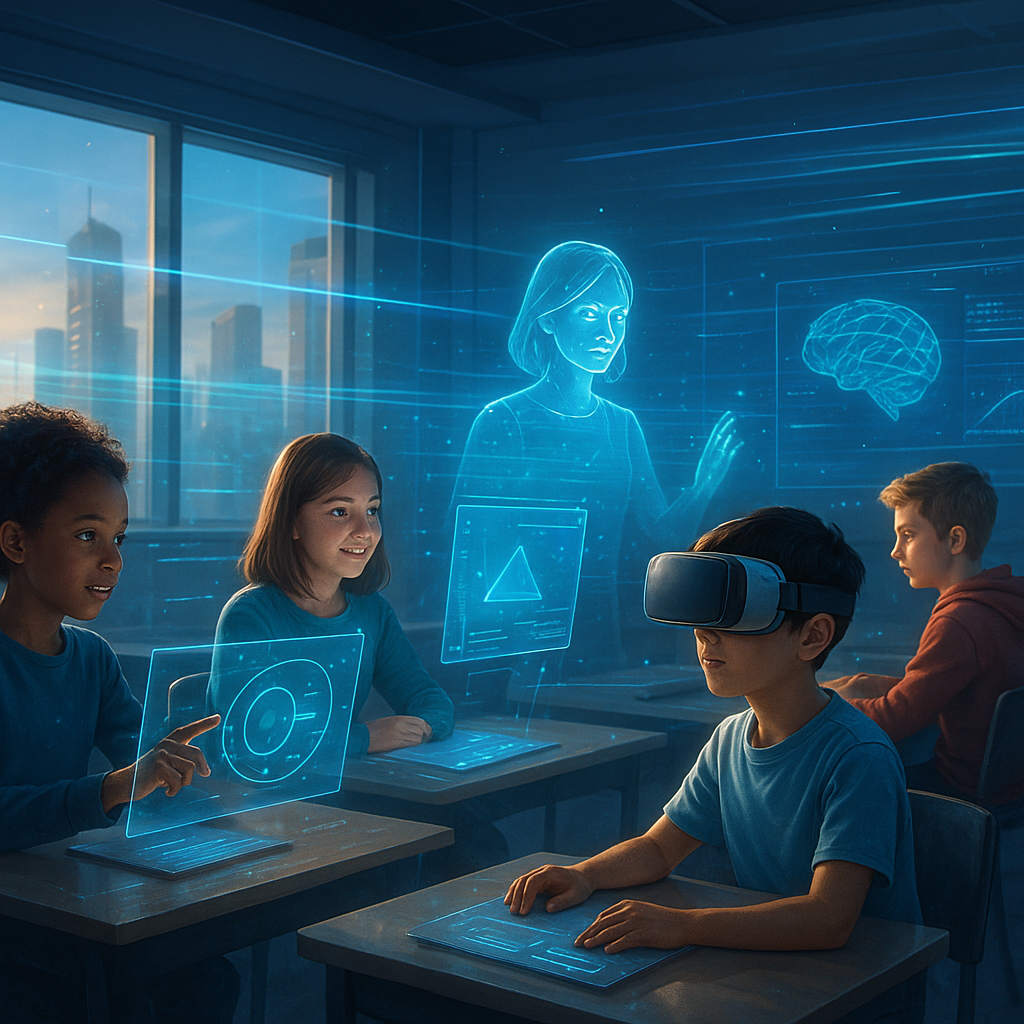
Reimagining Education: A Classroom Transformed by Technology
Picture a high school in 2026, where students don lightweight AR glasses that overlay interactive lessons on historical sites, while AI tutors provide personalized feedback instantly. This is no distant future—it's the evolving reality in many schools worldwide. The global EdTech market has surged past $400 billion, driven by innovations that blend artificial intelligence, immersive technologies, and data analytics to reshape how knowledge is delivered and absorbed.
Education technology, or EdTech, has moved beyond simple digital textbooks and video lectures. It now encompasses adaptive learning platforms, virtual reality simulations, and blockchain-powered credentialing, creating a holistic ecosystem that supports diverse learning styles and needs. The pandemic accelerated this shift, but 2026 marks a new phase where EdTech integrates deeply with traditional and informal education, expanding accessibility and engagement.
“EdTech’s potential is no longer just about access—it’s about fundamentally rethinking the learning process to empower every student,” says Dr. Maya Jensen, Chief Innovation Officer at LearnSphere.
To understand why the next wave of EdTech will be transformative, we must explore the historical context, current innovations, and future trajectories shaping this dynamic sector.
From Chalkboards to AI Tutors: The Evolution of EdTech
The journey of educational technology began with the introduction of audiovisual aids in the early 20th century and gained momentum with personal computers in the 1980s. The internet era enabled online courses and digital libraries, but these were largely content-replacement technologies.
The 2010s saw the rise of Massive Open Online Courses (MOOCs) and mobile learning apps, which democratized access but often struggled with engagement and completion rates. By 2020, the Covid-19 pandemic served as a catalyst for widespread adoption of remote learning technologies, exposing both the promise and the limitations of existing EdTech solutions.
The last six years have been marked by a pivot toward learner-centric models powered by AI and data analytics. Adaptive learning platforms now tailor content in real-time based on student performance, while gamification strategies improve motivation and retention. Countries with well-funded education systems lead the way, but emerging economies are leveraging mobile-first EdTech to leapfrog traditional infrastructure challenges.
- 1920s: Audiovisual aids introduced in classrooms
- 1980s: PC-based educational software emerges
- 2000s: Online courses and digital content expand
- 2010s: MOOCs and mobile learning democratize access
- 2020–2026: AI-driven adaptive learning and immersive tech transform engagement
“The real revolution is not just digital content but intelligent systems that respond to individual learner needs,” notes Professor Alan Cortez, an EdTech historian at University College London.
The Core of 2026 EdTech: Data, AI, and Immersive Experiences
At the heart of contemporary EdTech innovation lies the fusion of big data, artificial intelligence, and immersive technologies like virtual and augmented reality. According to recent reports, the AI in EdTech segment alone is expected to reach $25 billion in annual revenue by 2027, fueled by investments in personalized learning and automation tools.
Adaptive learning systems analyze vast datasets from student interactions to identify knowledge gaps and customize lessons accordingly. This approach has shown to improve learning outcomes by up to 30%, according to a 2025 meta-analysis published by the International Journal of Educational Technology.
Immersive technologies offer experiential learning environments. For example, medical students can practice surgeries in virtual operating rooms, while history learners can explore ancient civilizations through AR overlays on real-world sites. These tools not only enhance engagement but also provide safe, cost-effective practice opportunities.
Moreover, blockchain technology is gaining traction for securing academic credentials and enabling lifelong learning portfolios, which employers increasingly value. The integration of these technologies is supported by cloud infrastructure and 5G connectivity, ensuring scalability and real-time interaction.
- Adaptive AI tutors personalize learning paths and provide instant feedback.
- AR/VR simulations enable immersive, hands-on experiences.
- Blockchain-based credentials enhance verification and portability.
- Learning analytics offer actionable insights for educators and learners.
- Cloud and 5G ensure accessibility and real-time engagement.
This multi-layered ecosystem is redefining both pedagogy and administration across educational institutions.
2026 Breakthroughs: How EdTech Is Shaping Education Today
The current year has witnessed several breakthroughs that underscore EdTech's accelerating impact. One notable development is the widespread adoption of AI-driven formative assessment tools. These systems continuously evaluate student progress, allowing educators to intervene proactively rather than reactively. Schools using these platforms report up to a 25% reduction in dropout rates.
Another significant trend is the expansion of hybrid learning ecosystems. Institutions are no longer confined to physical or digital silos; instead, they blend real-world and virtual environments seamlessly. This hybrid approach caters to diverse learner preferences and helps bridge equity gaps.
EdTech companies are also innovating with multilingual AI tutors to support non-native speakers, addressing global diversity challenges. For instance, the startup LinguaLearn has deployed AI-powered language assistants in over 30 countries, improving language acquisition rates by 40%, according to internal data.
Governments and policymakers are increasingly investing in digital infrastructure to support these innovations. For example, the European Union’s Digital Education Action Plan 2026 allocates €5 billion toward EdTech research and equitable access initiatives.
- AI formative assessments reduce dropout rates by 25%
- Hybrid learning models expand learner engagement
- Multilingual AI tutors boost language acquisition by 40%
- EU’s €5 billion investment in EdTech infrastructure
- Public-private partnerships accelerate innovation adoption
These developments demonstrate how EdTech is moving from niche solutions to systemic transformation.
Voices from the Field: Experts and Educators Weigh In
To gauge the real-world impact of EdTech’s evolution, we spoke with industry leaders and education professionals.
“The shift towards AI-powered personalized learning is not merely technological; it’s pedagogical. It challenges educators to rethink their roles as facilitators and mentors,” explains Dr. Leila Ahmad, Director of Educational Innovation at GlobalEd.
From the classroom perspective, teachers report mixed feelings. While many appreciate the time saved through automation and data insights, concerns around digital equity and student privacy persist.
EdTech investors remain bullish. Venture capital funding in the sector has doubled since 2023, with firms targeting startups that integrate AI with social-emotional learning and accessibility features.
Meanwhile, institutions are experimenting with EdTech governance models to ensure ethical AI use and data protection. The International Society for Technology in Education (ISTE) recently released guidelines that emphasize transparency and inclusivity.
“EdTech must balance innovation with responsibility. The future depends on trust between learners, educators, and technology providers,” asserts Maria Gonzalez, CEO of EdTech firm Learnfinity.
What Lies Ahead: Navigating EdTech’s Future Pathways
Looking forward, the EdTech landscape promises both exciting opportunities and complex challenges. Key areas to watch include the following:
- Artificial General Intelligence (AGI) Integration: As AGI capabilities mature, they could power highly sophisticated tutoring systems that understand and adapt to emotional and cognitive states.
- Universal Learning Credentials: Blockchain and decentralized IDs will likely enable lifelong, interoperable educational records improving mobility and employability.
- Equity and Access: Bridging the digital divide remains critical, requiring targeted investments in infrastructure and inclusive design.
- Data Ethics and Privacy: As data-driven learning expands, robust frameworks for ethical data use will become non-negotiable.
- Global Collaboration: Cross-border partnerships will foster innovation diffusion and culturally responsive EdTech development.
Educators and policymakers must remain agile to harness these trends effectively. Continued research and dialogue, such as featured in our article Harnessing AI and Data: Advanced Strategies Transforming EdTech Today, offer valuable insights for stakeholders.
Furthermore, exploring how technology breaks free from classroom walls, as covered in How EdTech Is Redefining Learning Beyond the Classroom Walls, highlights the growing importance of informal and lifelong learning ecosystems.
Ultimately, the trajectory of EdTech will be shaped by its ability to enhance human potential rather than replace it.
Real-World Success Stories: EdTech in Action
Several case studies illustrate the transformative power of EdTech in diverse contexts. For example, the Indian initiative "EduLeap" deployed an AI-enabled mobile platform to rural schools, resulting in a 35% increase in literacy rates over three years. This success was driven by localized content and offline functionality.
In the United States, the "NextGen STEM Academy" leverages VR labs to provide under-resourced students hands-on science experiences. Post-implementation surveys showed a 50% increase in STEM subject interest among participants.
Corporate training sectors also benefit. Global firms use AI-powered learning management systems to upskill employees rapidly, reducing training time by 40% and improving retention rates.
- EduLeap’s AI mobile platform boosts rural literacy by 35%
- NextGen STEM Academy’s VR labs increase STEM interest by 50%
- Corporate AI LMS cuts training time by 40%
These examples demonstrate EdTech’s versatility and scalability across education and workforce development.
As the sector continues to innovate, understanding these real-world impacts provides a roadmap for effective deployment and sustained growth.