
Automatic bottle cleaners can turn a repetitive chore into a consistent hygiene routine and free up time when energy is limited. For many families, the main value is reliable wash-and-dry performance during the toughest months.
Are you washing bottles at 2:00 AM with one hand while calming a hungry baby with the other? Parent-led testing tracked daily use across weeks and dozens of models, and the biggest difference was not marketing claims but dependable wash-and-dry consistency under real household pressure. This guide helps you decide whether one is worth it for your home and how to use it safely.
What an Automatic Bottle Cleaner Actually Solves
Safe bottle care has two separate jobs, and that distinction matters because cleaning and sterilizing are different steps. Cleaning removes milk or formula residue, while sterilizing reduces remaining germs after surfaces are already clean.
Daily hygiene still follows the 6-step workflow: wash, spray jets, rinse, steam sterilize, then dry and store only when fully dry. An automatic bottle cleaner mainly removes labor from washing and drying, and many units also add steam sanitizing and short-term sterile storage.
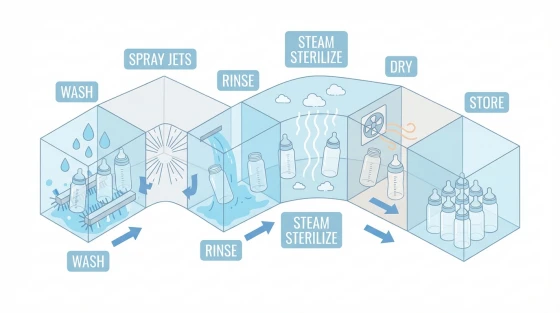
In practice, consistency is the biggest win when you are tired. If your unit runs a 19-minute rapid cycle and handles four bottles, two runs can clear eight bottles in 38 minutes of machine time while your hands are free for feeding, pumping, or resting.
Why It Matters Even If You Mostly Breastfeed
Bottle care is still part of breastfeeding life, because feeding supplies are needed whether milk is breast milk, formula, or both. Pump parts, storage bottles, and mixed-feeding days can create a steady sink backlog even when nursing is your main plan.
The burden is usually not one cleaning session; it is repeated interruption throughout the day. During postpartum recovery, reducing start-stop scrubbing helps protect limited energy, lowers decision fatigue, and makes hygiene easier to maintain when schedules get crowded.
What the Best Available Evidence Says
Some product pages provide concrete specs, including 26 spray jets, 212°F steam, and up to 72-hour sterile storage claims. These details can help you compare designs, but they are still manufacturer claims unless independent testing confirms methods and outcomes.
Confidence improves when repeat testing is transparent, and one major review series reports nearly 100 hours across 24 sterilizers with daily parent use. Long-use testing matters because it reveals practical issues like noise, setup friction, and incomplete drying.
Drying quality is often the hidden decision point, since fan-assisted drying can finish in about one hour. A sanitized bottle that stays damp can still delay feed prep and increase contamination concerns.
Sterilization frequency guidance is not perfectly uniform. Some long-running review guidance emphasizes daily sterilization in early infancy, while other guidance allows less frequent sterilizing as immunity matures if washing is thorough.
Source quality also varies, and one popular roundup currently loads as a verification interstitial instead of usable article content. Prioritize sources with visible methodology over list-style rankings.
Even official help pages can be thin in practice, and one bottle-washer how-to page in the research notes had no visible operating steps. When instructions are incomplete, check the full product manual before purchase.
How to Choose a Unit That Fits Your Day
Hands-on comparisons of four popular all-in-one washers show that capacity, water use, and placement needs affect daily satisfaction more than marketing language. Many models cluster around 19-minute rapid cycles, but they differ on footprint, noise, and compatibility.
Water use can be a practical tie-breaker. A 0.98-gallon cycle versus a 0.66-gallon cycle differs by about 0.32 gallons per run; at two runs a day, that is about 0.64 gallons more water each day.
Decision point
What to check before buying
Why it matters in real life
Capacity per cycle
Whether your true load is closer to 4 bottles or 6–8 bottles with pump parts
Under-capacity creates extra cycles and erases time savings
Drying system
Fan-assisted drying and filtration quality
Faster complete drying reduces wait time and moisture risk
Bottle compatibility
Fit with your bottle shape, nipple style, and pump accessories
Poor fit leads to hand-washing leftovers after every cycle
Placement needs
Sink drainage requirement, removable tanks, footprint
Placement friction causes skipped use during busy hours
Ongoing costs
Detergent tablets, filters, electricity, water
Recurring costs can outweigh a lower upfront price
Compatibility checks deserve extra attention because bottle and nipple designs vary widely by infant tolerance and feeding style. The safest move is matching the machine to your exact daily bottle-and-pump setup, not a generic "fits most" claim.
A Practical Daily Routine That Prevents Rework
After each feed or pumping session, follow the take-apart, rinse, wash, and full-dry sequence so residue does not harden and force extra scrubbing later. This keeps your machine focused on routine maintenance instead of rescue cleaning.
In newborn weeks, a conservative approach is sensible, and newborn-focused hygiene guidance supports regular sterilizing, especially during illness or after cleaning lapses. As risk drops, many families keep strict washing after every use and sterilize on a schedule agreed with their pediatric clinician.
When your machine is full or you are away from home, rolling-boil sterilization for 5 minutes after washing is a practical backup. A reliable backup prevents skipped hygiene days without turning every feed into a sink marathon.

Pros and Cons in Real Households
Day-to-day comparisons from tested bottle-washer models show a consistent pattern: these machines reduce repetitive labor and mental load, but they are not one-size-fits-all.
Typical gains
Typical tradeoffs
More predictable hygiene during sleep-deprived periods
Limited cycle capacity can require multiple runs
Less hand scrubbing of bottles and pump parts
Some units have compatibility limits for certain bottle or pump shapes
Built-in dry cycles reduce damp storage problems
Larger footprint or sink/drain setup can constrain placement
Integrated wash-sterilize-dry flow reduces task switching
Detergent tablets and filters add ongoing cost
Better routine adherence when both parents are stretched
Claims vary in evidence quality and test transparency
Quick FAQ
Do you still need to wash before sterilizing?
Yes. Sterilizing does not replace residue removal, so milk film must be cleaned off first for sterilization to be meaningful.
Is a dishwasher enough if you skip an automatic bottle cleaner?
For many families, yes, if you use dishwasher-safe loading, contain small parts, and fully air-dry before storage. The key is consistency and complete drying.
Should you trust "99.9%" germ-kill claims?
Treat those numbers as useful but conditional, since high-percentage claims tied to steam temperature and cycle design depend on loading, maintenance, and testing methods.
A good automatic bottle cleaner does not replace attentive parenting; it helps protect your energy so you can spend more of it on your baby. Choose the unit that matches your real daily load and routine, and the payoff often appears fastest during middle-of-the-night feeds.