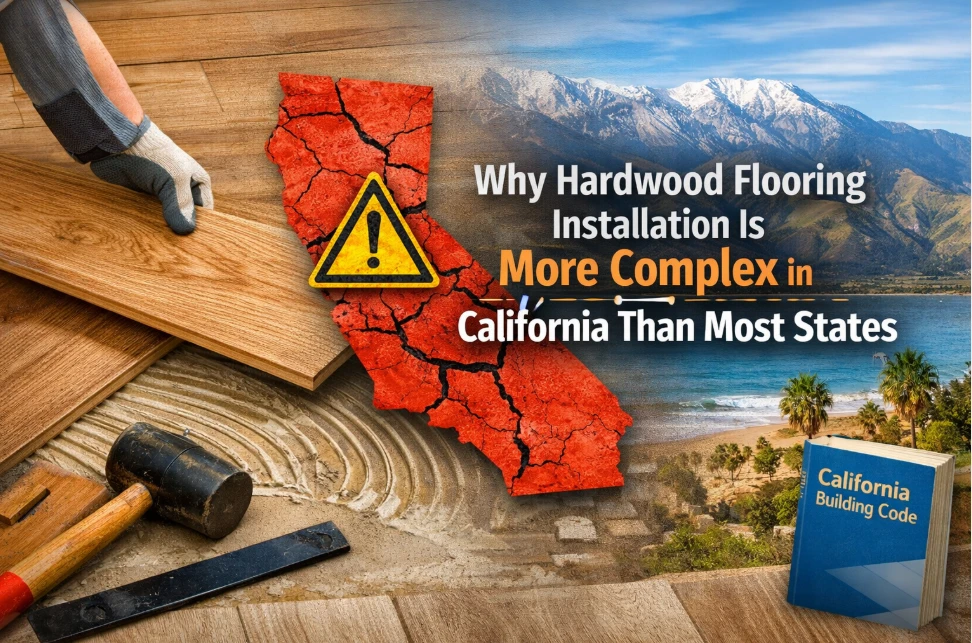
California homeowners deal with flooring challenges that don't come up the same way in other parts of the country. Understanding them upfront helps you evaluate whether a contractor actually knows what they are doing - or whether they're just telling you what you want to hear.
Climate Variation Across the State - Hardwood is a natural material that responds to moisture and temperature. California's climate swings - coastal humidity in San Diego and Malibu, extreme dry heat in Palm Springs and the Central Valley, the marine layer in the Bay Area - all affect how wood behaves after installation. A contractor who doesn't ask about your home's humidity levels and HVAC situation before recommending a product is skipping a step that matters.
Older Housing Stock - A significant portion of California homes were built between the 1940s and 1980s. These homes often have subfloors that have shifted, settled, or absorbed moisture over decades. Experienced local hardwood flooring contractors know how to assess and prep these subfloors properly. Inexperienced ones skip it and hope for the best.
Open Floor Plans and Indoor-Outdoor Living - California home design often features large open spaces and transitions between interior and exterior living areas. These layouts require more precise planning around plank direction, expansion gaps, and transition pieces than a simple rectangular room in a traditional floor plan.
Seismic Considerations - This one surprises people. California's seismic activity means floors experience subtle but real movement over time. Certain installation methods and adhesive types hold up better under this kind of stress than others. Local hardwood floor experts who have been working in California for years have seen what fails and what doesn't.
A contractor who acknowledges these California-specific factors during your initial conversation is demonstrating exactly the kind of local knowledge worth paying for.
Solid Hardwood vs. Engineered Hardwood: Which One Is Right for Your California Home?
This is the first real decision you'll make — and it's one where local expertise genuinely changes the outcome.
Solid Hardwood - Solid hardwood is exactly what it sounds like: a single plank of wood milled from top to bottom. It's the traditional choice, it can be sanded and refinished multiple times over its lifetime, and it adds undeniable character and resale value to a home.
The limitations in California:
- Solid hardwood is highly sensitive to moisture fluctuations
- It cannot be installed below grade or over radiant heating systems
- In coastal areas with high humidity variation, solid wood requires careful acclimation and ongoing humidity management
- It's typically more expensive both in material and installation cost
Best suited for: Inland California homes with stable indoor humidity, upper floors, living rooms, dining rooms, and bedrooms in homes with good HVAC control.
Engineered Hardwood - Engineered hardwood has a real wood veneer on top bonded to multiple layers of plywood or high-density fiberboard beneath. That cross-ply construction makes it significantly more dimensionally stable than solid wood — meaning it handles California's humidity swings, temperature changes, and even mild moisture exposure much better.
The advantages for California homeowners:
- More stable in coastal humidity and dry inland heat
- Can be installed over concrete slabs — common in California construction
- Compatible with radiant floor heating systems
- Available in wider plank formats that work well in modern California open-plan homes
- Often more affordable than solid hardwood without sacrificing the look
Best suited for: Coastal California homes, slab-on-grade construction, kitchens adjacent to living areas, and homes with underfloor heating.
According to the National Wood Flooring Association, engineered hardwood now accounts for more than 50% of all wood flooring sales in the United States — and in California, that percentage is even higher due to the state's climate diversity and construction characteristics.
A knowledgeable hardwood flooring installer will walk you through this decision based on your specific home — not push you toward whatever they have most of in their warehouse.
The Acclimation Step That Many Contractors Rush — And Why It Costs You Later
Hardwood acclimation is one of the most skipped steps in flooring installation — and one of the most important.
Before any hardwood floor is installed, the wood needs to sit inside your home and adjust to the indoor temperature and humidity levels. This process allows the wood to expand or contract to its natural equilibrium in your specific environment. If you skip it or rush it, you get floors that gap in dry seasons, buckle in humid ones, or develop squeaks within months of installation.
Proper acclimation timelines:
- Solid hardwood — minimum 3 to 5 days, sometimes up to 2 weeks in coastal California
- Engineered hardwood — typically 48 to 72 hours depending on the product and manufacturer specification
- Wide plank formats — always on the longer end of these ranges due to greater surface area
Ask any hardwood flooring contractor directly: how long will you acclimate the material in my home before installation begins? If the answer is "we usually just do it the same day" or they seem uncertain, that's a genuine red flag. In California's variable climate, rushing acclimation is one of the top causes of post-installation floor failure.
What Hardwood Floor Installation Actually Costs in California?
Pricing is where a lot of homeowners get surprised — usually because the initial quote looked reasonable and the final invoice didn't.
Here's a realistic breakdown of what professional hardwood flooring installation costs in California:
Material Costs:
- Solid hardwood — $5 to $15 per square foot depending on species and grade
- Engineered hardwood — $3 to $12 per square foot
- Premium wide plank or exotic species — $12 to $25+ per square foot
Installation and Labour:
- Standard nail-down or glue-down installation — $3 to $7 per square foot
- Floating installation — $2 to $5 per square foot
- Complex layouts, herringbone, or diagonal patterns — add $2 to $4 per square foot
Additional Costs That Often Surprise Homeowners:
- Subfloor inspection and repair — $1 to $3 per square foot
- Old floor removal and disposal — $1 to $2.50 per square foot
- Moisture barrier installation — $0.50 to $1.50 per square foot
- Transitions, trims, and stair nosing — varies by linear footage
Total installed cost for a typical California home renovation: $8 to $22 per square foot all-in, depending on material choice, home condition, and regional labour rates.
For a 500 square foot main living area, that's a realistic range of $4,000 to $11,000. For a full-home renovation covering 1,500 square feet, budget $12,000 to $33,000 depending on choices made at each stage.
Any quote that comes in dramatically below these ranges deserves a line-by-line explanation. Low bids almost always reflect something left out — usually subfloor prep, proper acclimation time, or quality materials.
How to Evaluate Hardwood Flooring Contractors in California — The Right Way
Most homeowners compare two or three quotes and go with the middle one. That approach doesn't filter for quality — it just filters for price. Here's a more useful evaluation framework.
License Verification — California requires flooring contractors to hold a C-15 license from the Contractors State License Board. Check the CSLB database before any conversation goes further. Active license, bonded, insured, no outstanding complaints. This takes two minutes and eliminates a large portion of risk immediately.
California-Specific Portfolio — Ask to see completed projects in your region specifically. A contractor who has installed hardwood in coastal San Diego understands moisture management differently than one who has only worked inland. Photos, addresses you can drive by, and references from your area are all reasonable requests.
Subfloor Assessment Process — Ask exactly how they assess and prepare the subfloor. What tools do they use to measure moisture levels? How do they handle uneven subfloors? What's their process if they discover rot or damage during a demo? A professional answer to these questions indicates real experience.
Acclimation Protocol — As covered above, ask specifically about their acclimation timeline and process. The answer tells you a lot about their overall approach to quality.
Written Itemised Proposal — Every legitimate hardwood flooring contractor provides a written proposal before work begins. It should break out material costs, labour, subfloor prep, removal of existing flooring, and any additional line items clearly. Verbal agreements and lump-sum quotes are not acceptable for a project of this size.
Labour Warranty — What does it cover, for how long, and how are claims handled? A standard labour warranty on hardwood installation should run at least one to two years. Some contractors offer longer. Get it in writing.
References From Recent California Projects — Ask for two or three references from jobs completed in the past 12 months, ideally in your region. Call them. Ask about communication, how surprises were handled, whether the timeline was accurate, and whether they'd hire the same contractor again.
Hardwood Species That Perform Well in California Homes
Not all wood species behave the same way in California's climate conditions. Here's a practical breakdown of commonly available species and how they perform locally:
White Oak — Currently the most popular choice in California residential projects. Excellent stability, takes stain beautifully, works well with the wide plank formats favoured in modern California interiors. Strong resale value.
Red Oak — Traditional and widely available. More porous than white oak and slightly less stable in high-humidity coastal environments. Good value option for inland California homes.
Hickory — Extremely hard and durable. Handles foot traffic, pets, and California lifestyle well. The pronounced grain character suits rustic and transitional interior styles popular across the state.
Maple — Very hard, light in colour, and consistent in grain. Works well in contemporary California interiors. Less forgiving to finish changes over time compared to oak.
European Oak — Growing in popularity in higher-end California renovations. Known for its distinctive grain and wire-brushed finish options. Performs well in engineered format across California's climate zones.
Walnut — Rich, dark, and premium in character. Softer than oak so shows wear faster in high-traffic areas. Best suited for bedrooms, studies, and lower-traffic living spaces in California homes.
Your hardwood flooring installer should be able to walk you through these options relative to your specific home, lifestyle, and location in California — not just hand you a catalogue and let you guess.
Where to Find Hardwood Flooring Installers Near You in California?
This is where most homeowners default to a basic Google search and end up overwhelmed. National lead-gen platforms sell your information to multiple contractors simultaneously. Generic review sites mix in outdated listings and businesses that no longer operate.
A more efficient approach is using a directory built specifically around California flooring and home improvement services — one organised by category and location so you're finding specialists, not generalists.
SD Floor Center's hardwood flooring directory connects California homeowners directly with local hardwood flooring contractors and specialists across Southern California. The listings are organised by category — so you're browsing professionals who focus specifically on wood flooring services, not a mixed bag of general contractors who occasionally install hardwood as a side service.
It's a practical starting point for building your shortlist before you start collecting quotes and making calls.
Browse hardwood flooring installers near you on the SD Floor Center hardwood flooring listings page.
The Questions to Ask Before Anyone Touches Your Floor
Print this list or save it to your phone before your first contractor conversation:
- What is your CSLB C-15 license number and can I verify it?
- How many hardwood flooring installations have you completed in California in the past 12 months?
- What is your acclimation process and timeline for this specific material?
- How do you assess and prepare the subfloor before installation?
- Will you personally be doing the work or is it subcontracted?
- What does your labour warranty cover and for how long?
- Can you provide two or three references from recent California projects?
- What happens if unexpected subfloor issues are discovered mid-project?
- Is your quote all-inclusive or are there line items that could be added later?
A contractor who answers all of these questions confidently and without hesitation is worth serious consideration. One who hedges, gets defensive, or can't answer several of them is telling you something important before you've committed to anything.
The Long-Term Reality of Hardwood Floors in California
Here's what nobody tells you in the showroom: hardwood floors are a decades-long relationship, not a one-time transaction.
Properly installed and maintained hardwood floors in a California home can last 50 to 100 years. They can be sanded and refinished multiple times — typically every 7 to 10 years depending on traffic and finish type. They age in a way that adds character rather than just showing wear.
But that longevity depends almost entirely on two things: quality installation from the start and basic ongoing maintenance suited to California's climate.
Keep indoor humidity between 35% and 55% year-round. Use felt pads under furniture. Clean with a hardwood-specific product — never a steam mop. Address scratches and finish wear before they penetrate to the wood itself. Refinish on schedule rather than waiting until the floor looks visibly damaged.
Do those things, work with a qualified local hardwood flooring installer from the beginning, and what you're investing in today will still be adding value to your California home when the next owners move in.
That's the case for doing this right the first time.
About the Author
This article was contributed in partnership with SD Floor Center, a California-focused directory platform connecting homeowners with local hardwood flooring installers, flooring specialists, interior designers, and home remodeling professionals across Southern California.
SD Floor Center was built to make it easier for California homeowners to find qualified local flooring professionals by category and service area — without wading through national aggregators or irrelevant results. The platform features verified listings across hardwood flooring, vinyl plank, tile, carpet, area rugs, and full home remodeling services.
To find hardwood flooring contractors serving your area in California, visit the SD Floor Center hardwood flooring listings page.