What happens when one owner has three LLCs, two state registrations, several filing dates, and legal mail that cannot be missed? The paperwork becomes difficult to track sooner than expected. A business registered agent gives those entities a dependable point for official correspondence, while an LLC registered agent helps each limited liability company keep its notices tied to the right record.
Most problems show up after formation. One entity has an annual report due in March, another has a different state deadline, and a third receives a legal notice at an address nobody checks each day. None of these tasks looks complicated alone. Put them together, though, and the room for error grows.
Why Multiple Entities Create More Compliance Work
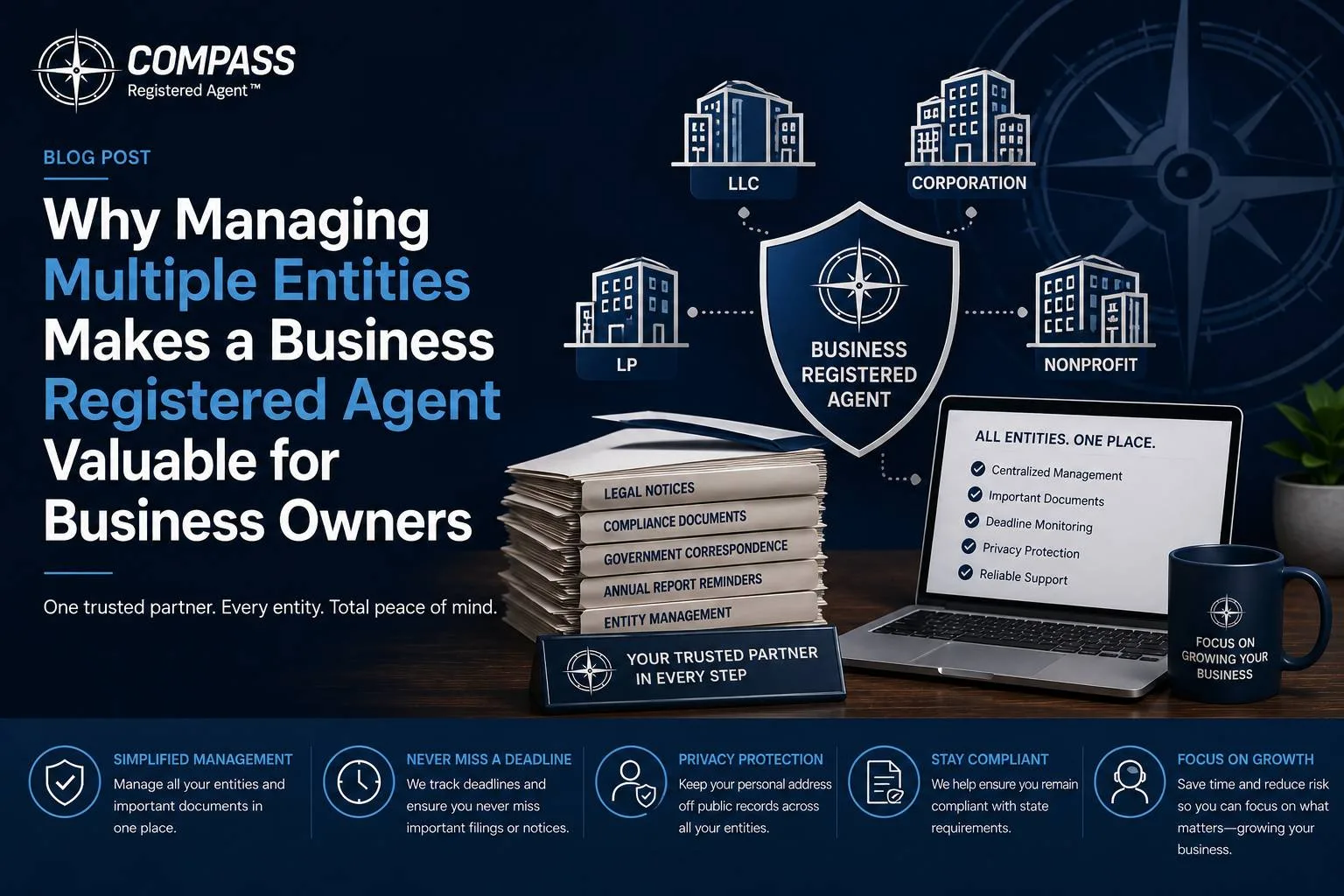
Every company has its own legal identity. Each LLC or corporation may carry separate state records, annual filing dates, address requirements, tax notices, and service-of-process obligations. A business registered agent gives owners a consistent receiving point instead of relying on a home address, a shared office, or an employee whose responsibilities may change.
The point is not to combine the companies. Owners still need separate filings, governing documents, financial records, and legal correspondence. What they can standardize is the way official information comes in, gets reviewed, and reaches the person responsible for it.
How Registered Agent Support Keeps Entity Records Clear
Multi-entity owners often create shortcuts without meaning to. State notices go to one inbox. Formation documents end up in a common folder. A staff member receives mail for several companies. It can work for months until someone files a document under the wrong entity or overlooks a deadline.
An LLC registered agent can make that process cleaner because official correspondence arrives under the correct company name. Each notice can then move into the proper internal file instead of being sorted after the fact.
Compass Registered Agent supports privacy-focused filings where state rules allow it, which may help owners avoid placing a personal address on certain public records. For someone managing several companies, that also keeps public-facing information more consistent.
What Owners Should Centralize Across Several Companies
Centralizing administration does not mean mixing company records. It means building one repeatable process for tasks that occur across every entity.
Owners should usually keep these functions under the same administrative system:
- Registered agent details for each company and state
- Annual report and state filing calendars
- Service-of-process receipt and internal routing
- Compliance reminders for recurring obligations
- Access to filed formation and amendment records
- Responsibility for reviewing urgent legal correspondence
A business registered agent can support that structure by giving owners one reliable intake point for legal and government notices. Separate entity files still remain necessary, but the path from receipt to review becomes easier to control.
An LLC registered agent can also help when one management team oversees several limited liability companies. Clear labeling and a defined review process reduce the chance of responding under the wrong company name.
Why Multi-State Expansion Adds Another Layer of Work
Registering in another state creates more than another filing. A company may need foreign qualification, a local registered agent, new annual reports, and additional state deadlines. If several entities expand at the same time, owners can end up maintaining different compliance calendars for each jurisdiction.
Compass Registered Agent offers multi-state support, digital document delivery, compliance reminders, and secure portal access. Those features suit owners who prefer one organized process instead of separate registered-agent arrangements.
An LLC registered agent becomes especially useful during expansion because states do not follow one identical filing schedule. Owners need to know where each entity is registered, which notices belong to it, and who handles the next step.
How Better Document Routing Reduces Missed Notices
Many compliance failures start with ordinary administrative confusion. A letter reaches an old office. A state notice goes to an employee who no longer handles filings. Legal documents arrive, but nobody has clear responsibility for reviewing them.
A business registered agent creates a defined destination for official correspondence. That does not finish the job. Someone inside the company still needs to review the notice, record the deadline, assign responsibility, and confirm that the required response or filing was completed.
This is where internal discipline counts. Registered agent service does not replace legal counsel, accounting support, or internal compliance management. It gives those functions a more reliable starting point.
Conclusion
Managing several companies becomes easier when owners preserve legal separation but standardize the administrative work around it. To assist in that structure, a registered agent can help to receive notices, provide privacy, and coordinate interstate correspondence for businesses. An LLC registered agent will help to maintain each restricted liability company related to the proper filing, deadlines, and legal paperwork.
Owners should assess the number of entities involved, the states where they operate, how they deliver the product, their confidentiality requirements, and in-house follow-up obligations before selecting a provider. It should be arranged properly to minimize notice messages while at the same time not compromising the separation each company demands.