
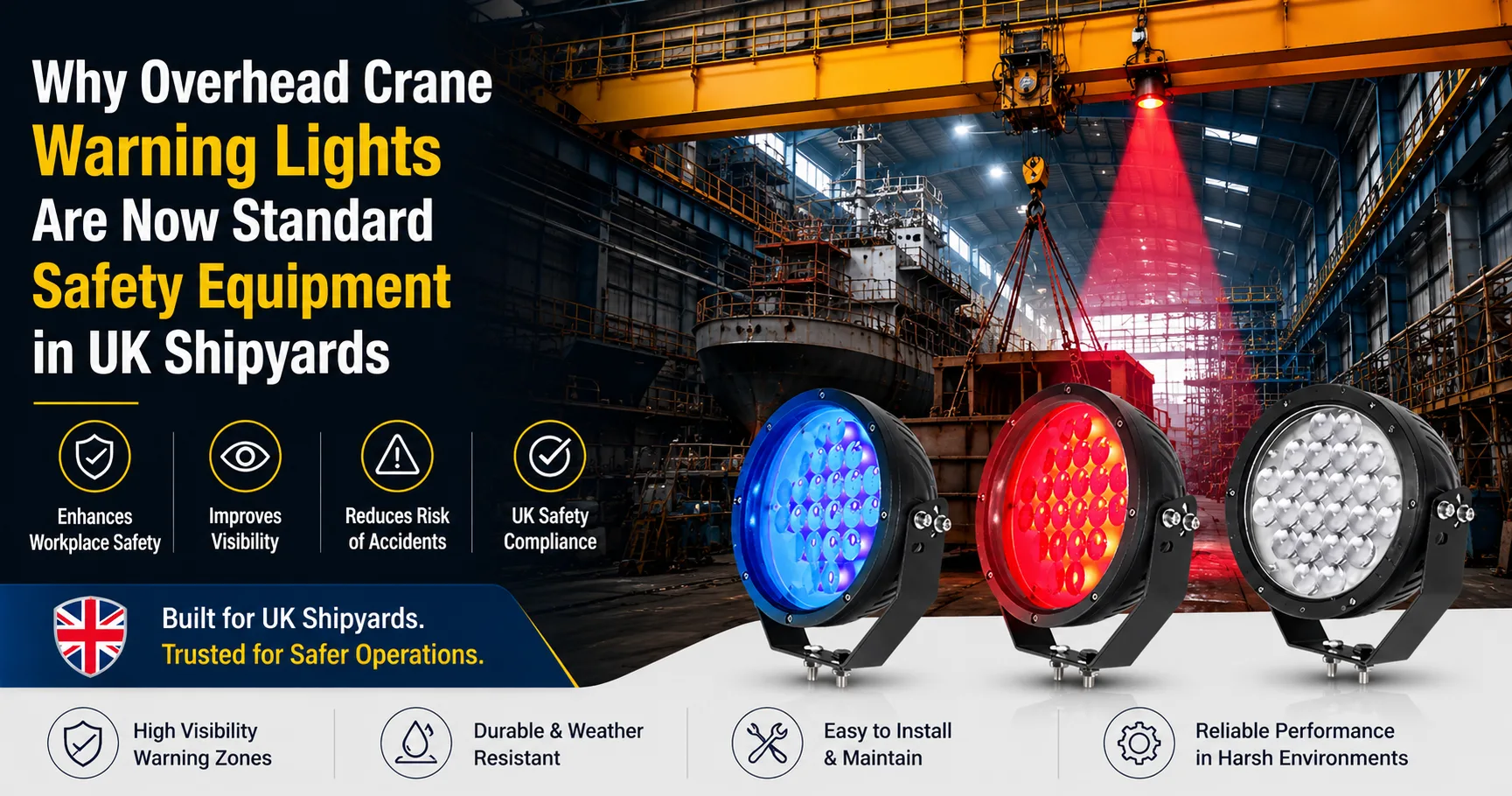
The Shipyard Hazard Nobody Talks About Loudly Enough
A load moves overhead. A worker below does not know it is there.
That single scenario — repeated dozens of times a day across every active shipyard in the UK — is responsible for a disproportionate share of serious crane-related injuries. Struck-by incidents account for over 50% of all crane fatalities, and the majority involve ground workers who had no warning the load was moving above them.
Shipyards are not quiet. They are not well-lit in every corner. And overhead crane operators do not always have a clear line of sight to every person working beneath them.
This is the problem overhead crane warning lights were built to solve — and the reason UK shipyards are now treating them as standard equipment, not an optional upgrade.Why Audible Alarms Alone Are Failing Shipyard Workers
The traditional answer to overhead crane hazards was noise: horns, buzzers, sirens. Alert people with sound and they will move.
That logic breaks down completely in a shipyard environment. Grinding, welding, engine testing, hydraulic systems — shipyard noise levels routinely exceed the point where audible crane alerts are simply lost in the background. A worker wearing ear protection in a loud zone will not hear a crane alarm. A worker focused on precision assembly will not register it.
The result is not negligence. It is physics. Sound-based warnings depend on the worker hearing them, processing them, locating the source, and reacting. In a high-noise environment, that chain breaks at step one.
Visual warning systems do not have this problem. A bright red or blue light projected onto the floor directly in a worker's field of vision does not compete with ambient noise. It communicates through a completely separate channel — and it communicates instantly.
What Overhead Crane Warning Lights Actually Do
Overhead crane warning lights — also called crane zone lights or crane safety lights — are LED units mounted directly on the crane. As the crane moves, the lights project a clearly defined illuminated zone onto the floor beneath the load.
The projected zone moves with the crane in real time. Workers on the ground see the lit zone approaching and know to clear the area — without needing to look up, without needing to hear an alarm, and without needing anyone to shout a warning.
The key technical features that make them effective in shipyard conditions:
- High-intensity LED projection — visible in both low-light and well-lit environments
- Spot beam mode — marks the exact point beneath the crane hook for precise load positioning
- Line beam mode — creates a visible boundary line marking the crane's travel path
- Adjustable beam angle — to account for different lift heights and floor distances
- Durable aluminium housing — rated for industrial and marine environments
Multiple units can be combined to create custom safety zones — warning boxes, corridors, or approach boundaries — depending on the layout and risk profile of a specific shipyard zone.
Why Shipyards Specifically Need Them
Overhead crane warning lights are used across warehouses, steel plants, and manufacturing facilities. But shipyards present a combination of conditions that makes them particularly critical in this environment.
Scale of Operations
Shipyard cranes handle loads measured in tonnes across large, open floor areas. The potential consequence of a struck-by incident is not a minor injury — it is catastrophic.
Workforce Density
Active shipyards have multiple trades working simultaneously in close proximity. The same zone a crane is working in may have welders, riggers, and engineers all present at once.
Noise Saturation
Shipyard noise makes audible-only warning systems structurally unreliable. This is not an edge case — it is the daily working environment.
Variable Lighting
Enclosed dock areas, underdeck spaces, and night shifts all create lighting conditions where ground workers may struggle to track crane movement overhead.
Operator Sightlines
Shipyard crane operators frequently cannot see the full working area beneath a large load. Warning lights extend their safety reach beyond their line of sight.
Each of these factors alone would justify visual warning systems. Combined, they make the case straightforward.
CCTV vs. Crane Warning Lights: What the Difference Looks Like
CapabilityTraditional Alarm OnlyCrane Warning Light SystemWorks in high-noise zonesNo — alarm lost in backgroundYes — visual, not audibleAlerts without operator actionNoYes — automatic with crane movementMoves with the loadNoYes — mounted on craneEffective in low-light areasPartialYes — high-intensity LEDCreates defined safety zoneNoYes — spot or line beamSupports LOLER complianceBasicStrong proactive evidenceThe Compliance Case: What UK Regulations Expect
UK shipyard operations fall under the Lifting Operations and Lifting Equipment Regulations (LOLER) 1998 and the Provision and Use of Work Equipment Regulations (PUWER) 1998. Both place clear duties on employers to ensure that lifting equipment operations do not expose workers to risk.
LOLER compliance data indicates that facilities meeting its requirements have seen around 30% fewer overloading and equipment-related incidents — a direct result of safety controls being in place before something goes wrong.
HSE enforcement has increasingly focused on whether employers can demonstrate proactive risk controls, not just reactive procedures. An overhead crane operating without visual warning systems in a high-noise, high-traffic shipyard environment is increasingly difficult to defend under LOLER and PUWER if a struck-by incident occurs.
Crane warning lights are not yet universally mandated by name in UK legislation — but the duty to protect workers from foreseeable overhead crane hazards makes their absence a compliance risk that is hard to justify when the solution is this accessible.What Smart Shipyards Are Installing Right Now
The shift toward visual crane warning systems in UK shipyards is being driven by safety managers who have stopped waiting for an incident to force the change.
SharpEagle's Overhead Crane Warning Lights are among the purpose-built systems being deployed across UK and international industrial sites — designed with aluminium-body construction, high-intensity LEDs, adjustable beam angles, and straightforward installation that does not require crane downtime.
The installation conversation has changed. It is no longer "should we add warning lights?" It is "which configuration is right for our specific crane zones and shift patterns?" That is what standard equipment looks like.
Evaluating overhead crane safety upgrades for your shipyard? Speak to the SharpEagle team about the right warning light configuration for your site layout and compliance requirements.
Frequently Asked Questions
Q1. Are overhead crane warning lights a legal requirement in UK shipyards?There is no single regulation that mandates crane warning lights by name in UK law. However, LOLER 1998 and PUWER 1998 require employers to eliminate or adequately control foreseeable risks from lifting operations. In a high-noise shipyard environment where audible alarms alone are not reliably effective, the absence of visual warning systems is increasingly difficult to justify under a suitable risk assessment. HSE inspectors assess whether control measures are proportionate to the risk — and struck-by incidents from overhead cranes are a well-documented, foreseeable risk category.
Q2. Can crane warning lights be used on all types of overhead cranes?Yes. Warning lights are designed to mount on bridge cranes, gantry cranes, and overhead travelling cranes — the types most commonly used in UK shipyards. Units are mounted on the crane body or hook block and project downward onto the working floor. Most quality systems use adjustable mounting brackets that accommodate different crane structures without modification to the crane itself.
Q3. What is the difference between a spot beam and a line beam, and which does a shipyard need?A spot beam projects a single point of light directly beneath the crane hook — useful for precision load placement and marking the exact drop zone. A line beam projects a straight line across the floor, marking the crane's travel path and alerting workers ahead of the crane's movement. Shipyards typically benefit from both: spot beams for load positioning accuracy and line beams for travel path awareness. Many installations combine units to create custom warning zones suited to their specific crane layout.
Q4. How much maintenance do overhead crane warning lights require?Quality LED crane warning lights are designed for industrial environments and require minimal routine maintenance. LED light sources have operational lifespans measured in tens of thousands of hours. The primary maintenance requirement is periodic inspection of mounting hardware, cable connections, and lens condition — particularly in marine environments where salt air and moisture exposure are factors. Systems with sealed, rated housings significantly reduce maintenance requirements in shipyard conditions.
Q5. Will bright ambient lighting in a shipyard reduce the effectiveness of warning lights?High-intensity LED warning lights are designed to remain visible in well-lit industrial environments, not just in low-light conditions. Beam intensity and contrast are engineered to work on light-coloured industrial floors under standard facility lighting. That said, the specific beam intensity rating matters — it is worth confirming that any system under evaluation has been tested in environments comparable to your shipyard's lighting conditions, not just in controlled demonstrations.
Q6. How long does installation take, and does it require crane downtime?Installation time varies by crane type and the number of units being fitted, but most single-crane installations are completed in a few hours by a qualified electrician. Crane downtime is typically limited to the installation window — systems are designed to integrate with the crane's existing electrical supply without complex modifications. Multi-crane deployments can often be scheduled across shifts to minimise operational disruption.
In a shipyard, the loads are heavy, the noise is constant, and the margin for error is zero.
Warning lights don't replace safety procedures — they make sure the procedures have a chance to work.